

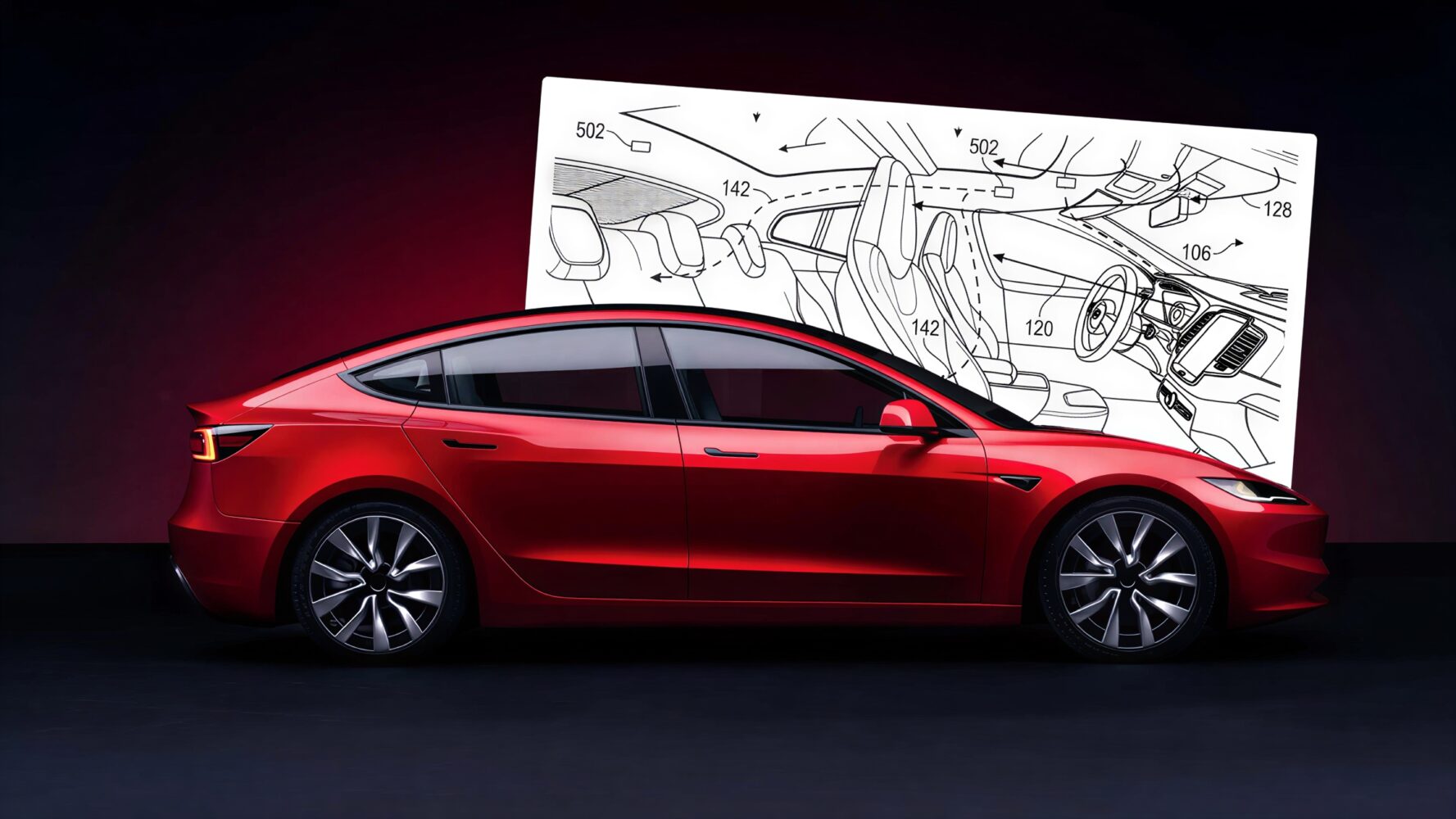
Your Tesla’s panoramic glass roof shouldn’t feel like a greenhouse on 100-degree days, yet here we are. Tesla has filed two climate control patents that flip this liability into an asset—transforming the very surface that bakes your cabin into an active cooling system that could preserve precious EV range.
Glass Roof Becomes Giant Air Conditioner
Multi-layer honeycomb design diffuses cool air through tiny perforations overhead.
Tesla’s first patent reimagines the panoramic roof as a massive overhead vent. The “automotive perforated glass structure” features a multi-layer design with an inner perforated glass layer separated from the outer pane by a honeycomb framework.
Cool air from the HVAC flows through this cavity, then diffuses down through tiny perforations directly over passengers’ heads. Think of it as turning your sunroof into a gentle rain shower of cold air.
The honeycomb structure blocks heat and noise, while the perforations create natural convection—cool air sinks, and warm air rises back into the roof cavity for re-cooling. This eliminates Arctic blasts from the dashboard vents while your head roasts under the hot glass.
Key innovations across both patents:
- Perforated roof replaces traditional glass with active cooling distribution
- Vacuum suction targets “hot pockets” near the roofline with negative pressure vents
- Tesla’s suction system testing shows 7.4% HVAC power reduction (127 watts saved at 104°F)
- Honeycomb insulation blocks external heat while enabling internal airflow
- Conditional activation uses sensors to cool only zones that need conditioning

Vacuum System Sucks Out Hot Air Where It Gathers
The second patent creates negative pressure to eliminate heat pockets before they spread.
Tesla’s companion patent attacks the problem from the opposite direction. Rather than just pushing cold air in, strategically placed suction vents create negative pressure to pull hot air out of problem zones—especially that layer of superheated air that collects near glass roofs.
This vacuum system specifically targets thermal stratification, where hot air rises and gets trapped. Traditional A/C assumes uniform cabin air, but reality creates localized furnaces near sun-exposed surfaces. Tesla’s solution removes heat where it accumulates rather than fighting it with more cold air from central vents.
Internal testing shows the suction approach dropping peak HVAC power from 1,720 watts to 1,593 watts during extreme heat. On days when A/C can slash EV range by 18%, even single-digit efficiency gains translate to meaningful miles.
Both patents remain concepts without production timelines. Manufacturing perforated honeycomb glass adds complexity and potential repair headaches compared to current solid roofs. Yet the engineering elegance—turning glass from liability to cooling asset—suggests Tesla’s broader efficiency focus continues finding new targets beyond batteries and aerodynamics.