

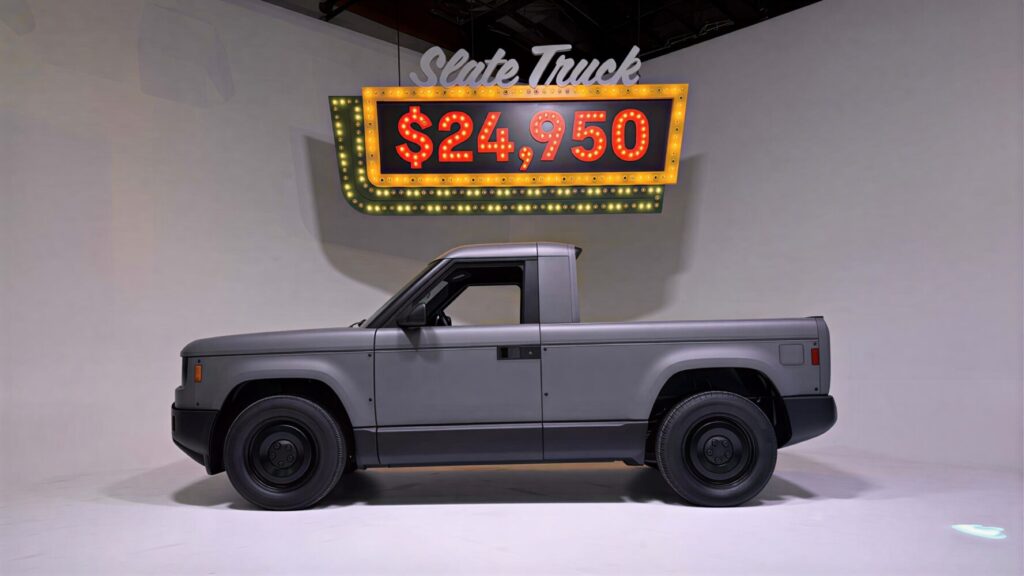
After months of vague “mid-twenties” promises, Slate Auto has confirmed the number buyers actually needed: a $1,450 destination and freight charge. Add that to the $24,950 MSRP, confirmed via spokesperson to InsideEVs rather than a formal press release, and America’s affordable new car EV pickup carries a true sticker of $26,400 before tax and registration. The $24,950 figure was everywhere after Slate’s June 24 launch event. The freight charge was the missing piece anyone trying to budget realistically had been waiting for.
What $26,400 Actually Buys You
Bare bones isn’t a metaphor here — it’s the product specification.
The base Slate Truck ships with manual crank windows, no infotainment screen, no radio, and unpainted gray composite body panels. Color costs extra. The sole piece of technology in the cabin is a backup camera — federally mandated, leaving Slate no choice on that one. The 65 kWh battery delivers an estimated 205 miles of EPA-rated range, with 181 horsepower routed to the rear wheels only. No all-wheel-drive option has been announced. The footprint lands closer to a Ford Maverick than anything resembling a full-size rig.
Here’s where the full lineup lands with the confirmed $1,450 destination charge included:
- Base pickup: $26,400 before tax
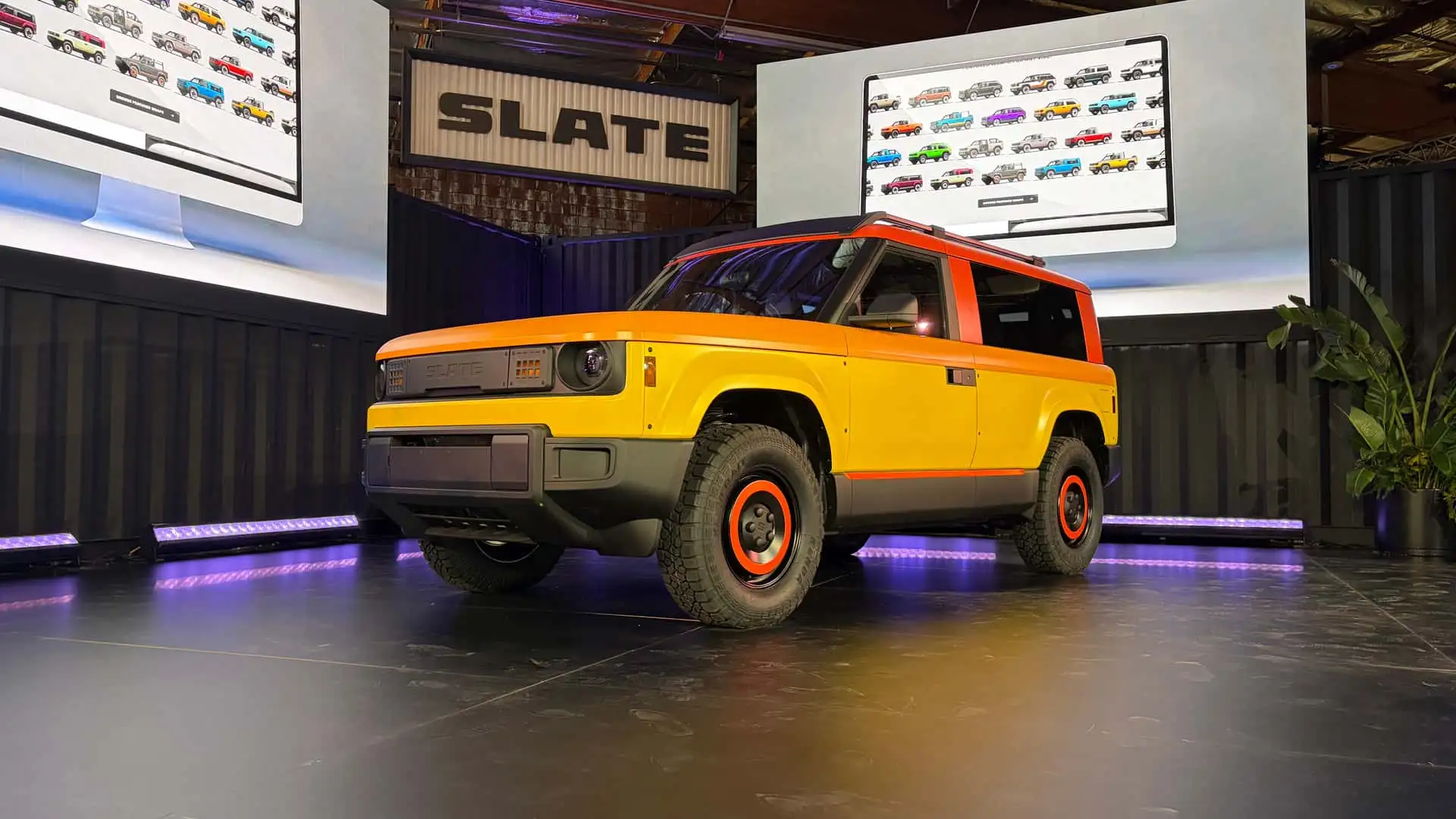
- Squareback SUV kit: $31,400 before tax
- Fastback SUV kit: $33,400 before tax
- Fully optioned Fastback builds: $46,000+ before destination
- Preorders open now; $300 non-refundable deposit; Indiana production target: end of 2026
The Cheapest EV on the Market – By a Lot
The price gap between the Slate and every other EV truck isn’t a gap — it’s a canyon.
The Chevy Silverado EV opens around $58,000. The Cybertruck starts near $70,000. Even the Ford Maverick XL — a gasoline truck — runs $27,145 before freight, according to manufacturer pricing. Slate undercuts all of them. Early marketing once promised a sub-$20,000 effective price built around the $7,500 federal EV value tax credit. That math grew uncertain as the credit landscape shifted, and Slate pivoted away from leading with it. State and local incentives can still push the effective cost below $20,000 in some markets, but it’s a scenario that depends heavily on where the truck is registered and a buyer’s individual eligibility.
Slate has described its approach as keeping every part of ownership cost — not just the sticker — “aggressively affordable,” according to InsideEVs coverage. The $1,450 destination fee is notably lower than freight charges on most pickup trucks, and the company frames that gap as intentional. Think of this truck as the IKEA flat-pack of EVs: the buyer is purchasing the bones, not the furnished room.
“It’s gonna be a no from me, dog.” — Jalopnik, after a ride-along with the Slate Truck
The Real Question Is Who Shows Up to Buy It
Online enthusiasm for analog, screen-free cars is loud — actual purchase orders will tell the quieter truth.
Slate is explicitly targeting two types of buyers: those who genuinely dislike touchscreens and want something straightforwardly simple, and DIY builders or small businesses seeking a cheap EV platform to outfit themselves. Like early Broncos before the aftermarket defined what they became, this truck is a canvas waiting for its owners to fill it in. Whether the vocal online community calling for back-to-basics vehicles translates into actual buyers remains an open question — one that the Indiana assembly line will begin answering by the end of 2026. A sub-$30,000 Ford EV truck is expected sometime after that, and for buyers weighing whether it’s worth waiting for, that calculus depends on what Slate proves in the meantime. A $26,400 bare-bones pickup only wins if people genuinely want bare bones, and that verdict hasn’t arrived yet.