

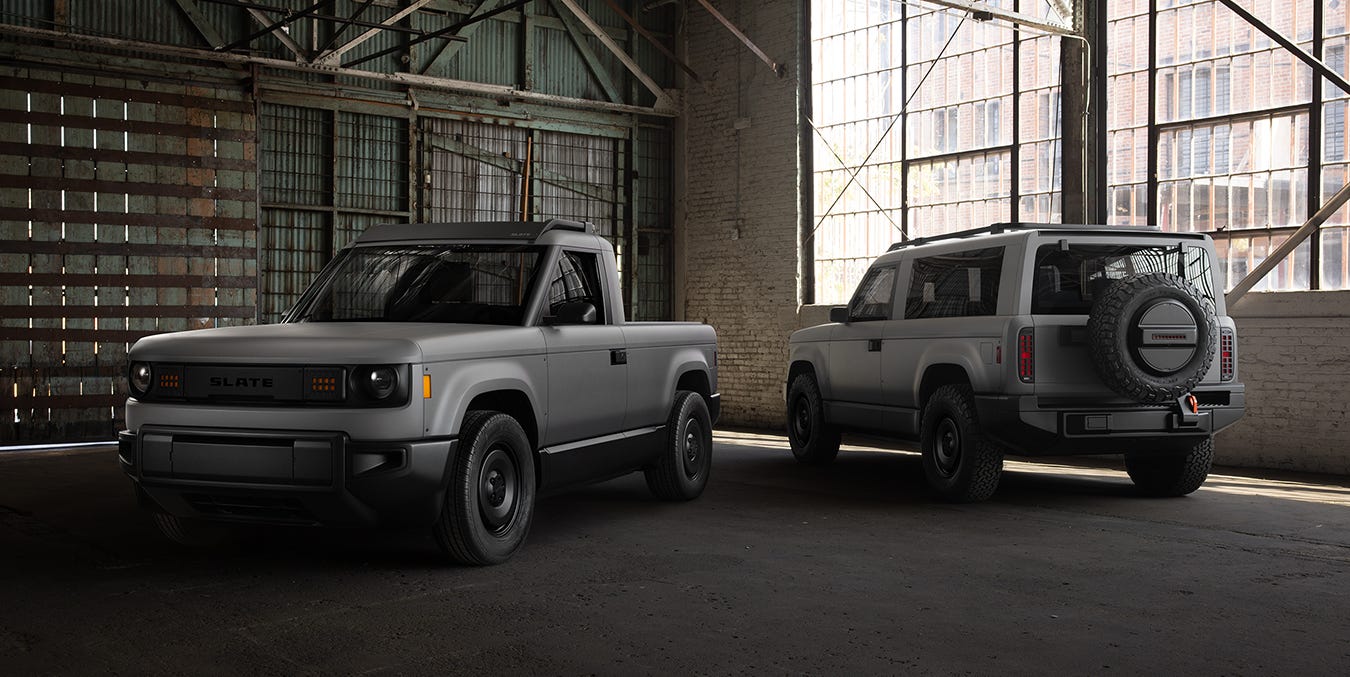
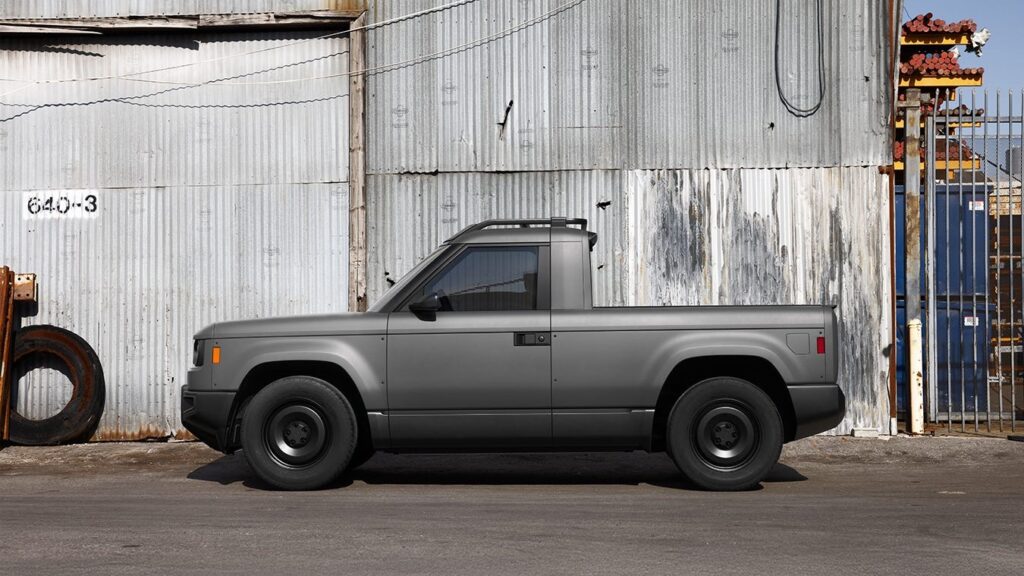
Slate Auto has officially announced a base price of $24,950 for its Blank Slate electric pickup — roughly half the average U.S. new-car transaction price, according to TechCrunch — making it simultaneously the cheapest new EV and the lowest-priced new pickup on the American market. That number is real. It also excludes destination fees, taxes, title, and registration. Slate says the destination charge will be “minimal” but hasn’t finalized it, meaning the actual out-the-door price will be somewhat higher. That asterisk matters, and it’s worth keeping front of mind.
What $24,950 Actually Buys You
The base configuration is genuinely bare-bones — and that’s entirely by design.
The base truck omits a stereo, infotainment screen, and power windows, offering manual cranks and a single unpainted body color with wrap options applied at the end of the production line. Drivers mount their own smartphones in place of a built-in display. What the price does include: a 63 kWh LFP battery with an estimated 205-mile range, a NACS charge port for Supercharger network access, DC fast charging up to 120 kW targeting 20%–80% in under 30 minutes, 181 horsepower, a 0–60 time of about 8.0 seconds, and a 7-cubic-foot frunk. This vehicle was built from scratch as a tool, not stripped down from something more comfortable.
- Base price: $24,950 before destination fees (not yet finalized); SUV conversion with rear seats and enclosed body at $29,950; fastback SUV at $31,950
- Battery: 63 kWh LFP; estimated 205-mile range; 20%–80% charge in under 30 minutes at a DC fast charger
- Payload: 1,550 lb (truck); max towing: 2,000 lb — suited to local work, not highway hauling
- Accessories: 100+ user-installable options; roughly 80% priced under $500; approximately 40 wrap colors at $499
- Sales model: Direct-to-consumer only; $50 refundable reservation; Q4 deliveries targeted; Indiana factory targeting 150,000 units per year at full production
The Business Model Is the Bet
Slate’s wager is that radical simplicity can sustain profitability at a price where rivals simply cannot compete.
“The truck will be profitable even at approximately $25,000,” Slate leadership told CNBC. That framing echoes the Model T logic for the EV era — strip the product to its essentials, hold manufacturing costs low enough to make money at a price point competitors cannot reach, positioning Slate to disrupt the auto industry in ways rivals have not managed. Whether that proves visionary or optimistic depends largely on how the Indiana factory ramps toward its 150,000-unit annual target.
Context sharpens the stakes. The federal $7,500 EV tax credit has been eliminated, ending Slate’s earlier pitch of a sub-$20,000 effective price. The company currently holds approximately 180,000 reservations at a refundable $50 each, according to Car and Driver. Converting those into firm, non-refundable $300 orders represents the next genuine test of real-world demand.
The Catch Nobody’s Hiding
Real out-the-door costs and a modest tow rating mean this truck suits a specific buyer — not every buyer.
Buyers on Reddit’s r/electricvehicles community are already noting that once destination charges, taxes, and a handful of practical accessories are factored in, actual costs will likely approach $30,000. That remains competitive for a new truck, but it is worth stating plainly rather than burying. The 2,000-lb tow rating further limits appeal for anyone expecting conventional pickup capability — Car and Driver characterizes it as best suited to local towing, given the available range and power output.
Buyers seeking an affordable daily driver with a truck bed will find the value case compelling — provided the destination fee stays modest and early production units ship at base specification rather than pre-loaded with options. Slate’s pitch is transparent about what the price excludes. Whether that honesty reads as a feature or a limitation depends entirely on what a buyer actually needs from a truck.