


Five-point-seven meters doesn’t sound dramatic until you’re traveling at 110 kph on a wet road and something steps into your path. That’s the gap evo recorded at Pirelli’s Vizzola test track near Milan: a Cyber Tyre-equipped car stopping nearly 19 feet shorter than a non-connected setup running without the system active. No new rubber compound. Just a tire that finally talks to the car.
The core problem Cyber Tyre addresses has always been straightforward. A car’s ABS, stability control, and traction systems are calibrated around broad assumptions — a wide range of possible tires, conditions, and wear states built into the vehicle’s factory programming. Cyber Tyre narrows that uncertainty by supplying real-time data from the tires actually fitted, giving electronic safety systems something more precise to work with. For broader context on how vehicle design affects occupant safety, driver death rates tracked by IIHS illustrate just how much engineering decisions matter.
Inside the Tire: A 12-Gram Sensor Doing Heavy Work
Small enough to overlook, robust enough to survive highway speeds, this sensor changes how a car understands its own tires.
Each tire houses one battery-powered sensor — roughly the size of three stacked 10p coins, weighing about 12 grams, mounted on a starfish-shaped base pad on the inner liner. According to evo‘s September 2024 test report, it is rated to withstand approximately 3,000 g of force — the kind of engineering specification that makes sense once you consider what a tire endures at highway speed. Axle-mounted receivers collect the raw sensor data; Pirelli’s algorithms process it before anything reaches the car’s electronic control unit.
Key figures from evo‘s September 2024 track session at Vizzola:
- Wet-braking gain: 5.7 meters shorter stop from 110 kph to zero
- Sensor: approximately 12 grams; rated to approximately 3,000 g of force
- Data transmitted: pressure, temperature, acceleration, tire type, tread depth, and available grip
- Systems informed: ABS, ESP, traction control — each calibrated to the actual tire fitted
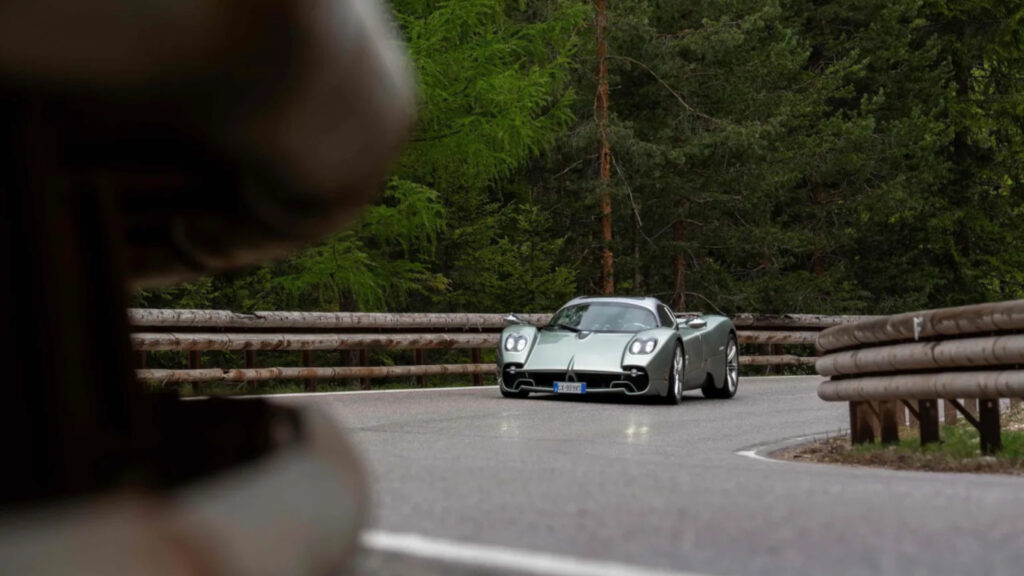
- OEM partners: deployed on the Pagani Utopia Roadster; future Aston Martin integration announced; developed in cooperation with Bosch Engineering
Wet braking is a demanding benchmark because available grip shifts quickly with water, temperature, and tread condition. Conventional electronic safety systems respond to wheel-slip behavior as it develops; Cyber Tyre supplies tire-specific information before intervention begins. As evo reported, the system “allowed the vehicle’s systems to identify the tire’s actual grip level more directly instead of gradually feeling for the available traction.”
The wet-handling results reinforced that finding — less pronounced understeer, longer steering control, a car whose interventions supported the driver’s inputs rather than reacting after the fact.
Worth stating plainly: the tire generates no extra grip. What changes is the car’s ability to use the grip that already exists.
From Pagani to the Broader Road
The Pagani Utopia Roadster and a future Aston Martin program signal serious intent, but broader questions remain.
The Pagani Utopia Roadster deployment and the announced Aston Martin integration suggest credible momentum, and the Bosch Engineering partnership points toward the kind of vehicle-electronics infrastructure needed for wider adoption. The underlying logic is straightforward: transform the one component that physically contacts the road from a passive assumption into a live data source.
Practical questions — sensor battery lifespan, service complexity, and cost at scale — are not yet fully resolved in publicly available sources, and whether those economics can reach everyday vehicles remains to be seen. Regulation of automotive safety systems more broadly is also an evolving landscape that could shape how quickly connected-tire technology reaches mainstream vehicles. Whether Cyber Tyre moves beyond high-performance applications may ultimately depend on those answers as much as on the technology itself. Given what 5.7 meters can mean on a wet road, it is a question worth following.