

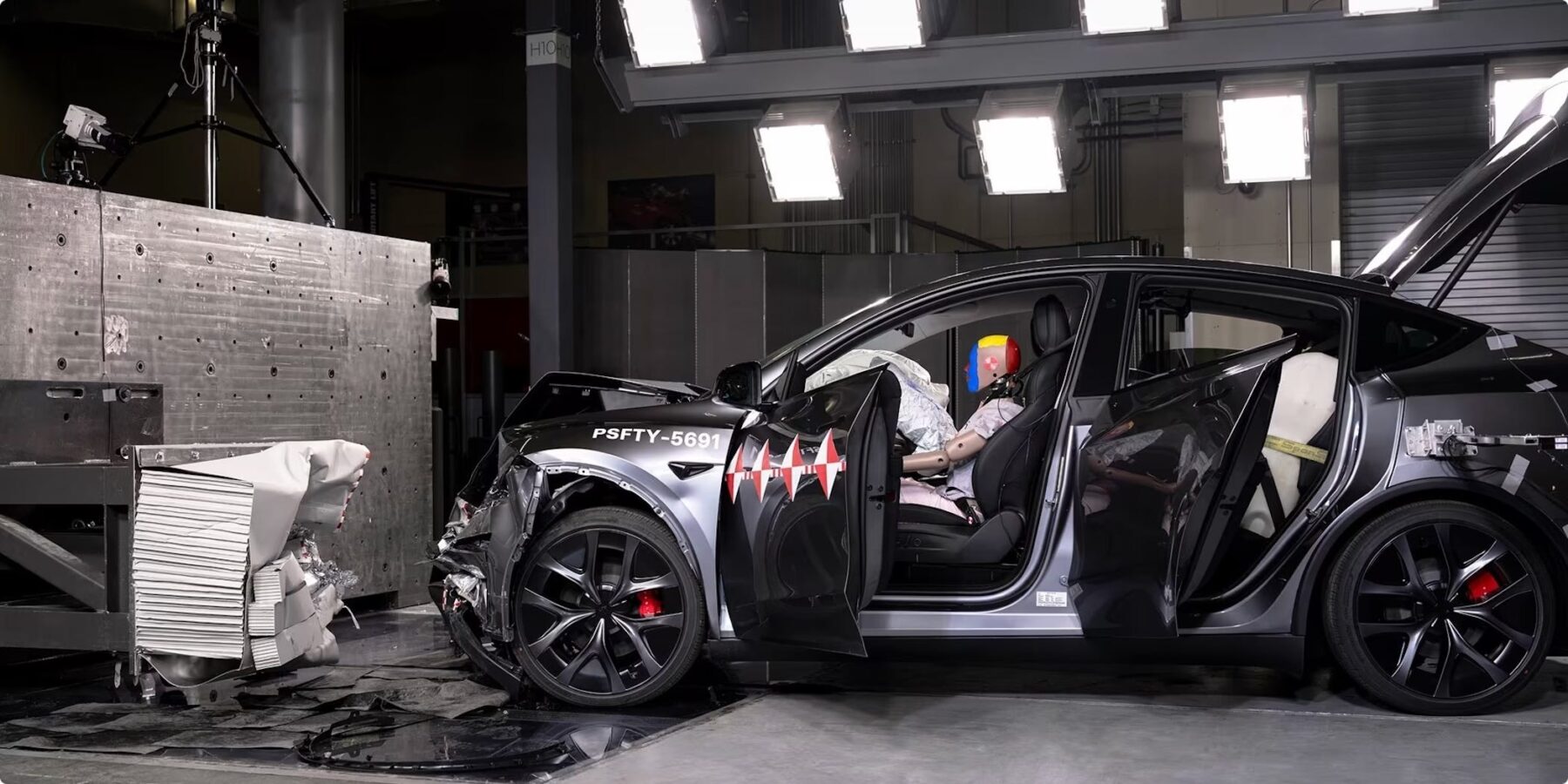
That critical moment between collision detection and impact just became crucial to survival. Tesla’s Vision AI now detects unavoidable crashes and fires airbags up to 70 milliseconds before traditional sensors even register contact—literally.
The technology uses external cameras to predict collision severity and prep safety systems while vehicles approach a disaster. Think of it as having a crash test dummy’s reflexes, but one that’s been through millions of accidents and learned from each one. Those extra milliseconds reportedly allow airbags to deploy and seatbelts to pretension with a crucial head start.
Real-World Impact Behind the Numbers
The 70-millisecond advantage transforms how Tesla vehicles respond to unavoidable crashes.
Traditional impact sensors wait for actual contact—bumper crumpling, metal grinding—before triggering airbags. Tesla Vision watches the world around vehicles, calculating trajectories and inevitable outcomes. When physics determines a crash is unavoidable, the system doesn’t wait for confirmation.
The over-the-air update (version 2025.32.3) delivered this capability to newer Teslas. Compatible 2023+ Model 3 or Y vehicles received enhanced crash protection overnight. Select 2022 models and newer S/X variants also gained the upgrade. No dealership visit, no new hardware—just improved crash protection through code.
Tesla crash engineer Jarad Hutchinson confirmed that Vision doesn’t deploy airbags independently—it works with existing sensors to lower activation thresholds. Translation: fewer false deployments from potholes, faster response to real threats. The system uses fleet-wide crash data to validate that earlier deployment reduces injury severity.
Key Updates for Tesla Owners:
- Compatible with 2023+ Model 3/Y and select 2022+ models
- Works alongside physical impact sensors, doesn’t replace them
- Rolling out via OTA software update 2025.32.3
- Validated using real-world Tesla crash data across the fleet
Tesla’s official announcement emphasized that the Vision upgrade reduces crash injury risk by giving safety systems a crucial head start on physics. For Tesla owners, that 70-millisecond advantage arrived silently through Wi-Fi, turning daily drivers into enhanced safety-equipped vehicles.
The company’s betting that cameras can see trouble coming better than sensors can feel it landing—and airbags are already programmed to agree. To put this in perspective, 70 milliseconds is faster than human reaction time, making the difference between preparation and impact.