

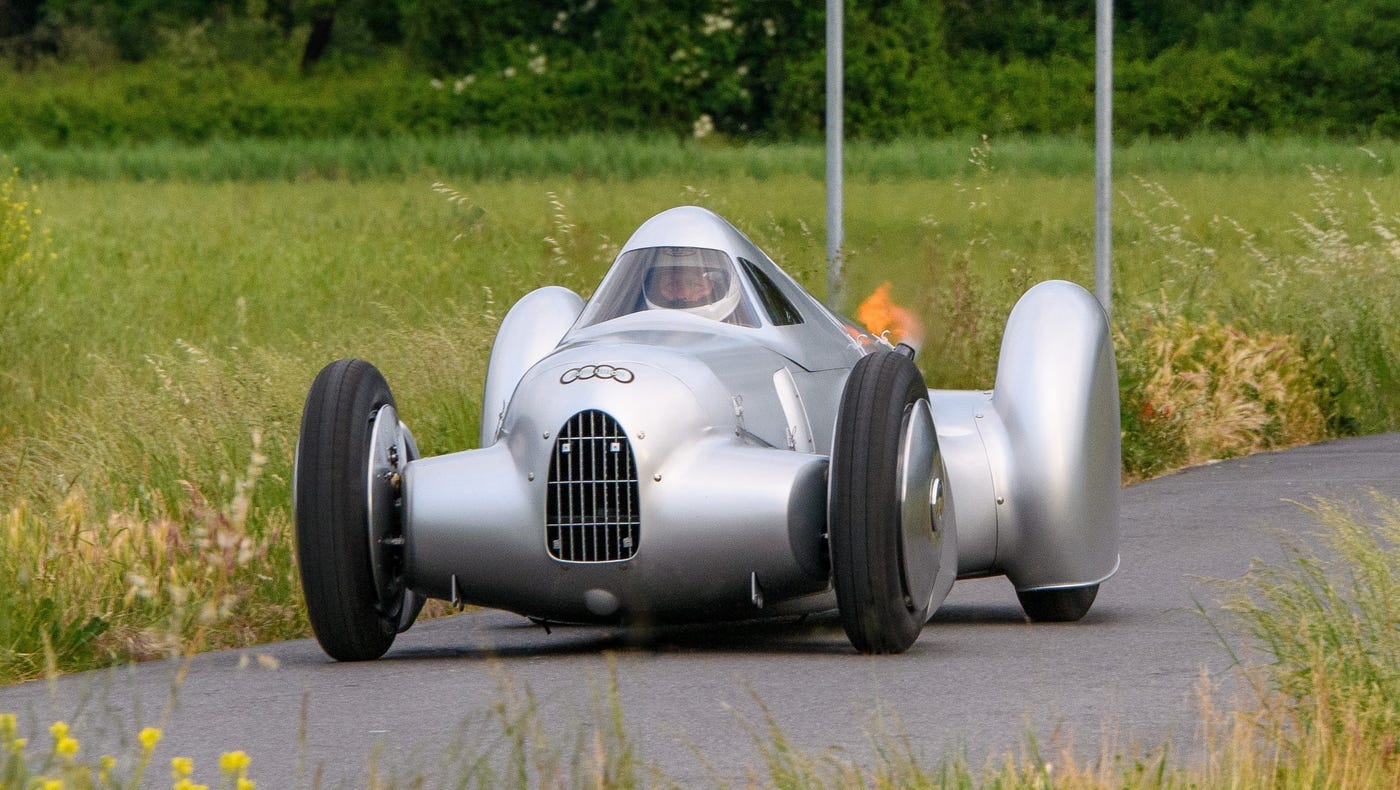
Speed demons hitting 203 mph barely register today—unless they accomplished that feat in 1935. On February 15 that year, Hans Stuck piloted the Auto Union Lucca down a straight section of Italian autostrada near Lucca, averaging 199 mph with a top speed that made it the “fastest road racing car in the world.” The machine vanished after WWII, likely scrapped or claimed as war spoils. Now Audi Tradition has brought this engineering lunacy back from the dead.
Engineering Insanity
The original Rennlimousine packed a 5.0-liter supercharged V16 producing 369 horsepower into a streamlined silver body.
The numbers sound modest until you consider the era. This “racing sedan” weighed just over 2,000 pounds and stretched nearly 180 inches long—a proper land missile designed when most cars struggled past 60 mph. The V16 engine came straight from Auto Union’s Type A Grand Prix racer, wrapped in wind-cheating bodywork that included covered wheels and aerodynamic refinements that wouldn’t look out of place today.
Silver Arrows Redux
Built by specialists Crosthwaite & Gardiner over three years using historical documents and photographs, the recreation improves on the original.
This isn’t some garage queen tribute car. The new Lucca packs a more robust 6.0-liter V16 from the Type C, cranking out 520 horsepower with improved ventilation and modern reliability upgrades. At 2,116 pounds with a wind-tunnel-tested drag coefficient of 0.43, it’s engineered to actually run rather than just pose.
The project follows Audi’s 2024 Type 52 prototype revival, part of a broader mission to preserve pre-war Grand Prix innovations that risk being forgotten in our SUV-and-EV landscape. While most manufacturers chase quarterly profits, Audi Tradition functions as mechanical archaeology, reconstructing lost chapters of automotive audacity.
The recreated Lucca makes its dynamic debut at the Goodwood Festival of Speed from July 9-12, 2026, joining Audi’s growing Silver Arrows collection. In an age where speed is sanitized through electronics and regulations, this V16 beast reminds us when automotive progress meant strapping yourself to barely-controlled explosions and seeing what happened.