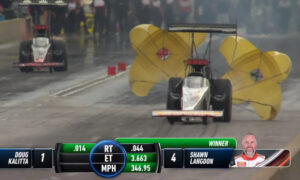


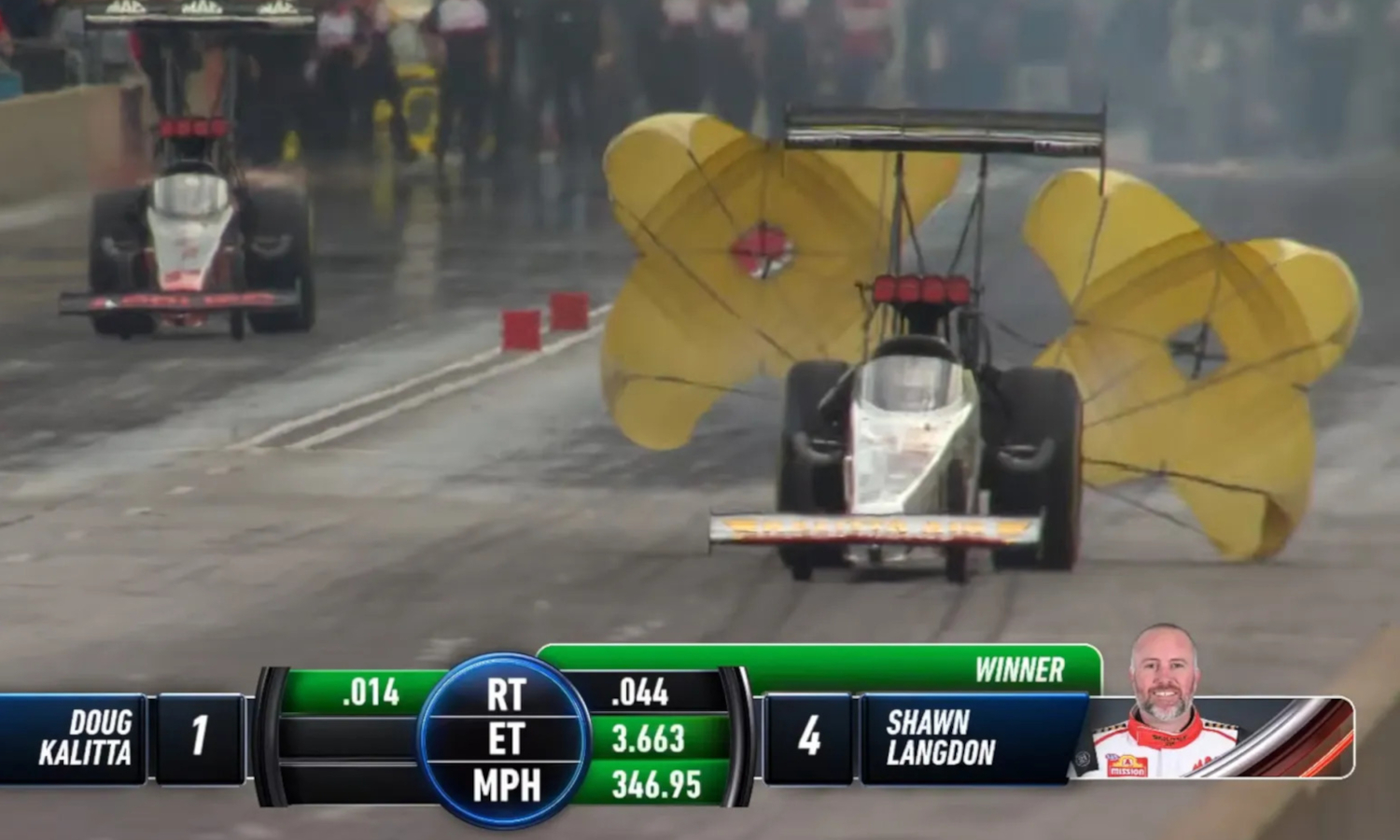
Three-point-six seconds. That’s roughly how long it takes to read this sentence. It’s also how long Shawn Langdon needed to rewrite the record books at U.S. 131 Motorsports Park in Martin, Michigan.
His semifinal pass of 346.95 mph — verified by NHRA’s official report, which supersedes the 346.96 figure circulating elsewhere — erased his own previous mark of 345.00 mph set earlier in 2026 at South Georgia Motorsports Park. He then went out and won the whole event.
By the Numbers
- 346.95 mph at 3.663 seconds — official NHRA Top Fuel speed record, September 21, 2026
- Previous record: 345.00 mph, also Langdon’s, set at South Georgia Motorsports Park in 2026
- Opening elimination run: 3.652 seconds at 344.04 mph — a standout pass before the semifinal even arrived
- Final round: 3.664 seconds at 346.15 mph; defeated Spencer Massey (3.764 sec / 327.75 mph)
- Langdon’s sixth win of the season with Kalitta Motorsports
The 350 Question
Brittany Force cracked 340 mph in April 2025; roughly 17 months later, Langdon has pushed that ceiling more than 5 mph further — and 350 is now only 3.05 mph away.
Top Fuel records don’t happen on command. The car’s supercharged 500-cubic-inch Hemi-based V8 produces roughly 12,000 horsepower, but raw power is only part of the equation. Air density, track preparation, traction, and driver execution all have to align within the same 3.6 seconds.
NHRA shortened the Top Fuel distance from 1,320 feet to 1,000 feet to address safety concerns associated with rising speeds — which makes reaching 346.95 mph before the parachutes deploy genuinely extraordinary.
Pursuing 350 mph is the sport’s version of breaking the four-minute mile: mathematically close, physically brutal. U.S. 131 sits at roughly 755 feet of elevation, and denser, lower-altitude venues could theoretically support faster runs. But aerodynamic drag increases sharply with speed, and the margin for mechanical error shrinks accordingly. It’s plausible. It is not guaranteed.
Langdon beat his own record, beat his own teammate in the semifinal, then closed out the final against Spencer Massey. The 350-mph threshold is now close enough to feel real — close enough that the next time conditions align perfectly, everyone will be watching the timing board very carefully.