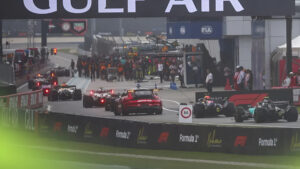


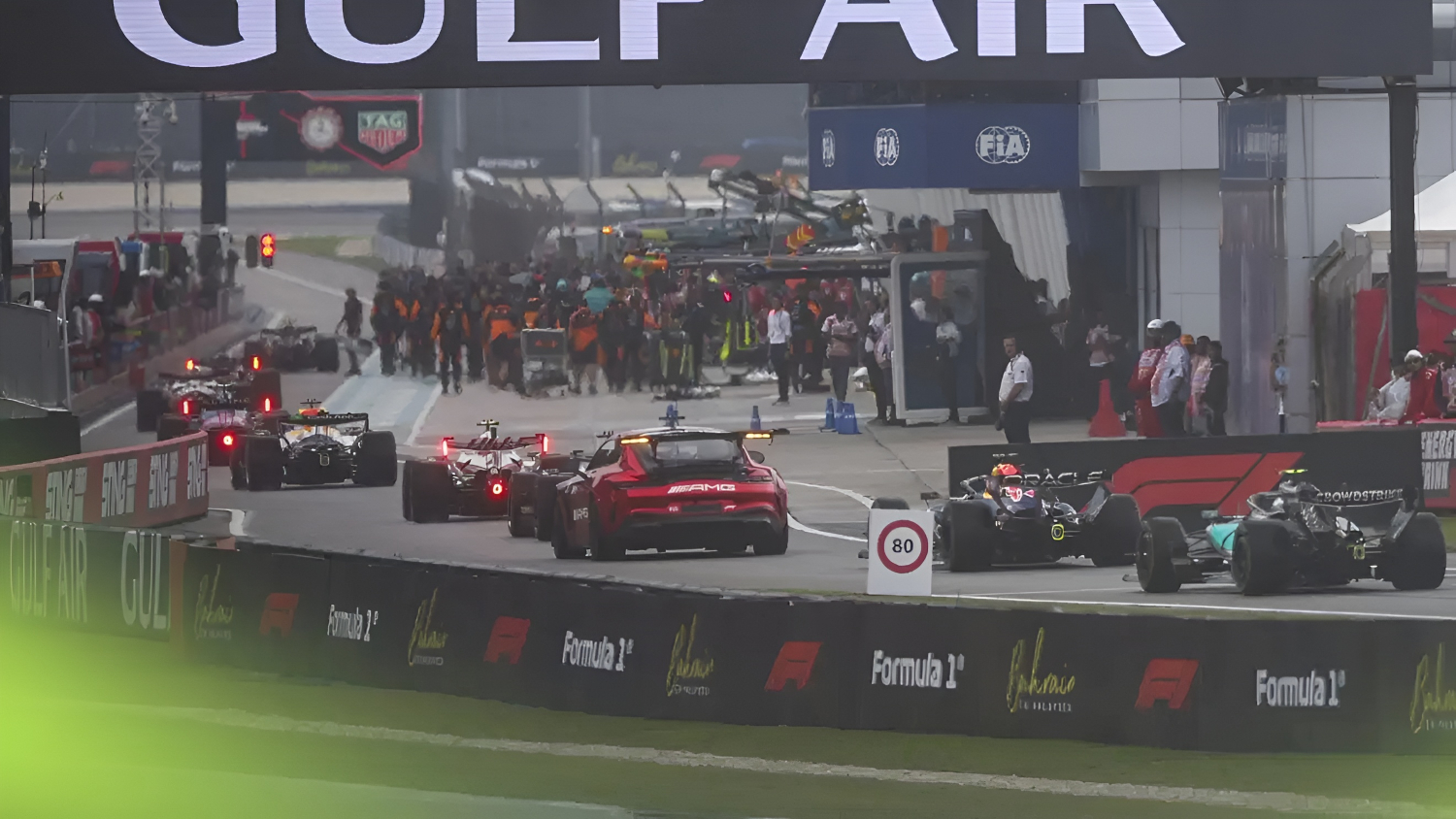
Formation laps aren’t supposed to look like a broken-down motorway queue. Yet at Sepang, that’s exactly what happened — Lewis Hamilton’s Ferrari, both Audis, both Haas cars, both Cadillacs, an Alpine, and a Racing Bulls all crawled or nearly stopped on a wet track during the formation procedure, well before a racing lap had turned. The start was suspended. The entire field retreated to pit lane.
This wasn’t a mechanical failure, and no driver error was identified as a common cause. A standardized FIA safety feature bug — triggered by a combination of conditions that had never been tested together — cut power across a significant portion of the grid during the same formation procedure.
How a Safety Feature Became the Problem
When a torque-reduction measure met an edge case nobody had rehearsed, the safety logic turned against itself.
The 2026 regulations include a wet-weather energy-management mode that reduces electrical deployment from 350 kW to 250 kW in specified low-grip sectors. Sensible in theory: less torque on a slippery surface means more controllable delivery. During the formation procedure at Sepang, however, overall speeds fell unusually low across the field. According to technical reporting from PlanetF1, turbocharger rpm dropped as a result, and the control software entered a failsafe state that prevented the MGU-K — the motor-generator unit on the kinetic side of the power unit — from redeploying power normally. A safety measure, consuming the very situation it was designed to manage.
The uneven spread came down to braking points and track position. Front cars slowed first; following drivers braked at different moments to avoid contact, so only those who crossed a critical low-speed threshold likely triggered the failsafe — regardless of which manufacturer built their engine. Because every team runs the same FIA-developed control software, a single flaw in that shared codebase was enough to affect cars from multiple teams during the same formation procedure. FIA single-seater director Nikolas Tombazis indicated — paraphrased from his remarks as reported by Racing News 365 — that the software had been tested, but not under this specific combination of low speed, wet-weather power reduction, low grip, and Sepang’s sector layout. The fix came during the delay: an updated software release distributed to all competitors removed the energy-limit constraint in the affected sectors, and teams installed the patch before the restart.
What Sepang Just Told the FIA About 2026
The race restarted cleanly, but the incident exposed an uncomfortable gap in how new regulations are validated under real conditions.
The FIA announced a full review with teams and power-unit manufacturers. The detail worth sitting with: the wet-weather mode had reportedly not been used in an actual wet race or representative wet testing session during the 2026 season. A safety feature built for slippery conditions had not been run in slippery conditions at competitive speeds and formation-lap pacing combined.
New power-unit regulations bring:
- new energy-management logic
- new sector-by-sector constraints
- a multiplication of edge cases
Laboratory and simulation testing can cover enormous ground, but some combinations only surface in the real world — at race pace, in the rain, on a specific circuit layout. Sepang provided one of those combinations.
The patch worked. The race ran. But the next wet formation lap just became the most technically interesting two minutes in Formula 1 — and the FIA’s review will determine whether Sepang was an isolated edge case or an early signal of how complex the 2026 rulebook really is.