

Before the 1973 oil crisis redrew Detroit’s design parameters, American automakers built full-size cars to dimensions that have no contemporary equivalent. The longest entry on this list — the 1973 Chrysler Imperial — stretched 235.3 inches, nearly 20 feet, which is longer than many studio apartments are wide. These were not unusual products of niche manufacturing; they were the mainstream offerings of the era’s major automakers, built at scale for buyers who expected size as a baseline feature of American luxury. These rolling monuments represent a specific moment in automotive history when the constraints that define modern vehicle design had not yet arrived.
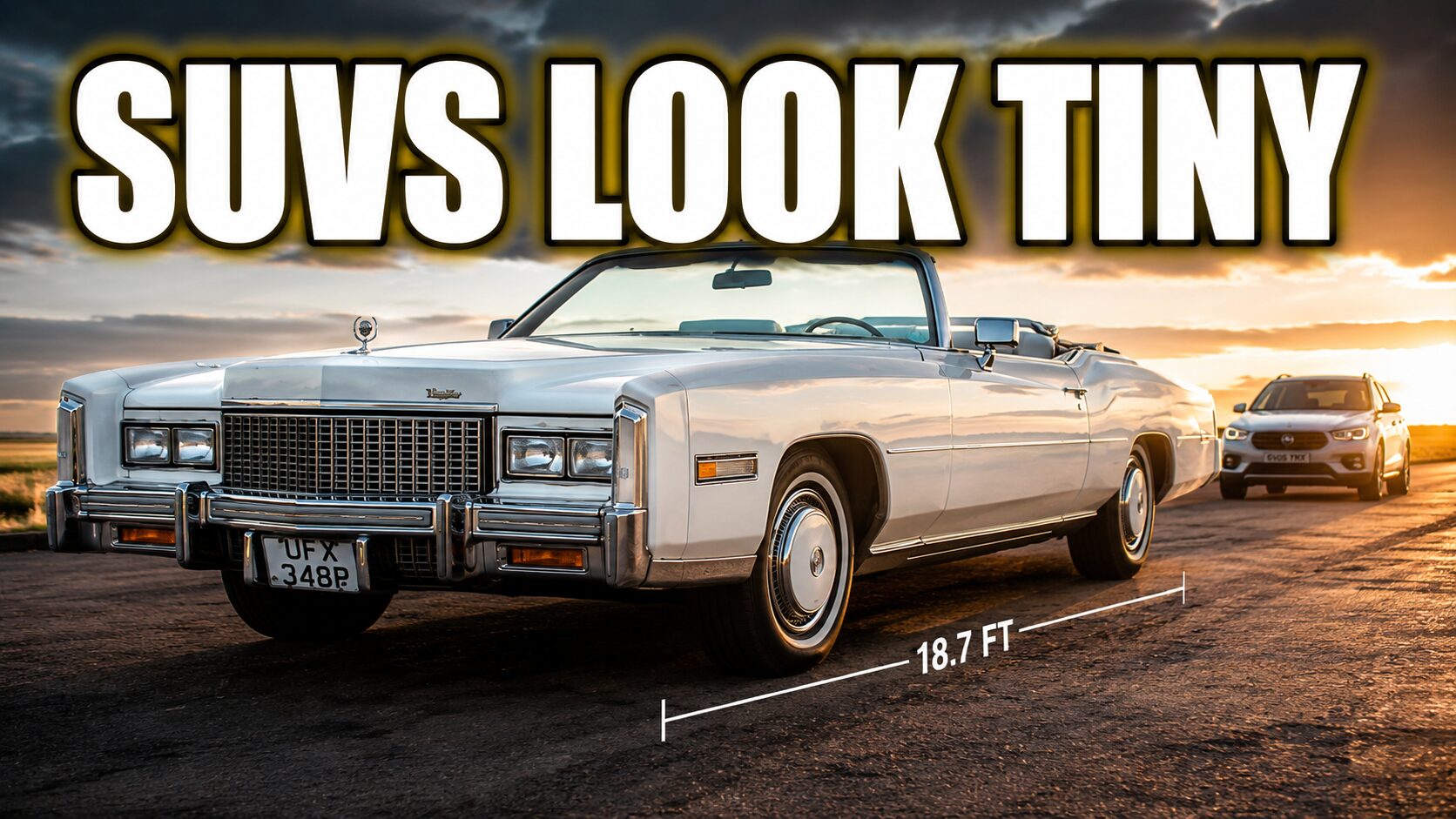
10. 1976 Cadillac Eldorado (224.1 inches)

The ’76 Eldorado arrived as the final production year before downsizing requirements reshaped the Cadillac lineup. Its 500 cubic inch V8 was the largest engine fitted to a post-war American production car — a displacement figure that would not survive the regulatory and fuel economy pressures that followed. The front-wheel-drive configuration at this scale was a specific engineering achievement: managing the handling demands of a vehicle this large through the driven front axle rather than the conventional rear-wheel-drive arrangement that most competitors used.
1976 Cadillac Eldorado (224.1 inches) – Interior

Chrome and wood trim across every surface not already covered in leather — a material specification that reflected the era’s understanding of what American luxury required at the Cadillac price point. The Eldorado’s cabin communicated the confidence of an automaker that had not yet been asked to reconsider its assumptions about scale, fuel consumption, or what buyers would eventually demand. The 1976 model year was the last moment that assumption held without qualification.
9. 1975 Buick Estate Wagon (231.5 inches)

The Estate Wagon at 231.5 inches remains the longest American station wagon ever produced — a record that has not been challenged because the market conditions that created it have not returned. The Glideway tailgate improved loading access without requiring the full-width gate swing that competing designs demanded. Nine-passenger seating in a wagon body on a full-size platform was the practical argument; the luxury appointments were the status argument. Buick made both simultaneously.
1975 Buick Estate Wagon (231.5 inches) – Interior

The 455 V8 moved the Estate Wagon with the torque reserve that a vehicle of this mass required to feel controlled rather than labored. Simulated wood grain and powerful air conditioning completed the mid-1970s suburban luxury specification — a package that told buyers they had arrived at a specific tier of American success, defined in part by how much vehicle they could justify acquiring and operating.
8. 1970 Imperial Crown (229.7 inches)

The Imperial Crown operated as a separate brand from Chrysler during most of this era — a positioning decision that placed it in direct competition with Cadillac and Lincoln rather than slotting it as Chrysler’s internal luxury tier. Understated elegance over chrome excess was the deliberate design philosophy, producing a vehicle whose visual restraint communicated a different kind of confidence than the more decorated alternatives at the same price point.
1970 Imperial Crown (229.7 inches) – Interior

The 440 cubic inch V8 produced 350 horsepower of smooth, refined power delivery — an engine calibrated for effortless highway cruising rather than performance acceleration, which matched the Imperial’s buyer profile. Bench seats, power everything, and a cabin tuned for isolation from road noise made the Crown the choice for executives and diplomats whose priority was arriving composed rather than arriving quickly.
7. 1977-1979 Lincoln Continental Mark V (230.3 inches)

The Continental Mark V at 230.3 inches was a personal luxury coupe — two doors, a rear seat, and a hood that extended far enough forward to constitute a separate zip code. The personal luxury category was specifically American, a segment that prioritized visual drama and comfort over passenger capacity or driving engagement, and the Mark V was its most complete expression across its three-year production run.
1977-1979 Lincoln Continental Mark V (230.3 inches) – Interior

Bill Blass, Pucci, Cartier, and Givenchy each created designer editions — fashion house names applied to opera windows, exterior color schemes, and interior trim packages that converted the Mark V from a luxury car into a fashion object. The collaboration reflected the era’s specific understanding of aspiration: that attaching a couture name to a personal luxury coupe elevated both the vehicle and its owner in ways that engineering specifications alone could not accomplish.
6. 1973 Mercury Marquis (225.7 inches)

The Marquis occupied Ford’s specific market position: Cadillac-adjacent luxury at Lincoln-minus pricing, aimed at upper-middle-class buyers who wanted full-size luxury without the flagship premium. Massive bumpers, hidden headlights, and a ride calibrated for highway isolation delivered the near-luxury specification at a price point the target buyer could justify without significant internal negotiation.
1973 Mercury Marquis (225.7 inches) – Interior

Velour upholstery and simulated wood accents — real wood was reserved for the vehicles at the next price tier, and the Marquis’s interior acknowledged that distinction honestly while delivering a cabin that felt genuinely comfortable rather than apologetically aspirational. The Marquis made the case that luxury transportation did not require the full Lincoln or Cadillac premium to deliver most of the experience those vehicles provided.
5. 1974 Oldsmobile 98 (234.4 inches)

At 234.4 inches, the ’74 Olds 98 occupied more road space than most modern crossovers. The federally-mandated 5 mph bumpers added both length and visual mass — chrome battering rams that were regulatory compliance translated into exterior presence. The 98 sat at the top of the Oldsmobile lineup and communicated that position through sheer scale as effectively as through any other design element.
1974 Oldsmobile 98 (234.4 inches) – Interior

The Regency package delivered leather seating that exceeded what most modern luxury vehicles offer at comparable price points in real terms. The 455 Rocket V8 moved 4,500 pounds with authority that reflected the engine’s torque output rather than its horsepower rating — displacement-era power delivery that felt effortless at highway speeds because the engine was barely working at cruise. The V8s under these hoods competed directly with contemporary muscle cars in displacement and torque output, packaged in a different set of priorities.
4. 1975 Cadillac Fleetwood 60 Special (233.7 inches)

The Fleetwood 60 Special sat above the standard Fleetwood in the Cadillac hierarchy — a distinction that communicated itself primarily through additional wheelbase and the interior space that created. The 8.2L V8 paired with GM’s Turbo Hydramatic transmission produced the specific power delivery character that made large American luxury cars feel effortless: adequate power available immediately at any throttle position, with no sense of the engine working to produce it.
1975 Cadillac Fleetwood 60 Special (233.7 inches) – Interior

Seven-passenger capacity in plush velvet seating, six-way power seat adjustment, dual climate zones, and early mobile phone options — a technology specification that reads as prescient rather than excessive in retrospect. The Fleetwood delivered the full executive suite interior package at a time when those features were genuinely novel rather than standard across the segment, which explains the vehicle’s position at the top of the American luxury hierarchy in the mid-1970s.
3. 1978 Ford Country Squire (225.7 inches)

The Country Squire’s simulated wood grain paneling was vinyl applied over steel — a material honesty failure that became so culturally embedded in the American family wagon identity that it transcended its origins and became the defining aesthetic of an era. Eight-passenger capacity and enough cargo space for month-long road trip luggage made the Country Squire the practical vehicle of choice for American families whose definition of a road trip involved driving until they ran out of country.
1978 Ford Country Squire (225.7 inches) – Interior

The 460 cubic inch V8 consumed fuel at a rate that became untenable within a few years of this model’s production — a consumption pattern that felt sustainable in 1978 and did not survive the decade’s second fuel crisis intact. The rear-facing third row seated children in a configuration that would not survive modern safety standards, which did not prevent multiple generations of American children from fighting for those backward-facing seats on every family road trip the Country Squire ever made.
2. 1975 Buick Electra 225 (233.3 inches)

The “deuce and a quarter” nickname referenced the original 225-inch length that defined the Electra nameplate — a name that had become aspirational branding by 1975 even as the actual vehicle had grown beyond its own legend. The combination of full-size dimensions with genuine luxury appointments and a chrome honeycomb grille that announced the vehicle’s arrival well before it reached the intersection produced a specific kind of road presence that smaller, more agile vehicles simply cannot replicate through any amount of styling effort.
1975 Buick Electra 225 (233.3 inches) – Interior

Red velvet interiors and a ride quality that absorbed road imperfections with enough mass and suspension travel to make the Electra feel genuinely isolated from the road beneath it — a specific comfort character that comes from vehicle weight and wheelbase rather than technology. The Electra remains one of the most underrated American cars of its generation, which reflects how completely the fuel crisis narrative displaced the vehicles that preceded it from automotive memory.
1. 1973 Chrysler Imperial (235.3 inches)

The 1973 Imperial at 235.3 inches holds the record as the longest non-limousine American production car built since World War II — a distinction that has not been challenged in the five decades since because the market conditions, fuel prices, and regulatory environment that produced it have not returned. Parking this vehicle required spatial awareness calibrated to dimensions that exceeded most standard parking spaces by a meaningful margin, which was an accepted inconvenience of the specific status the Imperial communicated.
1973 Chrysler Imperial (235.3 inches) – Interior

Chrysler’s “Corinthian leather” — a marketing term rather than a geographic designation, referencing a specific leather treatment rather than an origin — wrapped seating that felt closer to living room furniture than automotive upholstery. The 440 cubic-inch V8 pushed 215 horsepower through a suspension system calibrated to absorb road irregularities rather than communicate them. The Imperial was built during the final year before the oil crisis permanently altered Detroit’s understanding of what American buyers would accept and what the market would continue to reward with strong sales.