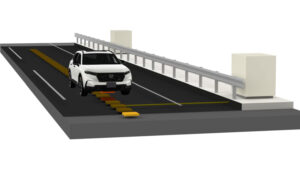


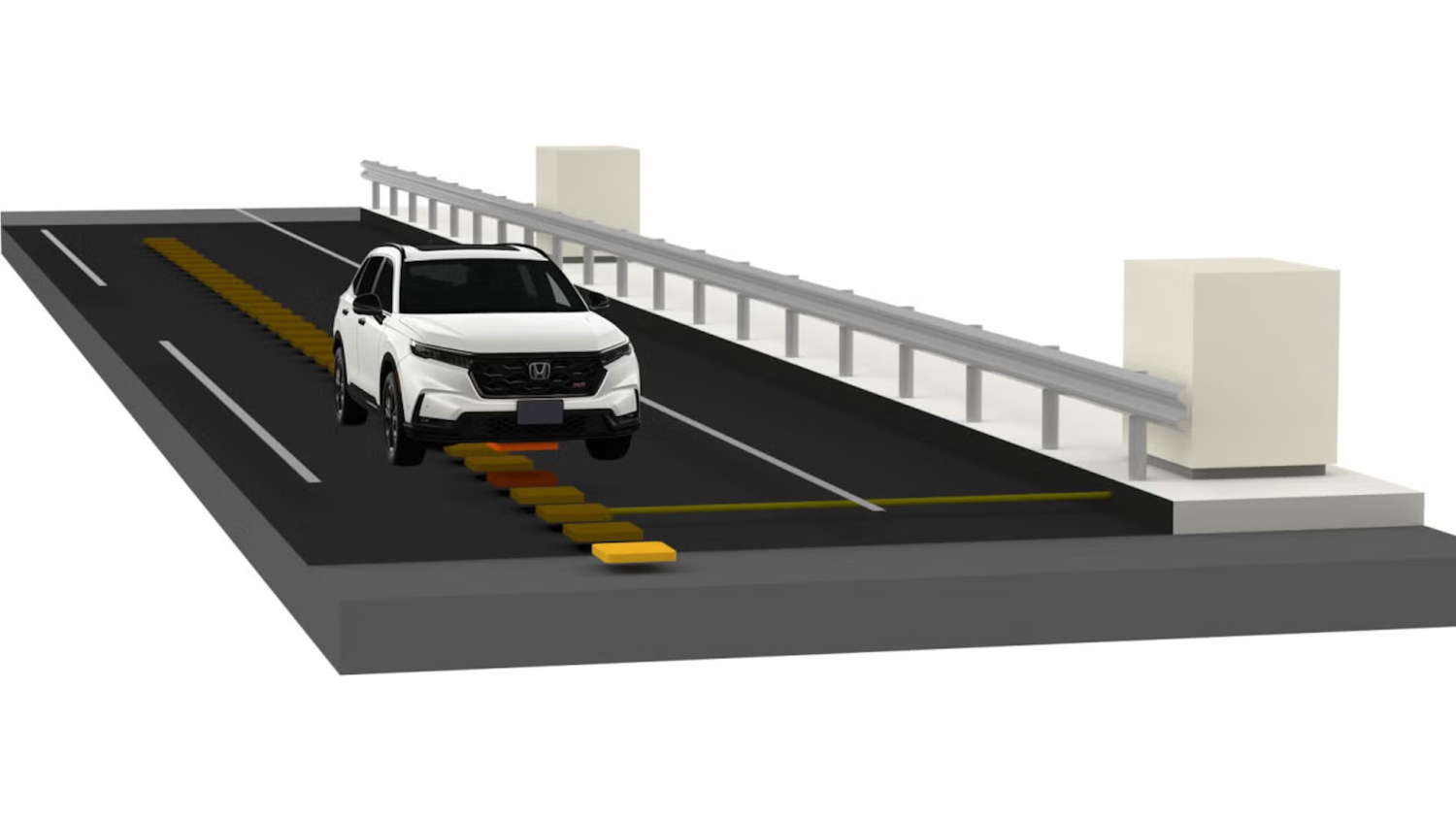
Honda, alongside construction partners Taisei Corporation and its Taisei Rotec subsidiary, plans to demonstrate wireless charging hardware embedded in the Tateyama Expressway in Chiba Prefecture, east of Tokyo Bay. Compatible EVs would draw power while moving — no stop, no plug. Public-road testing is planned from Japan’s 2027 fiscal year, beginning April 1, 2027. This isn’t a product launch. It’s a durability trial, and the question it’s actually answering is pointed: can electrical equipment survive inside a working highway?
Worth noting: Honda recently canceled three North American EV launches amid weakening demand. And yet here it is, drilling induction coils into Japanese tarmac.
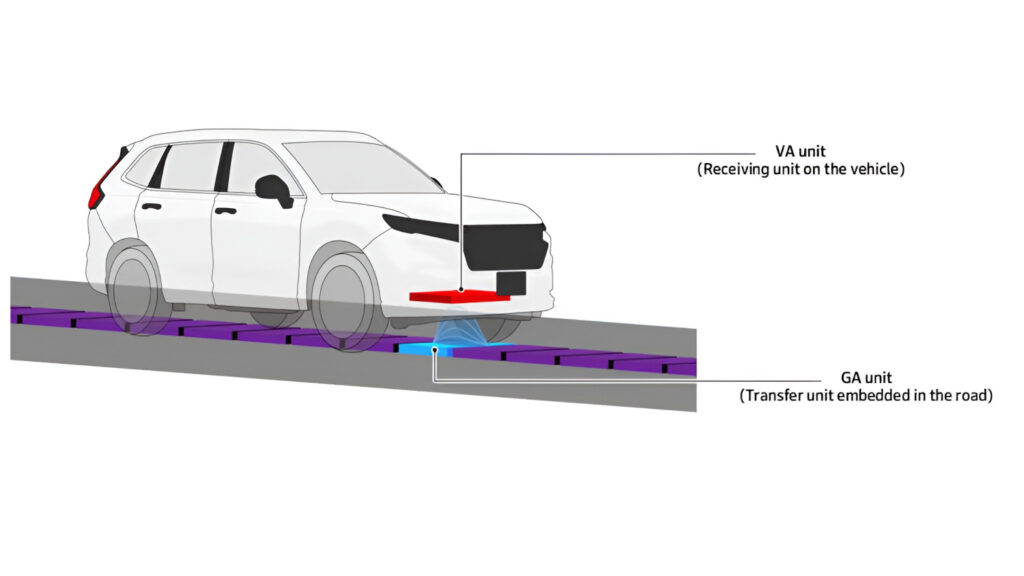
How the Road Actually Charges a Car
Each charging unit pairs an inverter and induction coil in a single pavement-embedded package, reducing the number of subsurface components required.
A vehicle fitted with a compatible receiving panel beneath its chassis draws power as it rolls over the units. According to secondary reporting on Honda’s project, test charging rates reach up to 150 kW for larger commercial vehicles — a test-condition ceiling, not a guaranteed rate for every vehicle on every stretch of road. Think of it less like a fast charger and more like a very efficient conveyor belt that quietly tops up a battery while the vehicle moves.
Key engineering details reported for the project:
- Durability target: equivalent of approximately one million wheel loads including trucks of around 20 tonnes
- Test sequence: facility trials at Taisei’s Future Technology Field in Fukushima Prefecture before Chiba public-road trials
- Public-road testing: planned from fiscal 2027, Tateyama Expressway, Chiba Prefecture
- Anticipated engineering hurdles: electromagnetic-field leakage control, water intrusion, and pavement resurfacing compatibility
The maintenance challenge is the real story. A failed roadside charger can be swapped out. Road-embedded hardware that fails means opening up the pavement. Resurfacing cycles, water intrusion events, and component wear all become part of the charging system’s operating problem — which is precisely why the durability testing phase matters before anyone considers broader deployment.
The most credible early use case isn’t the daily commute. Port vehicles, airport ground equipment, and freight shuttles on fixed, high-utilization routes are where partial dynamic charging arguably makes the strongest economic argument — predictable paths, motivated operators, and a genuine incentive to eliminate charging stops.
Honda’s Contradictory Moment
Pulling back from North American EV launches while embedding charging infrastructure in Japanese highways reflects two separate bets on two very different markets.
Honda confirmed the cancellation of the Honda 0 SUV, Honda 0 Saloon, and Acura RSX for North America, citing a significant decline in EV demand and a reassessment of its electrification strategy. Meanwhile, the Japanese road-charging project continues. Honda also has its Mobile Power Pack, a swappable battery designed for electric scooters and small mobility devices — a third approach to range and charging entirely. Japan gets the infrastructure experiments. North America gets fewer launches. In context, both decisions reflect the same underlying pressure: finding an electrification path that actually holds up.
Wireless power transfer while vehicles move is an established concept. Whether Honda’s road-embedded hardware survives approximately one million truck passes, manages electromagnetic-field leakage reliably, and produces a maintenance model that justifies the infrastructure cost is what the coming trials are designed to determine. The technology has promise. The road, quite literally, will decide the rest.