

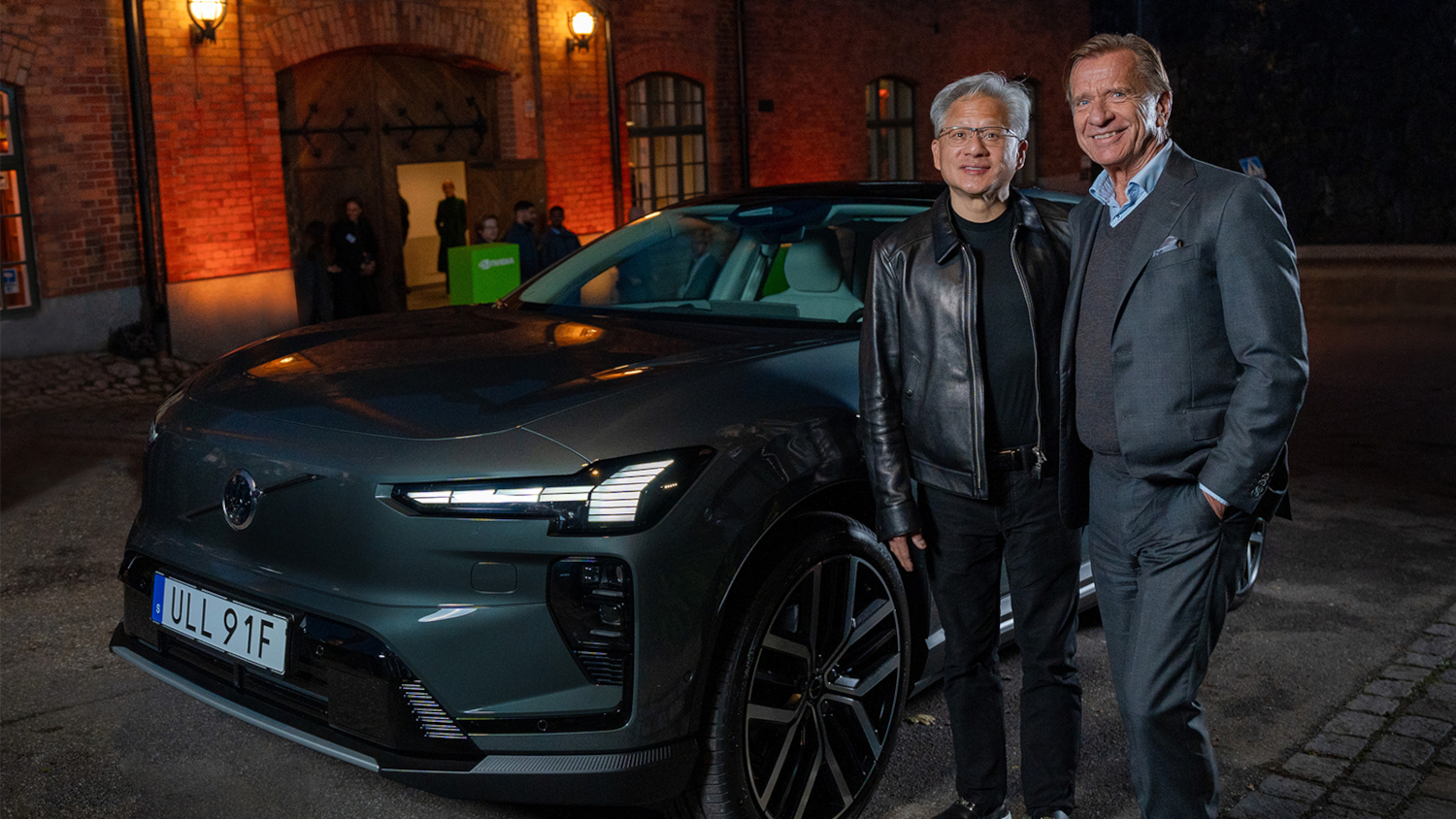
That morning highway crawl handled entirely by your car — eyes off, mind elsewhere — is the destination Volvo and NVIDIA are building toward. What arrives before 2030 is considerably more modest. The two companies announced October 15 an expansion of their 2017 partnership, combining Volvo’s safety engineering with NVIDIA’s Hyperion (a sensor and compute architecture), Halos OS (the software layer managing vehicle operations), and Alpamayo Stack (the driving software coordinating real-world decisions). Automakers are racing to develop the automated-driving stack, and Volvo is placing a significant bet on NVIDIA’s platform to get there.
What the Stack Actually Does
Three interlocking NVIDIA technologies form the backbone of a system designed to handle highways, city streets, and parking — eventually without driver input.
Standard driver-assistance technology handles one task at a time — adaptive cruise control here, lane-keeping there. This platform is designed across three environments: highways, dense urban streets, and parking situations. Hyperion manages sensors and raw compute power. Halos OS coordinates the vehicle’s software operations. Alpamayo Stack translates those inputs into driving decisions. Mercedes-Benz is also building on the same NVIDIA platform, a signal that this is a deliberate supplier strategy rather than a one-automaker experiment.
Key details confirmed so far:
- First deployment tied to Volvo’s “largest-ever product push” — specific model unnamed
- Timeline: production vehicles before 2030; no detailed rollout schedule announced
- Rollout planned across multiple regions simultaneously; China explicitly excluded, per Alwin Bakkenes (Reuters)
- Features not intended exclusively for premium vehicles; pricing structure remains undecided
- Eyes-off (no continuous road-watching required) and mind-off (no active supervision required) are future ambitions, introduced gradually — not capabilities present at launch
Supervised First. Everything Else Later.
Volvo’s own engineering leadership is clear: early systems keep the driver in charge, and the path to genuine automation depends on factors neither company fully controls.
Alwin Bakkenes, Volvo’s head of software engineering, told Reuters that the initial deployment keeps drivers responsible for the vehicle. That is not a caveat buried in fine print — it is the product as it launches. Supervised driving means the system assists while the driver continues watching the road. Any progression toward hands-free highway driving or urban automation will happen gradually.
That progression depends on regulatory approval in each market, reliable performance in adverse weather, and consistent handling of edge cases — construction zones, emergency vehicles, unusual road conditions — that no partnership announcement can guarantee. According to the joint announcement published October 15 on Volvo’s newsroom, both companies frame the initiative primarily as a safety effort rather than a convenience upgrade, with Volvo contributing its established safety systems and NVIDIA supplying the compute and software foundation.
NVIDIA’s Bigger Play
NVIDIA is signing established automakers onto a common platform, pursuing the same infrastructure-provider role in vehicles that it built in data centers.
NVIDIA’s automotive strategy follows a recognizable pattern — establish a standardized platform, attract major manufacturers as customers, and become the compute backbone of an industry before it consolidates. Hyperion, Halos OS, and Alpamayo Stack are that platform. With both Volvo and Mercedes-Benz building on the same architecture, NVIDIA is positioning itself as essential infrastructure for the automated-driving era, much as it became indispensable in AI data centers.
Volvo’s safety engineering credentials are well-established, and a partnership now entering its ninth year carries genuine technical history behind it. Even so, “before 2030” and “pricing details remain unclear” are honest signals worth taking seriously. For drivers weighing the technology today, the straightforward message from both companies is to temper expectations: supervised assistance is what is on offer, and the hands-free future remains contingent on regulatory and engineering milestones that neither partner fully controls.