

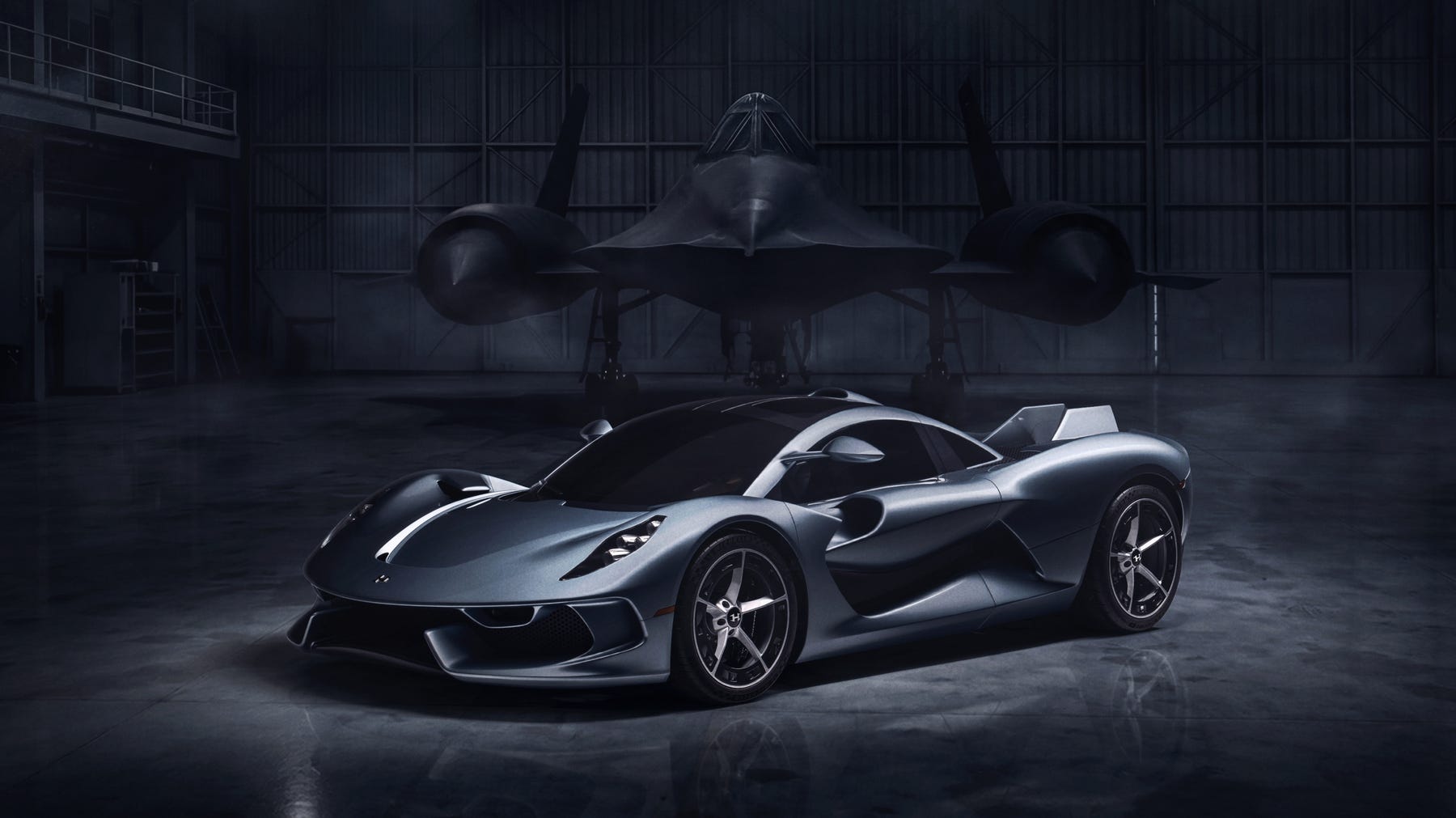
Most $2.5 million hypercars in 2026 arrive loaded with hybrid batteries, dual-clutch gearboxes, and touchscreens stacked like a Bloomberg terminal. Hennessey’s answer is a physical ignition key you twist to start the car. The Blackbird — 71 units, priced from $2.5 million, with deliveries targeted for 2029–2030 after the Venom F5 run concludes in 2028 — is a deliberate counter-move against the screen-first defaults of rivals. In a segment chasing lap records through electrification, Sealy, Texas built something that requires the driver to actually drive.
What’s Under the Carbon
An all-new 6.2-liter naturally aspirated V8, co-developed with Ilmor Engineering — the same outfit that builds Chevrolet’s IndyCar V6s — targets 800–850 hp and a ceiling above 9,000 rpm.
No turbos. No superchargers. No hybrid assist. Power routes exclusively to the rear wheels through a six-speed gated manual with an exposed shift linkage visible from the cockpit. Hennessey claims 0–60 mph in 2.5 seconds and a 220 mph top speed — targets, not yet confirmed figures — made plausible by a full carbon tub, carbon bodywork, and a dry weight goal under 3,000 pounds.
The Spec Sheet, Unfiltered
Every number here is a Hennessey target; independent testing has not yet confirmed these figures.
- Engine: All-new 6.2-liter naturally aspirated V8 with Ilmor; 800–850 hp targeted, 9,000+ rpm ceiling
- Transmission: Six-speed gated manual, rear-wheel drive only — no automated mode, no paddle option
- Performance targets: 0–60 mph in 2.5 seconds; 220 mph top speed
- Production: 71 units worldwide; more than two-thirds already spoken for before public debut
- Price: From $2.5 million; customer deliveries targeted 2029–2030
Screens Are Someone Else’s Problem
The cabin strips every screen from the equation, leaving analog dials, a large central tachometer, and a steering wheel with zero buttons.
Connectivity lives in a dedicated phone holster — the “Hennessey Holster” — where the driver’s own phone handles CarPlay or Android Auto. The screen-free interior is a design philosophy, not an oversight. It echoes a broader analog revival in the hypercar space — Koenigsegg’s CC850 and Porsche’s GT division both returned to manual gearboxes — but the Blackbird goes further by eliminating cabin screens entirely. Think of it as the vinyl resurgence applied to horsepower: not nostalgia, but a deliberate recalibration of what “better” means once digital optimization has removed every interesting rough edge.
John Hennessey frames the brief plainly: “Inspired by the legendary SR-71 Blackbird, this is a different kind of hypercar — built around the things that make driving special: a naturally aspirated engine, a manual gearbox, and a direct connection between driver and machine.”
That positions the Blackbird as the Venom F5‘s philosophical opposite — built not for record runs, but for the driver who still wants to feel the machine working underneath them.
Touring Car Ambitions, SR-71 Aesthetics
Named and shaped after the Lockheed SR-71 spy plane, the Blackbird translates aerospace drama into a hypercar designed for 800-mile days, not just standing-mile records.
Active vertical stabilizers deploy automatically above 71 mph, echoing the aircraft’s twin tailfins. The diamond-shaped quad exhaust references the Bell X-1, the first aircraft to break the sound barrier. Gullwing doors open to brown leather, brushed metal instrumentation, and carbon-fiber accents. Four cup holders and cargo room for two full-size carry-on bags underscore the touring intent. The unit count — 71 — is no accident; it’s the SR-71 written into the nameplate. The public debut is August 14 at The Quail, Monterey Car Week.
More than two-thirds of those 71 cars were spoken for before anyone outside Hennessey’s circle had seen the car in person. The market for analog hypercars is real, solvent, and apparently needs no convincing. Whether the Blackbird persuades other manufacturers to reconsider their screen-first, hybrid-default approach remains — speculatively — the more interesting question going forward.