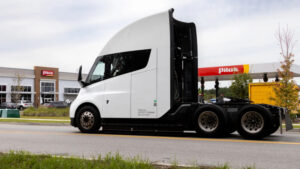


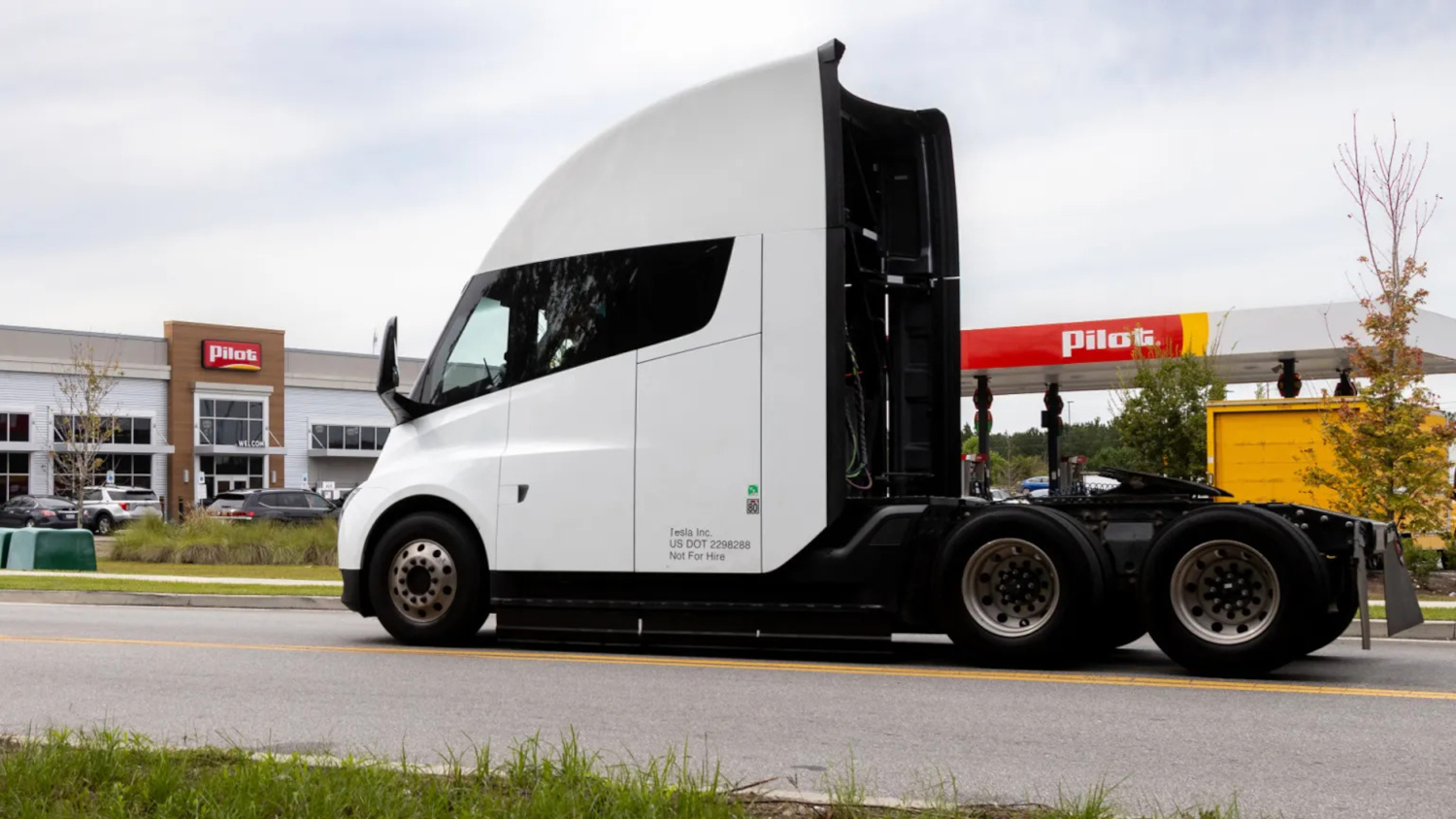
Fleet managers don’t lose sleep over range. They lose sleep over the charger that doesn’t exist on the lane they actually run. Diesel trucks stop at Pilot and Flying J because those 900-plus locations sit where freight moves. Before October 2026, Tesla Semi drivers had limited public charging options beyond Tesla-controlled facilities and a handful of customer-facing sites. That changed on Oct. 8, 2026, when six Tesla Megacharger stalls opened at Pilot Travel Center No. 1390 in Ellabell, Georgia — placing heavy-duty electric charging inside an established freight-stop network for the first time at this scale.
Where the Chargers Are – and Where They Aren’t
Four locations along major freight corridors is a start — North America runs on hundreds of routes.
The current rollout covers Ellabell, Georgia (open Oct. 8); Tulare, California’s Flying J No. 1071 (announced Oct. 9, 2026); Fort Stockton, Texas; and North Las Vegas, Nevada — positioned along I-5, I-10, and other major freight corridors. Twelve additional sites are under construction, each designed for four to eight stalls using Tesla’s V4 cabinet technology. The honest read: a handful of locations doesn’t move freight nationally. It demonstrates the model works logistically. That’s meaningful, but it isn’t enough to rewrite a fleet’s routing strategy yet.
Here’s what the hardware delivers at each stall:
- Up to 1.2 MW per stall — well above the 750 kW reported at Tesla’s earlier Ontario, California truck-stop site
- Tesla states Megachargers can restore 60% of a Semi’s battery in roughly 30 minutes, though battery state, ambient temperature, and simultaneous charging all affect real-world results
- That 30-minute window may align with the federally mandated break drivers take after eight hours behind the wheel, making charging a potential fit rather than a productivity penalty
- Pilot operates more than 900 travel centers across the U.S. and Canada, giving this partnership an established physical footprint to expand from
The Location Matters More Than the Megawatts
Charging speed is a specification — charging where freight actually moves is the harder problem to solve.
Speed matters, but placement is the real argument. Fleets are unlikely to commit to electric trucks on fixed lanes unless chargers exist along those exact lanes. Placing Megachargers at Pilot travel centers — where diesel trucks already fuel, drivers rest, and logistics services concentrate — is a different proposition than building private depot chargers. One serves a route; the other serves a parking lot.
The stalls use the Megawatt Charging System (MCS) connector, the same standard Daimler and Volvo are reportedly developing their vehicles around. For now, the sites serve Tesla Semis exclusively. Pilot and Tesla have not announced when, or whether, non-Tesla trucks will gain access. That unresolved question sits underneath every opening-day announcement: a network built around one manufacturer’s trucks could eventually become a shared industry asset — or remain a proprietary advantage. No timeline has been committed to publicly.
The 12 Sites That Will Actually Tell the Story
The concept is proven at Ellabell — execution across the corridors that matter is still pending.
The real test isn’t the Georgia opening. It’s whether the 12 additional sites open on schedule, maintain reliable uptime during peak freight windows, and extend coverage across corridors beyond the initial rollout. Fleet managers running fixed lanes through Texas, the Midwest, or the Southeast are weighing a practical question: is there a charger on their specific route when they need it?
At current coverage levels, likely not. The answer may look different in 12 months — if those additional sites open as announced.