

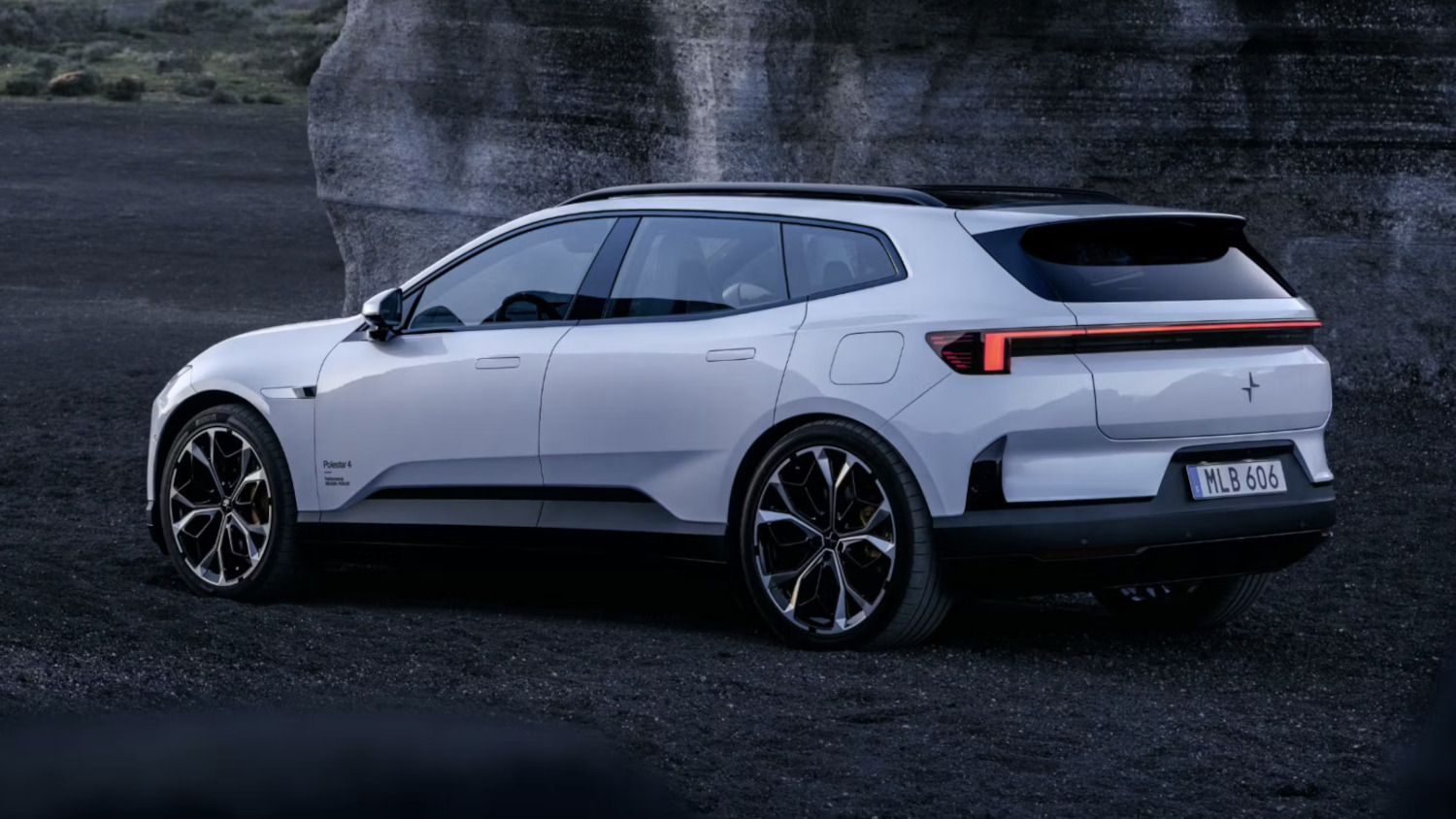
The original Polestar 4 deleted its rear window as a design statement. The new Polestar 4 SUV brings it back, adds roof rails, expands folded cargo space to 1,665 liters, and undercuts the Coupe by up to £3,000. It’s more practical and cheaper. Polestar announced it weeks after confirming it exits the U.S. new-car market from the 2027 model year — blocked by the U.S. Connected Vehicle Rule, which targets vehicles with Chinese-linked connected hardware and software. Canada and Europe get it. Americans get the spec sheet — though there are still worth waiting for alternatives on the horizon.
A Wagon by Any Other Name
The changes are concentrated entirely at the rear, where a boxier tailgate and upright roofline transform the Coupe’s fastback silhouette into something far more useful.
The rear doors and side glass are shared with the Coupe. The divergence starts at the D-pillar: boxier tailgate, upright roofline, genuine rear window with spoiler and wiper, roughly an inch more rear headroom. Roof rails are rated to 100 kg. Cargo grows from around 526 liters in the Coupe to 655 liters to the roofline, and 1,665 liters with the rear seats folded. The proportions are genuinely handsome — less Volvo estate, more Scandinavian airport lounge on wheels. Call it a wagon. Polestar won’t. Both are right.
Key specs worth knowing:
- Powertrains: Single-motor RWD (~272 hp) and dual-motor AWD (~544 hp); ~100-kWh battery on a 400-V architecture; DC fast-charging up to ~200 kW
- WLTP range: ~391 miles single-motor, ~373 miles dual-motor — a modest improvement over the Coupe
- V2L and Camping mode: Up to ~3.3 kW output; Camping mode delivers climate control, ambient lighting, and entertainment from a parked position
- UK pricing: Single-motor SUV ~£2,000 less than the Coupe; dual-motor ~£3,000 less
- Performance Pack: 22-inch wheels, Pirelli P Zero tires, Brembo calipers in Polestar’s signature Swedish Gold
American enthusiasts scrolling these numbers will find a Canadian configurator the only clickable destination. Polestar will keep selling existing Polestar 3 and 4 inventory stateside until it’s gone, and its 30-plus U.S. service points stay open for current owners. Polestar’s official launch communication described the SUV as offering “expanded versatility… additional luggage capacity and rear headroom” — corporate understatement for what is genuinely the more useful car.
The lifestyle additions land well. V2L and Camping mode position this squarely for road-trip culture. The panoramic sunroof now runs all the way to the tailgate, with optional electrochromic tinting. Eight paint choices include Aurora (bright silver green) and Ozone (bright silver purple). The optional 12-speaker Harman Kardon system is retuned specifically for the SUV’s cabin acoustics — the kind of detail that signals Polestar took this seriously rather than simply bolting on a taller tailgate.
Canada Gets the Good Version
First deliveries target Q4 this year, making the SUV an immediate option for Canadian buyers who can skip the Coupe entirely.
Real-world Canadian range lands around 500 km single-motor and 450 km dual-motor after accounting for climate and drive-cycle differences. Unless a buyer specifically wants the radical windowless experience, the SUV wins on every practical count. Polestar’s broader roadmap — Polestar 5, next-generation 2 and 7 — is now built entirely around markets where the brand can actually sell cars.
Polestar built the most sensible version of one of their most interesting cars, then immediately made it unavailable to the market that would have argued about it loudest — much like performance wagon decisions from other European brands. For everyone else, it’s a wagon worth taking seriously — whatever Polestar insists on calling it.