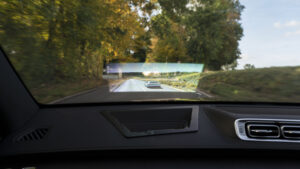


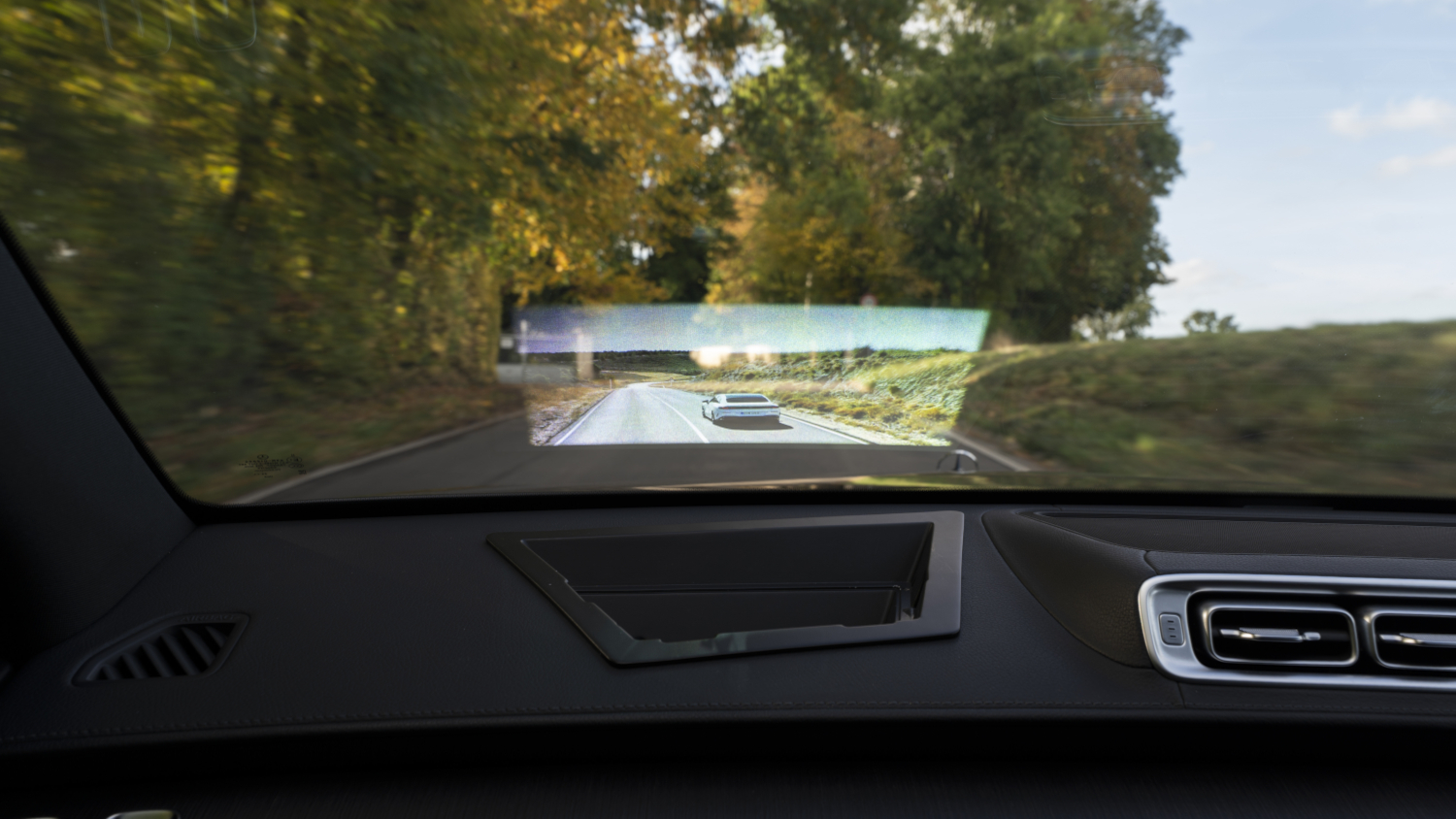
Sit behind the wheel of a future Mercedes, and the windshield in front of you might also be a screen — not a head-up display strip, but the glass itself. Mercedes-Benz announced a holographic windshield concept that uses a dashboard-mounted projector aimed at a laminated windshield embedded with holographic optical elements that selectively reflect the projector’s specific light wavelengths. Images appear on the glass. When the system shuts off, the windshield looks like a windshield. The physics work. Whether the idea does is a different conversation entirely.
How the Glass Becomes a Screen
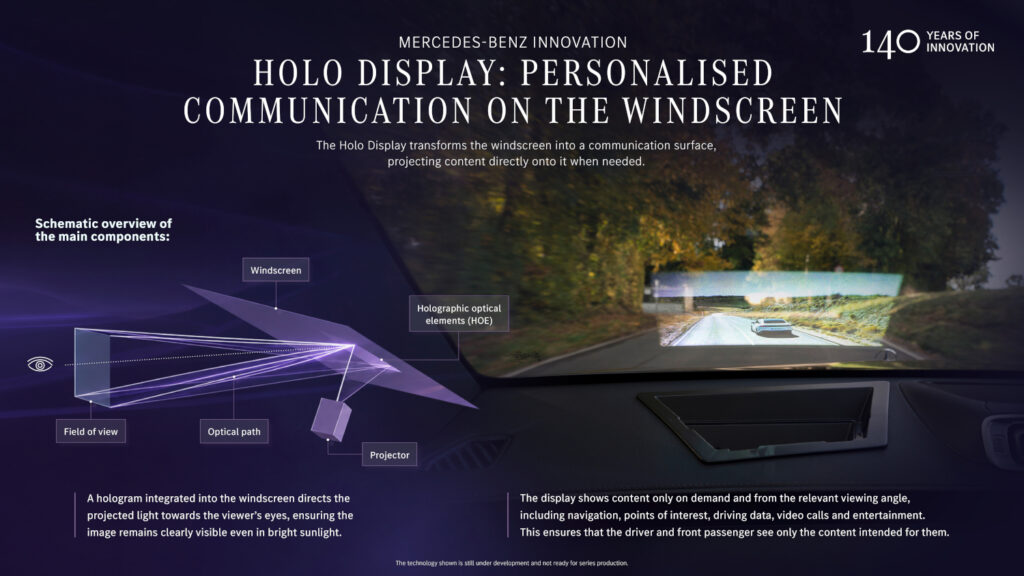
The laminated film does one precise job: reflect only the projector’s light while leaving everything else invisible — which is why the glass still looks like glass when the system is off.
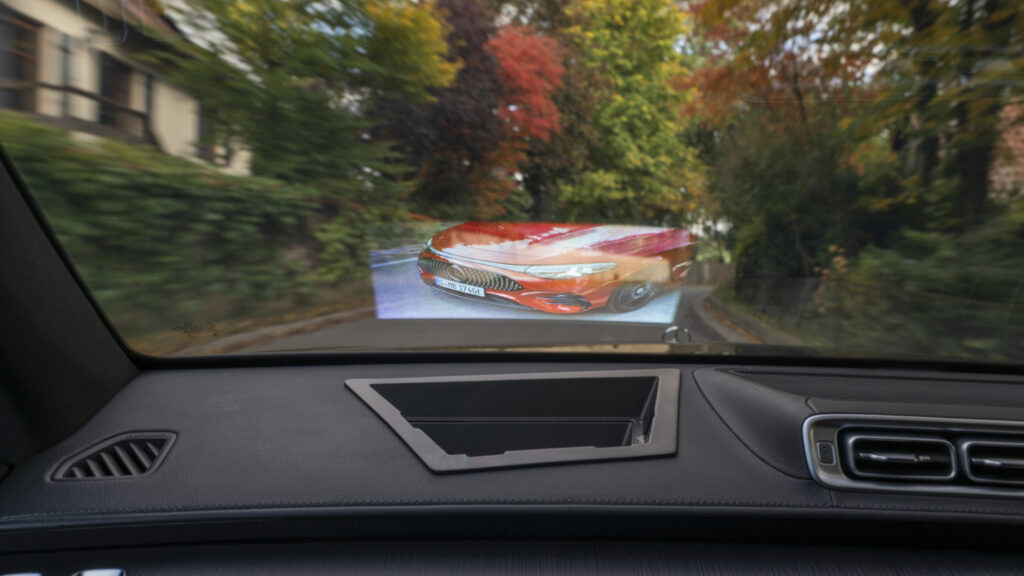
Traditional head-up displays use a small projection zone. Mercedes is proposing areas of the windshield as what it calls an “on-demand communication surface.” The laminated optical film reflects only the projector’s wavelengths, leaving everything else optically transparent. Mercedes says concentrated projection output keeps images visible even in direct sunlight. More pointedly, directional viewing angles mean the driver and front passenger could theoretically see different content simultaneously — navigation data for one, a film for the other — with Mercedes saying each viewer’s content remains out of sight from the opposite seat.
What Mercedes Says the System Could Do
These are proposed applications, not confirmed production features.
- Driver sees navigation and driving data; passenger gets separate video content not visible from the driver’s position
- Projected images designed to remain visible in direct sunlight, per Mercedes
- Proposed uses include points-of-interest overlays, video calls, and films
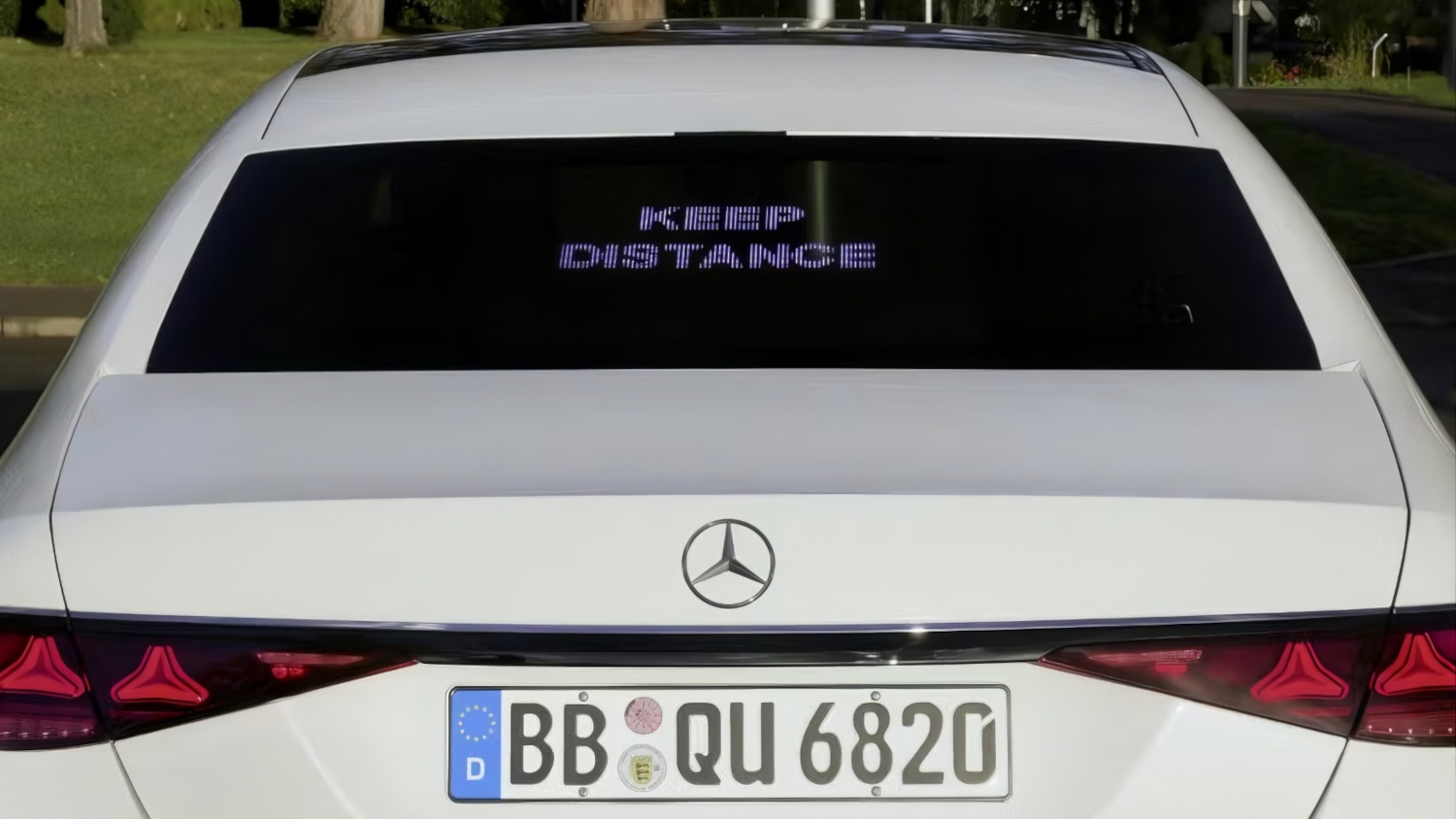
- Rear windows are separately under research, with mini-LED and micro-LED technology being explored for brake lights, warning symbols, and traffic information aimed at drivers behind the vehicle
- No production model confirmed, feature, or launch date announced
Plausible Technology, Unresolved Product
Mercedes isn’t alone in seeing the windshield as the next information surface — but being first to demonstrate the concept and first to solve it in production are very different achievements.
“The windshield will be your screen.” — Nissan design chief Alfonso Albaisa, as reported by The Drive.
Albaisa’s prediction has company. Apple filed a related projection-technology patent application in 2023, according to The Drive. Mercedes has built a demonstrable concept. The broader direction is real — multiple players in the auto industry are exploring glass as an AI Assistant-integrated information surface.
The unresolved problem list is equally real: driver distraction standards, regulatory approval across markets, optical clarity over time, and windshield replacement costs when the laminate is part of the display. These are legitimate development hurdles, not minor footnotes. Mercedes already ships the Hyperscreen and the Superscreen inside its cabins. At some point the interior stops feeling like a cockpit and starts resembling a Times Square billboard the driver is legally required to face.
The Real Question Nobody Wants to Answer
Making an image appear on glass was never the engineering challenge — the harder task is making a convincing case that the image belongs there at all.
Mercedes has demonstrated that windshield-scale projection is technically plausible. What it hasn’t yet answered is whether adding another visual layer to the driver’s field of view improves the experience or simply adds to it. That distinction, quiet as it sounds, is the one that will determine whether this concept ever reaches a production line.