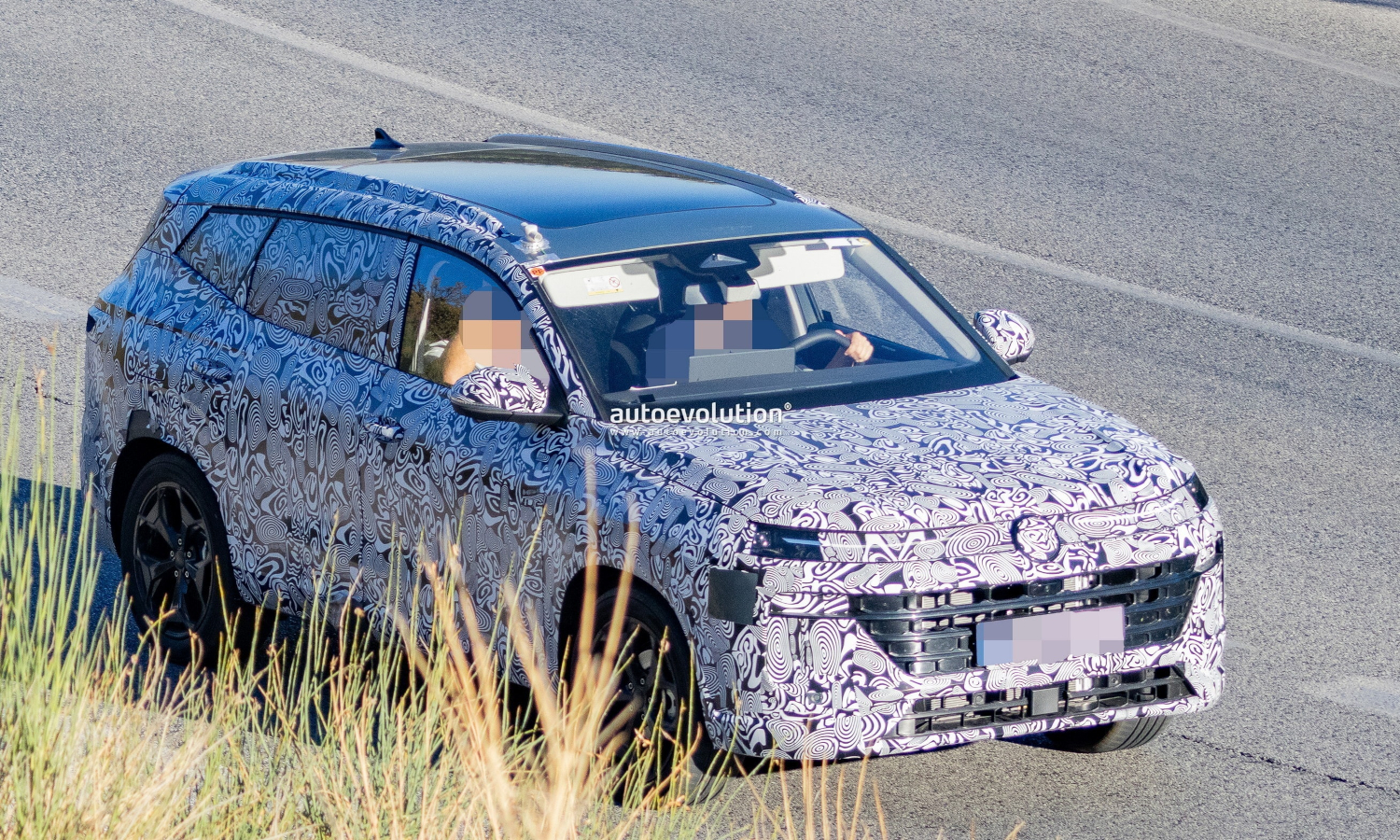


That familiar situation: a large SUV threaded into a parking bay clearly designed for a compact hatchback and sheer optimism. Getting in was manageable. Getting out requires mirrors, patience, and mild existential dread. Hyundai’s answer is Memory Reverse Assist — a system in the all-new 2027 Tucson that records the entry path and automatically steers the vehicle back out along the same trajectory, no hands on the wheel required. The timing is deliberate: the fifth-generation Tucson is 60 mm longer and 40 mm wider than the model it replaces. Parking bays, as any city driver has noticed, remain stubbornly unchanged.

Bigger Car, Same Tight Spaces
Hyundai grew the Tucson by 60 mm in length and 40 mm in width — then engineered a system to help drivers escape the consequences.
The wheelbase stretches roughly 30 mm, landing at approximately 2,785 mm. Second-row headroom grows by about 29 mm, and rear doors now open 10 degrees wider — a detail that matters when loading children or groceries in a crowded lot, making easy entry a genuine priority in the design. The interior gains are real and practical. The parking challenge is the trade-off. Cars keep expanding while urban infrastructure stays fixed, a dynamic that has made low-speed maneuvering one of the more stressful parts of everyday driving.
What the 2027 Tucson adds to manage that reality:
- Memory Reverse Assist records the entry trajectory; on reversal, it automatically controls steering to retrace that exact path
- Ground View uses the 360-degree camera array to display the road surface directly beneath the car on the infotainment screen — useful for curbs, bollards, and obstacles invisible from the driver’s seat
- Pedal misapplication safety assist limits propulsion if the accelerator is floored instead of the brake at low speed, and can bring the car to a stop
- Forward and reverse parking collision avoidance uses sensors and automated braking to catch low-speed impacts before they happen
- A door-unlock power backup keeps doors operable after a crash even if the main electrical system fails
The Cabin, The Engine, and When You Can Buy One
Android-based infotainment, a more powerful hybrid option, and Korean sales starting October — with North America close behind.
The previous twin-curved display is gone. The new cabin centers on a tablet-style Pleos Connect screen — Hyundai’s new Android-based infotainment platform, making its SUV debut in this generation. It pairs with Gleo AI, a voice assistant built on a large language model that handles vehicle settings, searches, and travel suggestions through natural speech. Physical buttons are retained for core functions, and USB ports output up to around 100W.
Externally, the design language is called “Art of Steel” — sharper surfaces, pronounced fenders, a boxier stance than the outgoing model. An XRT trim adds a unique grille, wheel-arch cladding, and skid plates for buyers drawn to the rugged aesthetic.
Powertrains start with a 1.6-liter turbocharged mild-hybrid producing roughly 190 hp, now paired with an eight-speed automatic that replaces the previous seven-speed dual-clutch. The full hybrid version delivers approximately 242 hp. Plug-in hybrid details remain unconfirmed. US models are expected to adopt the 1.6-liter turbo in place of the current 2.5-liter non-turbo engine, though Hyundai has not officially confirmed American specifications.
South Korean sales begin October 2026, with a global reveal expected around the Paris Motor Show that same month and a US debut at the LA Auto Show in November. North American sales are projected for late 2026 or early 2027, with production starting at Hyundai’s Montgomery, Alabama plant in Q1 2027. For anyone who has ever broken a sweat reversing out of a tight bay, exploring what else might be worth waiting for could make the wait feel entirely reasonable.