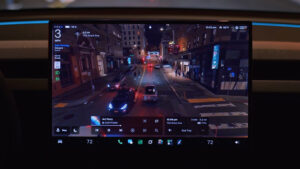


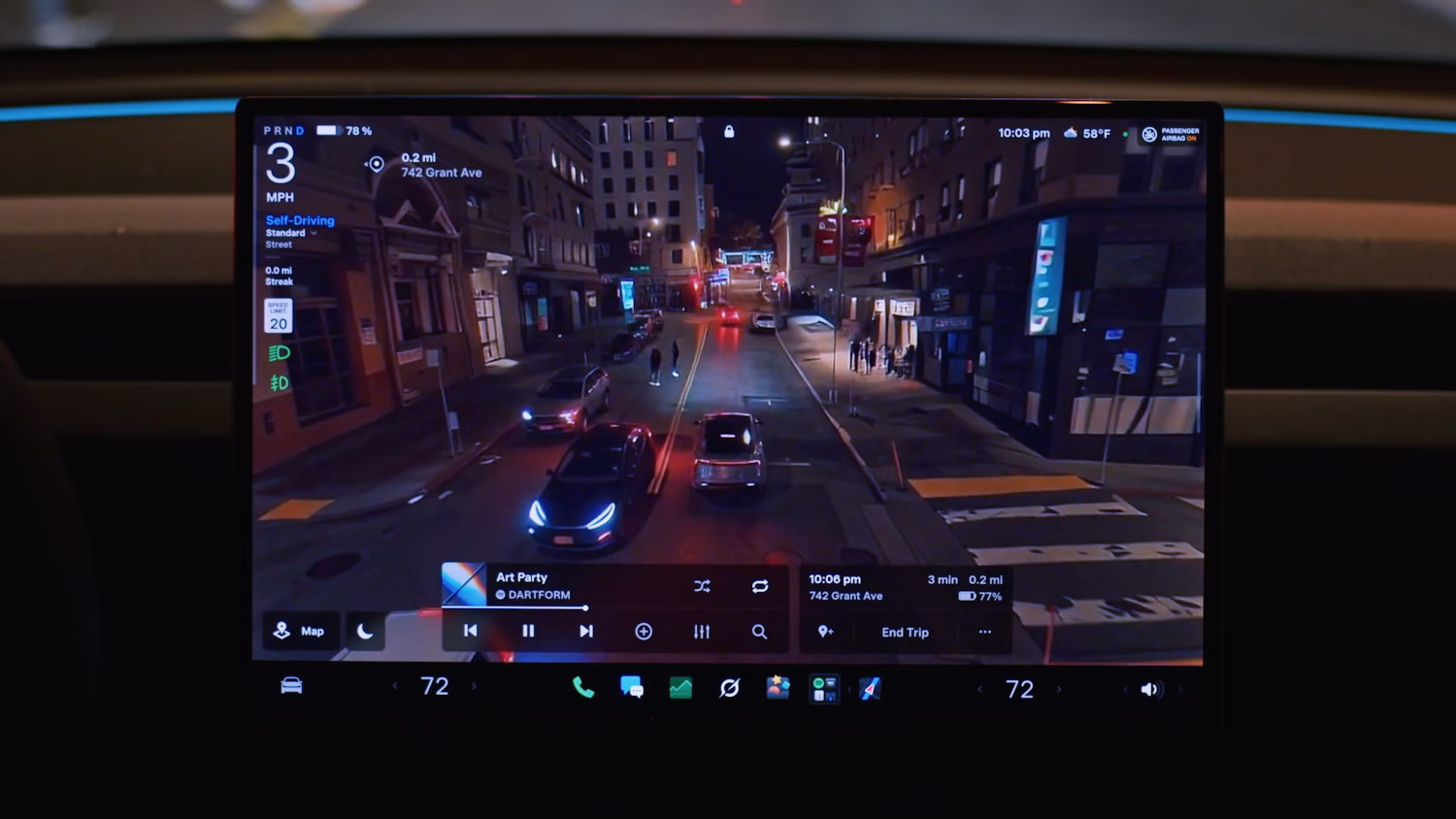
Tesla’s new Reality View interface resembles a GTA V loading screen — an overhead, AI-generated render of the road ahead, complete with photorealistic roads and planned turns drawn in clean overlays. That’s the headline feature of Full Self-Driving (Supervised) v15, which began an early-access rollout in the U.S. around November 21–22, 2026. The display is genuinely impressive. It is also still supervised driver assistance, meaning the driver must watch the road and be prepared to take over at all times.
What Reality View Actually Shows
This isn’t animation — it’s a live, model-generated visualization of what the car thinks it sees.
Reality View generates a real-time, AI-rendered overhead perspective of the vehicle’s surroundings, replacing the older block-style object graphics with something that looks almost cinematic. The system draws from the same visual-processing pipeline Tesla uses to interpret its camera feeds, so the display reflects a model-generated representation of nearby roads, vehicles, pedestrians, and cyclists — though it may simplify or omit elements and should not be treated as a literal, complete readout of the car’s perception. Planned maneuvers such as turns appear as overlaid paths. Three display modes are available: full-screen, map view, and split-screen. Drivers can reportedly influence the planned path through the AI Assistant touchscreen.
Beyond the visuals, v15 also brings functional changes:
- Early-access rollout began in the U.S. around November 21–22, 2026
- Tesla says the update improves detection of potholes, small animals, and road debris, incorporating fleet-learning techniques based on data from other Tesla vehicles
- Three display modes available: full-screen visualization, map view, and split-screen
- Tesla reportedly claims a “25x” improvement in handling safety-critical cases — but has not disclosed the baseline, the definition of a critical intervention, or supporting mileage data, according to reporting by The Verge
- Early users report the system occasionally over-reacts to road-repair zones, flagging them as potholes (anecdotal, per notateslaapp.com)
Here’s the tension the update doesn’t address: a beautiful display is not the same as a safer car. The GTA-style aesthetic may create a human-factors concern — a realistic overhead scene could attract visual attention away from the road at the exact moment FSD requires active supervision. The car is not driving itself. It requires the driver to stay ready, always.
Three Questions the Data Still Needs to Answer
Separating perception accuracy, decision quality, and display usability isn’t optional — it’s the whole evaluation.
Three distinct things need independent verification, and they are not the same question:
- Does Reality View accurately represent what the car perceives?
- Does FSD v15 make objectively better driving decisions?
- Does the display help drivers supervise — or does it distract them?
Tesla’s “25x” claim reportedly addresses the second question, specifically an improvement in the critical-intervention rate. Without disclosed methodology, it remains unverifiable. Tesla’s driver-assistance software also remains under NHTSA scrutiny — The Verge reports an active investigation involving millions of FSD-equipped vehicles. Visual polish does not change that regulatory reality.
If this update reaches a Tesla near you, the display is worth seeing. Just remember: impressive and safe are not synonyms. Keep eyes on the road, not the render.