

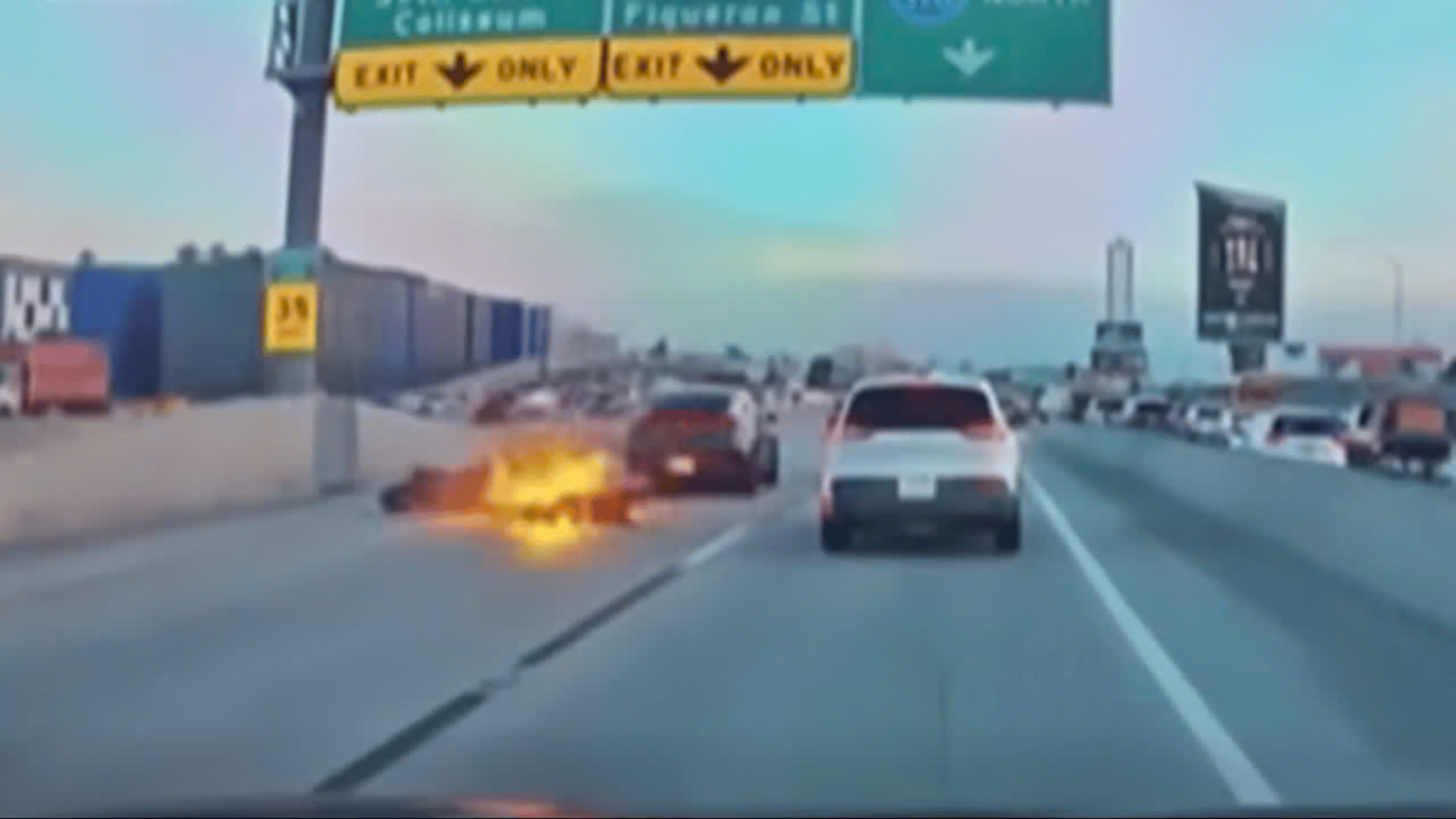
Heavy traffic on northbound Interstate 110. A Tesla Model Y moves into the left lane. A motorcyclist, reported to be traveling between lanes — a maneuver permitted under California law subject to safety conditions — approaches from behind. The motorcycle strikes the Tesla’s rear. Both the bike and the rider catch fire.
Then something remarkable: the rider stands up, moves away from the burning wreckage, and bats out the remaining flames.
CHP released dashcam footage of the October 29 crash as a public safety warning. The rider was transported to a hospital with moderate, non-life-threatening injuries, according to CHP information cited by Fox10. The investigation was ongoing at the time of available reporting, and no final fault determination had been issued.
Key confirmed facts at time of publication:
- Date and location: October 29, northbound I-110, Los Angeles
- Rider condition: Moderate, non-life-threatening injuries, per CHP via Fox10
- Fault determination: Unresolved; investigation ongoing
- Tesla driver-assistance systems: No available reporting confirms whether any system was active at the time
- CHP’s message: Check mirrors and blind spots before every lane change
The Blind Spot Every Driver Needs to Know About
This crash illustrates a danger that applies to every vehicle on every freeway — not just electric ones.
Some reporting cited a CHP characterization of the Tesla’s maneuver as an unsafe lane change, though legal responsibility remained undetermined as of available reports. What the agency made clear by releasing the footage publicly is a broader safety lesson: checking mirrors alone is not sufficient before moving lanes.
Motorcycles present a genuine detection challenge. Their smaller profile means they occupy far less visual space than a car, and they can close distance through traffic more quickly than many drivers expect. That combination can turn a routine lane change into a collision in seconds. Driver death rates from IIHS data further underscore how quickly these situations turn fatal.
“Check mirrors and blind spots, especially before changing lanes or making turns,” CHP advised after releasing the footage.
This is not Tesla-specific guidance. The same physics apply to every vehicle. No available reporting establishes which driver-assistance features, if any, were active in the Model Y at the time — and CHP’s warning makes no distinction by vehicle type.
Drivers and riders share the same pavement and the same risk. The rider on the I-110 walked away from fire. A full mirror-and-blind-spot check before every lane change is a small habit — and, as this footage makes plain, a potentially lifesaving one. For those concerned about dangerous states for driving, new data offers additional context on where road risks run highest.