

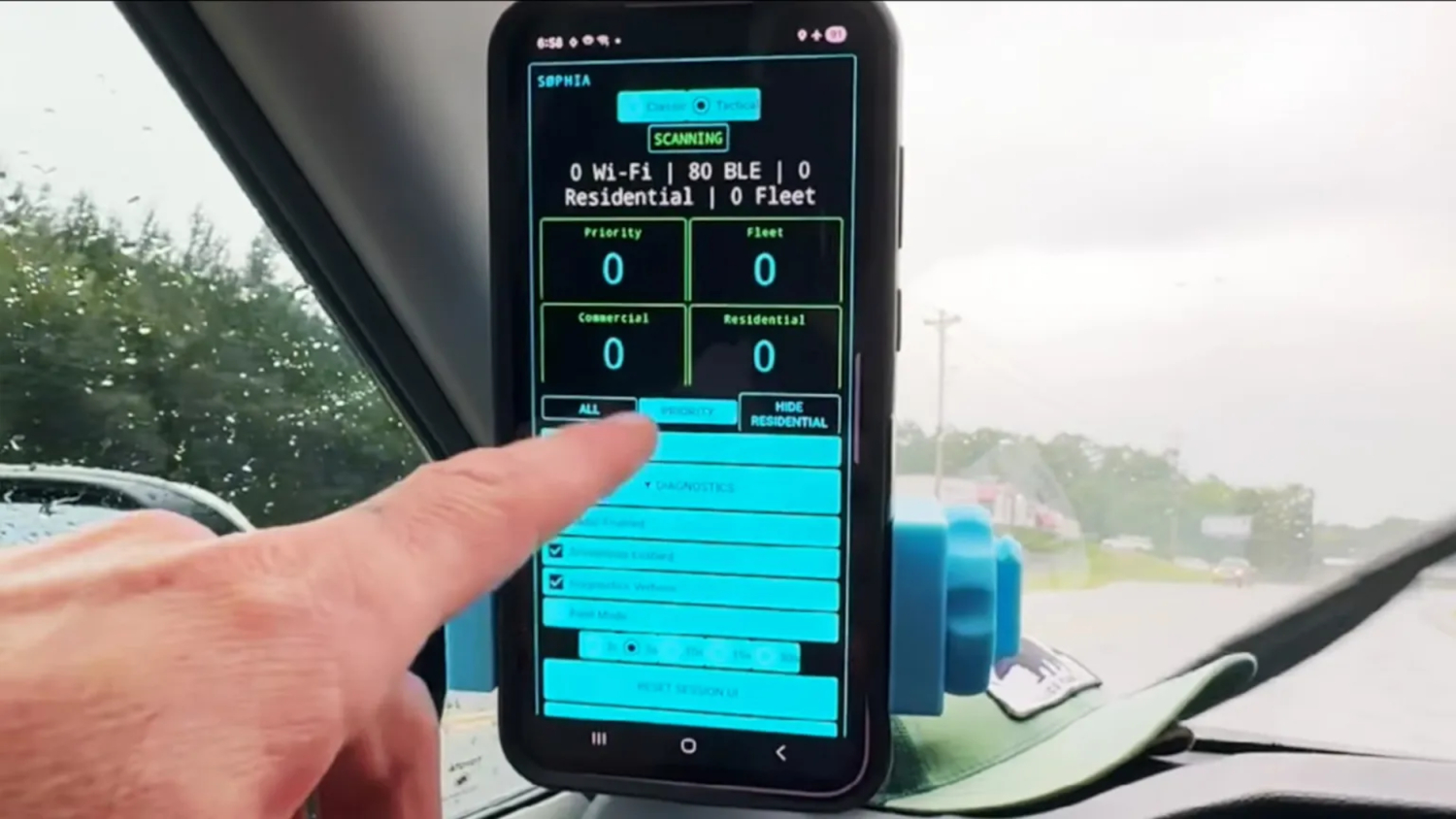
A quiet ping. An unfamiliar network identifier surfaces on screen — one flagged as associated with police fleet equipment. Now what? That’s the actual question SØPHIA forces you to sit with, and the answer is messier than the breathless coverage implies.
SØPHIA runs on Android 8 or newer, costs $39 once via Gumroad, and requires no root access, no SIM card, and no external hardware. It passively observes the Wi-Fi and Bluetooth activity already visible to your phone. Modern police vehicles may carry connected equipment — routers, body-camera docks, telematics systems — and if those devices emit detectable signals, SØPHIA may surface them. If they don’t, or if a vehicle is operating without broadcasting supported signals, the app may not detect anything at all.
That gap matters enormously:
- SØPHIA is Android-only, with no iOS support
- One-time $39 purchase via Gumroad; no subscription required
- Passive scanning only — it cannot read messages or pinpoint a transmitter’s location
- Detection depends on whether equipment is powered, broadcasting, and within range
- Absence of a signal does not mean absence of a vehicle
The same manufacturer signature that flags as “fleet equipment” may plausibly belong to a city bus, a delivery van, or a commercial crew’s dashcam system — these are illustrative possibilities, not documented cases. According to detecx.io, a detected signal is contextual, described in the developer’s own framing as “not proof of who owns a device or what it’s being used for.” Related Android tools like RF Sentinel and Cop Spotter make similar detection claims, though the available research found no independent controlled validation of their accuracy.
The Mirror Points Both Ways
While you’re observing ambient wireless noise, law enforcement is already using the same signals — far more systematically — to observe you.
Here’s where the story gets genuinely uncomfortable. SØPHIA is an awareness tool. SignalTrace, a platform marketed by Leonardo to law enforcement, is a system designed to associate recurring wireless signatures with license-plate-reader data. Prince George’s County, Maryland, has reportedly piloted it, while the Harford County Sheriff’s Office was said to be in the research stage. The system combines Bluetooth, Wi-Fi, and RFID observations with license-plate-reader records, correlating device signatures with plates, locations, and timestamps. Leonardo’s marketing describes this process as building an “electronic fingerprint.” According to reporting in The Conversation, the maker states that “electronic signatures alone do not identify a person and should be corroborated through other investigative methods” — framing that should sound familiar to anyone who followed the early rollout of facial-recognition technology.
The asymmetry here is the actual story. One tool costs $39 and surfaces contextual signals that are easy to misread. The other is a law-enforcement platform being piloted in Maryland while most drivers remain unaware it exists. Neither is neutral. Both exploit the same underlying reality: connected devices in or around a vehicle may emit observable wireless signals intermittently, and those signals carry information.
SØPHIA is worth understanding — not because it reliably identifies unmarked police vehicles, which the available evidence does not support, but because it makes visible something most people ignore entirely. Configure alerts before driving. Mount the device in accordance with local laws. Keep eyes on the road. The wireless noise around any moving vehicle has always been there. The difference now is that someone, on at least one side of this equation, has been listening for a while.