

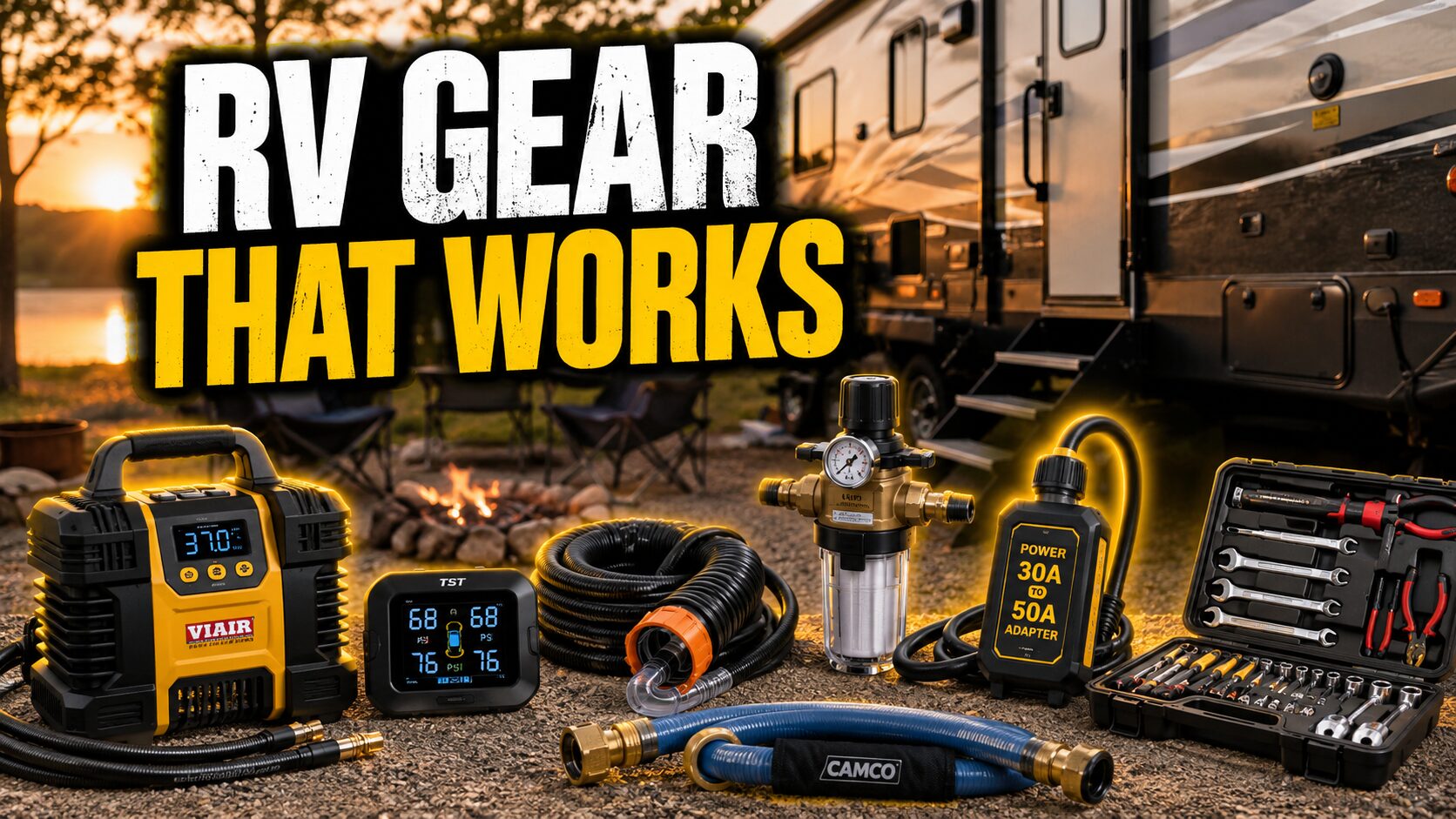
The RV accessory market runs on the same logic as airport gift shops — captive audience, inflated prices, and the persistent feeling that you are buying something you do not actually need. Most of what fills RV storage bays was purchased in the first year of ownership and has not moved since. The accessories that earn their space solve problems that show up on every trip: the campground with the sewer hookup three feet beyond hose reach, the park with water pressure that will destroy your fittings, the tire that loses pressure at mile 200. Nine products below solve those problems. Three do not.
This content may contain affiliate links. If you wish to support us and use these links to buy something, we may earn a commission.
10. What Wastes Your Money

Generators for Beginners: Heavy, loud, and expensive for occasional off-grid needs at $2,000-$4,000. A car inverter handles the actual power requirements most new RVers have without the storage problem or noise complaints from neighboring sites.
Outdoor TVs: Sun glare converts $800-$2,500 screens into mirrors. Most buyers end up watching them indoors.
Coat Hanger Extenders: Organizational gadgets at $15-$30 that sound useful and perform like participation trophies. Proper folding solves the same problem for free.
9. TST Tire Monitoring System

Tire failures on heavy RVs escalate faster than they do on passenger cars — the weight multiplies the consequences of a blowout significantly. Real-time pressure monitoring provides enough warning to pull over before a pressure drop becomes a catastrophic failure. TST systems adapt to various wheel configurations and provide early warnings that convert roadside emergencies into planned stops.
8. Rhino Flex Extra Sewer Hose

Campground sewer connections are positioned without apparent regard for where RVs actually park. A hose that falls three feet short at the end of a long driving day is a specific kind of frustrating. Some sites require up to three hose sections for a proper connection — carrying spare sections eliminates the improvised solutions that experienced campers recognize immediately as a bad idea.
7. RVGuard Water Regulators and Filters
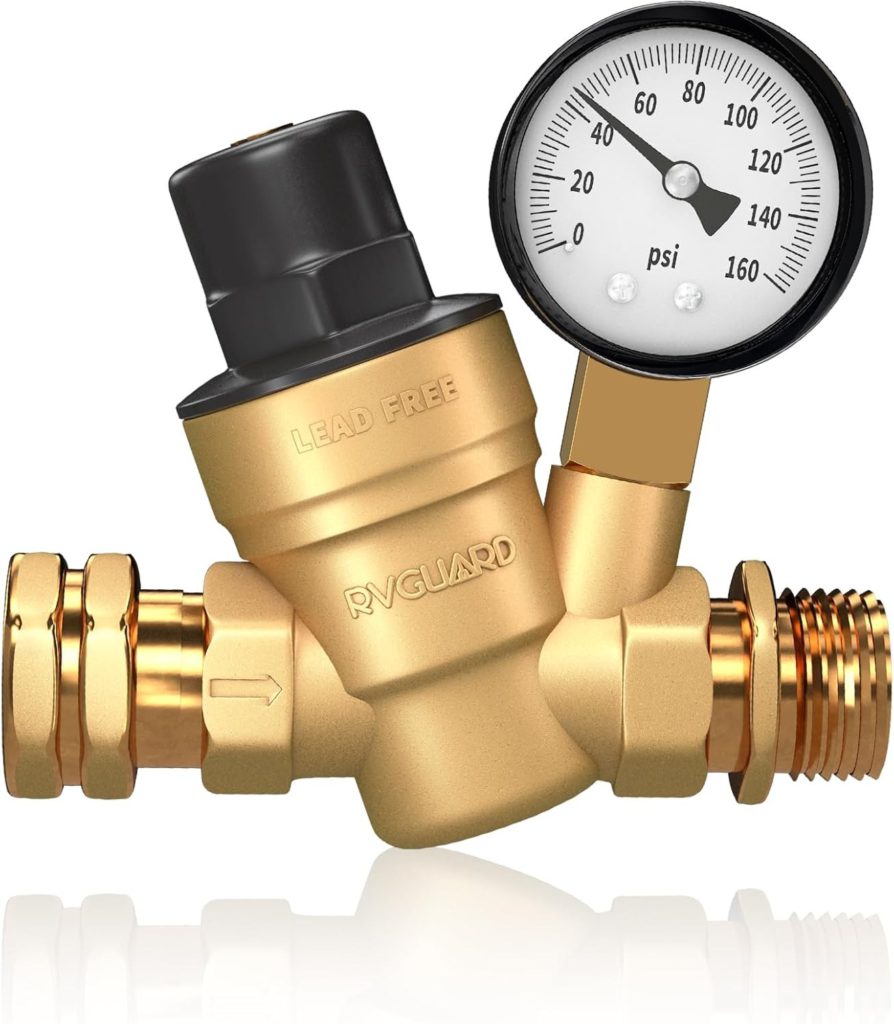
Campground water pressure varies without warning and high pressure bursts pipes — the kind of water damage that happens inside your walls and turns up later as a large repair bill. Regulators protect the RV’s plumbing system while filters address water quality from older park infrastructure. The upfront cost is small relative to what a single pipe failure costs to repair.
6. Camco Heated Water Hose

The freeze protection argument sells this hose, but the real value is reach. Standard hoses fall short of awkwardly positioned hookups that campground designers did not apparently test before installation. A heated hose extends connection options in any weather and serves as emergency backup when a primary hose fails during setup — multi-purpose gear that earns its storage space on both counts rather than one.
5. X-Chocks

RV movement while parked produces squeaks, rattles, and sleep disruption that accumulates over multi-night stays. Standard stabilizers reduce motion inadequately for longer rigs where flex and movement are more pronounced. X-Chocks fit between tandem wheels and eliminate the wheel movement that standard stabilizers cannot address — the difference is immediately noticeable on the first night and compounds across every subsequent stay.
4. Comprehensive Toolkit

Road repairs do not schedule themselves around your access to proper equipment. An organized toolkit converts fixable problems into service calls when the right tool is missing — a single avoided call covers the kit’s cost. The storage footprint is small, the use case shows up on every extended trip, and the alternative is improvising with whatever is available, which experienced RVers recognize as the beginning of a worse problem.
3. Starlink Internet

Campground WiFi is shared infrastructure that degrades predictably as occupancy increases. Cellular boosters help in some locations and do nothing useful in others. Starlink provides consistent speeds that make remote work and reliable streaming actually functional rather than aspirational. Tree coverage occasionally requires repositioning the dish, but the consistency is categorically better than any campground or cellular booster alternative for full-time or extended RVers.
2. RVGuard Power Adapters

Campground electrical service varies by park age and infrastructure investment. A 50-amp RV at a 30-amp site cannot connect without the right adapter, and the wrong connection damages equipment. Multiple adapter types in a compact storage footprint ensure electrical compatibility does not become a reason to avoid a campsite — small, inexpensive, and the kind of problem that only surfaces when you do not have the solution already in the bay.
1. Viair Air Compressor

Gas station air compressors are not built for Class A RV tires requiring 80+ PSI — they overheat, cycle off, and leave the job unfinished. Underpressure on a loaded RV increases tire wear, degrades fuel economy, and raises blowout risk across every mile driven in that condition. Viair units deliver consistent pressure to large-format tires reliably — built to the specification the job actually requires rather than the consumer market the product is sold to. The compressor that works every time is the one worth carrying.