

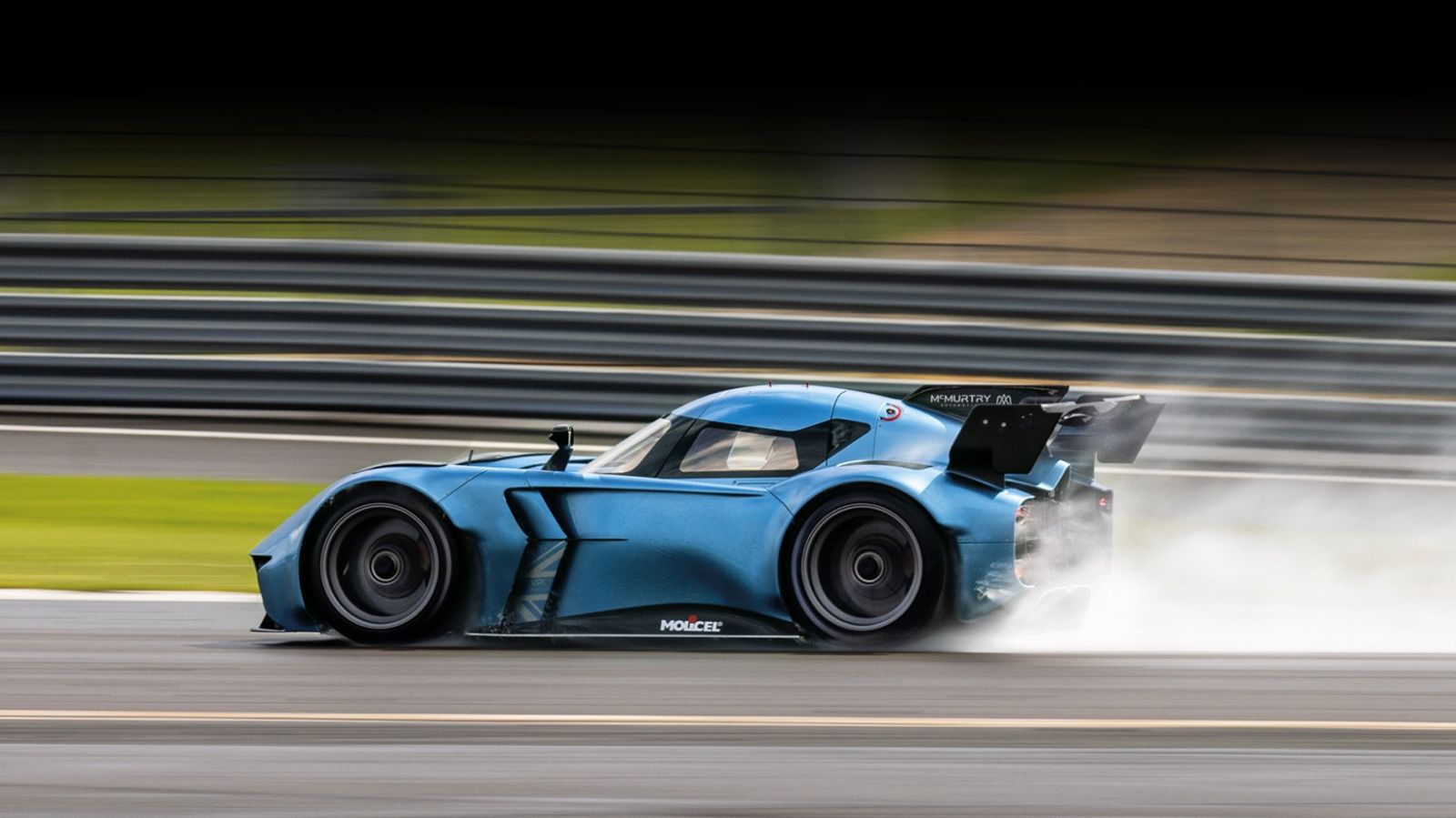
Physics just got flipped the bird. The McMurtry Spéirling has become the first car in history to drive upside down from a standstill.
Not a stunt. Not CGI. Actual wheels-to-the-ceiling, middle-finger-to-gravity driving.
How The Hell Did They Do That?
The secret weapon is McMurtry’s “Downforce-on-Demand” fan system. This isn’t theoretical physics—it’s 2,000 kg of instant downforce available even when the car isn’t moving.
That’s enough suction to stick this single-seater EV hypercar to a ceiling and drive it there like some deranged Hot Wheels experiment come to life.
The demonstration happened at McMurtry’s Gloucestershire headquarters on a purpose-built rig with independent adjudicators present. No smoke, no mirrors—just engineering that makes Newton reconsider his career choices.
A Track Monster That Happens To Defy Gravity
The Spéirling’s party trick isn’t its only claim to fame. This pint-sized terror already holds the Goodwood Festival of Speed hillclimb record with a blistering 39.08 seconds.
Its dimensions tell half the story:
- Just 135.8 inches long
- Barely 62.2 inches wide
- A mere 40.2 inches tall
The other half comes from its 999-1,000 horsepower dual electric motor setup. All packaged in a vehicle that weighs less than some motorcycles.
Yours For The Taking (If You’re Quick And Loaded)
Production is capped at 100 units. Customer deliveries won’t start until 2026.
Thomas Yates, McMurtry’s MD and co-founder, described the upside-down driving experience with refreshing understatement: “That was just a fantastic day in the office. Strapping in and driving inverted was a completely surreal experience.”
The Spéirling Pure is track-only, which makes sense. Road regulations typically frown upon cars that can drive on ceilings.
What McMurtry has built isn’t just a record-breaker—it’s a physics-breaker. A car that treats gravity as a suggestion rather than a law.
When other manufacturers talk about “groundbreaking” performance, they typically mean shaving milliseconds off lap times. McMurtry means literally breaking contact with the ground while still maintaining perfect control.
That’s not engineering evolution. That’s engineering revolution.