


Every Ferrari that competes in sanctioned GT racing lives under Balance of Performance rules — BoP, in shorthand — a regulatory system designed to keep competition close by artificially capping power and restricting aero. The 296 GT3 Evo operates inside those limits. The 296 GT Modificata does not. Ferrari built it specifically for Club Competizioni GT, a non-competitive track program for wealthy clients who want the car without the rulebook. The result, Ferrari estimates, potentially laps the company’s Fiorano test circuit about three seconds faster than the GT3 Evo it’s based on — Ferrari’s own figure, not an independent benchmark. Still, three seconds is enormous.

What Ferrari Actually Changed
Freed from BoP constraints, Ferrari reworked nearly everything that the rulebook had been quietly suppressing.
Ferrari retained the 3.0-liter twin-turbo V6, mid-rear mounted, but reworked the cranktrain, camshafts, intake system, intercoolers, turbochargers, and fuel delivery to extract 730 cv — approximately 720 hp at 7,500 rpm, according to Ferrari. That’s roughly 120–130 hp more than the BoP-capped GT3 Evo. No hybrid system here; unlike the road-going 296 GTB, this is pure V6, accountable to nothing but physics. A six-speed sequential gearbox with carbon clutch and circuit-tuned ratios handles the output. Aero follows suit: new hood with a larger opening, slotted splitter, additional brake cooling ducts, and a single-pillar rear wing with enlarged endplates and a 5mm Gurney flap — a design lineage that traces directly to the Le Mans-winning Ferrari 499P.
Four things worth noting about the package:
- Peak output: 730 cv (~720 hp) at 7,500 rpm, versus approximately 600 hp in BoP trim
- BoP rules suppress power to equalize competition; the Modificata answers to none of that
- Two-seat layout — bring a coach, bring someone brave, bring whoever needs convincing
- Data acquisition and onboard video come standard, not optional
A Race Car With a Passenger Seat
Club Competizioni GT reframes track driving as a destination experience — part traveling private club, part automotive masterclass.
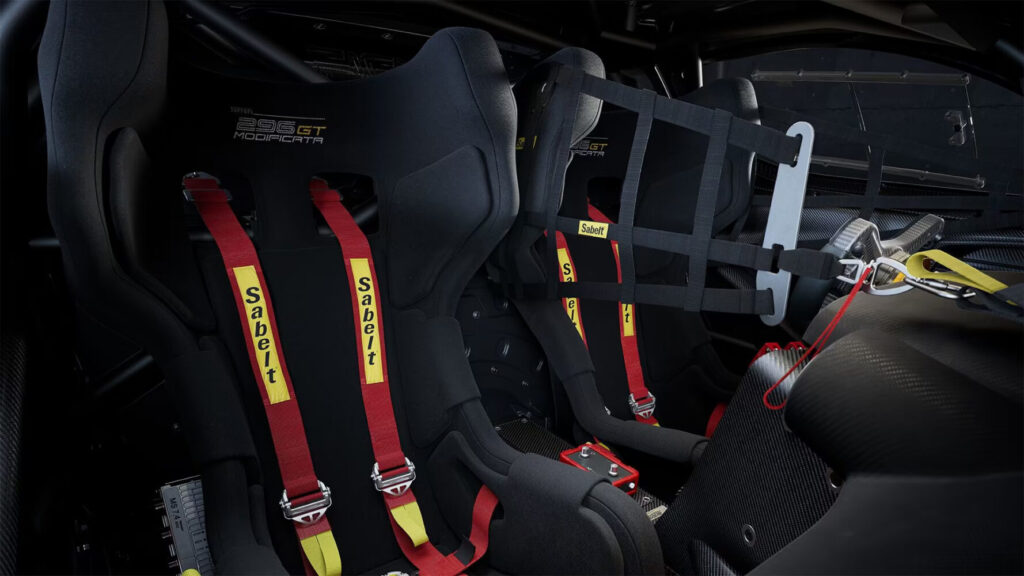
Club Competizioni GT is not racing. No trophies. No podiums. Think Soho House, but you arrive in a 720-hp race car and the dress code is a helmet. Purchase includes two years or 12 rounds of factory-supported track events. The 2027 calendar runs through Jerez, Misano, Fuji, Indianapolis, Paul Ricard, and Spa-Francorchamps, closing at the Ferrari World Finals. Price remains undisclosed — the road-legal 296 GTB starts above $330,000 in the U.S., which tells you approximately nothing useful about what this costs. If you’re curious how exotic cars can quietly drain a fortune beyond the sticker, the pattern is well established.
The two-seat configuration signals intent clearly. The Modificata isn’t purely a solo time-attack weapon — owners can bring a coach or a passenger, framing every session as a learning experience as much as a performance exercise. The car teaches as readily as it terrifies. It follows the earlier 488 GT Modificata, confirming Ferrari’s pattern: take the race car, remove the constraints, hand it to clients who can handle the consequences.
Three seconds is Ferrari’s number, measured on Ferrari’s track, under Ferrari’s conditions. Whether that gap holds at Spa or Fuji, nobody outside Maranello knows yet. For the people who can afford to find out, that uncertainty is probably part of the appeal.