

After 46 years and more than 100 million combinations, California’s standard passenger plate sequence quietly hit its limit in 2026. The series that launched in 1980 with 1AAA000 — marching steadily through every possible arrangement — ended with 9ZZZ999. DMV spokesperson Ronald Ongtoaboc confirmed the close of what he called the “long-existing 9-series configuration,” according to the Los Angeles Times. When a state has 35 million registered vehicles and nearly 1.8 million new cars hitting the road every year, the math eventually catches up.
California’s answer wasn’t a redesign. It was a mirror.
Same Plate, Flipped Sequence
California flipped its familiar format rather than reinvent it — unlocking another 100 million-plus combinations without disrupting recognition for law enforcement or the public.
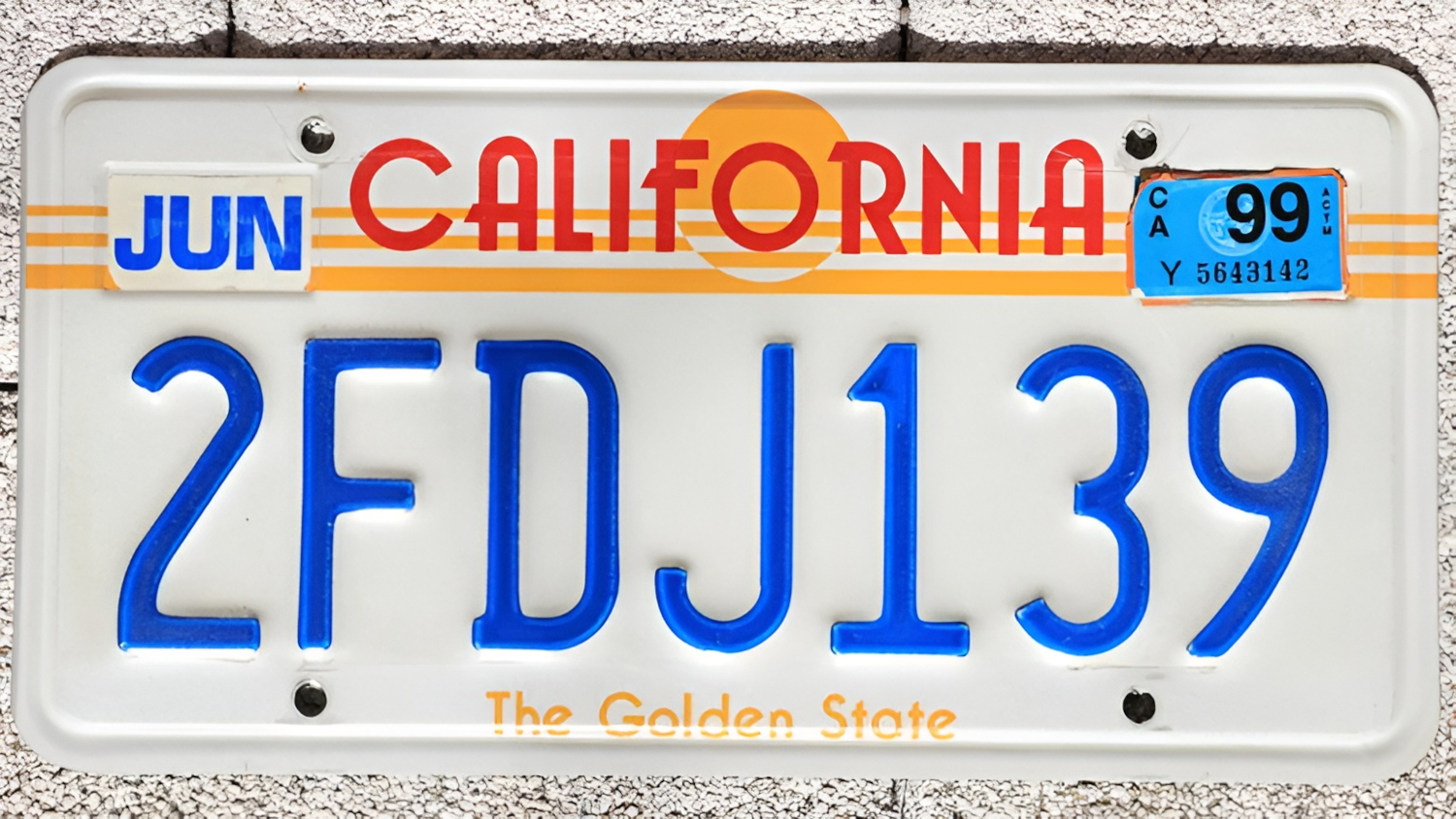
The old format ran one numeral, three letters, three numerals: 1ABC123. The new sequence reverses that logic — three numerals, three letters, one numeral. Ongtoaboc described it to LAist as “Numeral Numeral Numeral Alpha Alpha Alpha Numeral,” yielding plates that look like 000AAA0 or 123ABC1. The DMV projects this format will last roughly 40 years. California has used this mirroring strategy before precisely because it maintains visual continuity while instantly unlocking a fresh century’s worth of combinations.
A few details worth knowing during the transition:
- About 110,000 old-format plates remain in DMV and auto club storage and will keep being issued until exhausted, according to Jalopnik.
- Current vehicle owners do nothing — existing plates stay valid.
- The California New Car Dealers Association reported approximately 1.8 million new passenger vehicles registered in 2025.
- Every standard California plate is still manufactured at Folsom State Prison by roughly 100 incarcerated workers, producing 45,000–50,000 aluminum plates per day under a partnership between the DMV and the California Correctional Training and Rehabilitation Authority.
That last point deserves a moment. Every plate you’ve ever glanced at in a parking lot outside a taco truck or a farmers’ market was stamped inside a state prison — a detail most drivers never consider. The labor program has operated for decades, providing work assignments to incarcerated workers while supplying the state’s entire standard-plate demand.
The Rarest Plate in California
Neither 9ZZZ999 nor 000AAA0 had been assigned to a vehicle at the time of reporting, making both the automotive equivalent of a mint-condition first pressing.
According to Jalopnik, the odds of landing one of those bookend plates run roughly 2-in-1.8-million based on annual new-vehicle registration rates. For plate collectors and car enthusiasts, that’s the whole game — the California equivalent of a factory-sealed limited edition.
Both formats now share the road during the transition. Newly registered vehicles and used cars being re-plated may still receive an old-format plate from existing inventory, while fresh registrations increasingly carry the new sequence. The number arrangement changed; the iconic California plate look did not. When the mirrored sequence eventually runs its course — projected around 2066 — the state will face the same question again. For now, the sequence flipped, the inventory turns over, and the drive continues.