

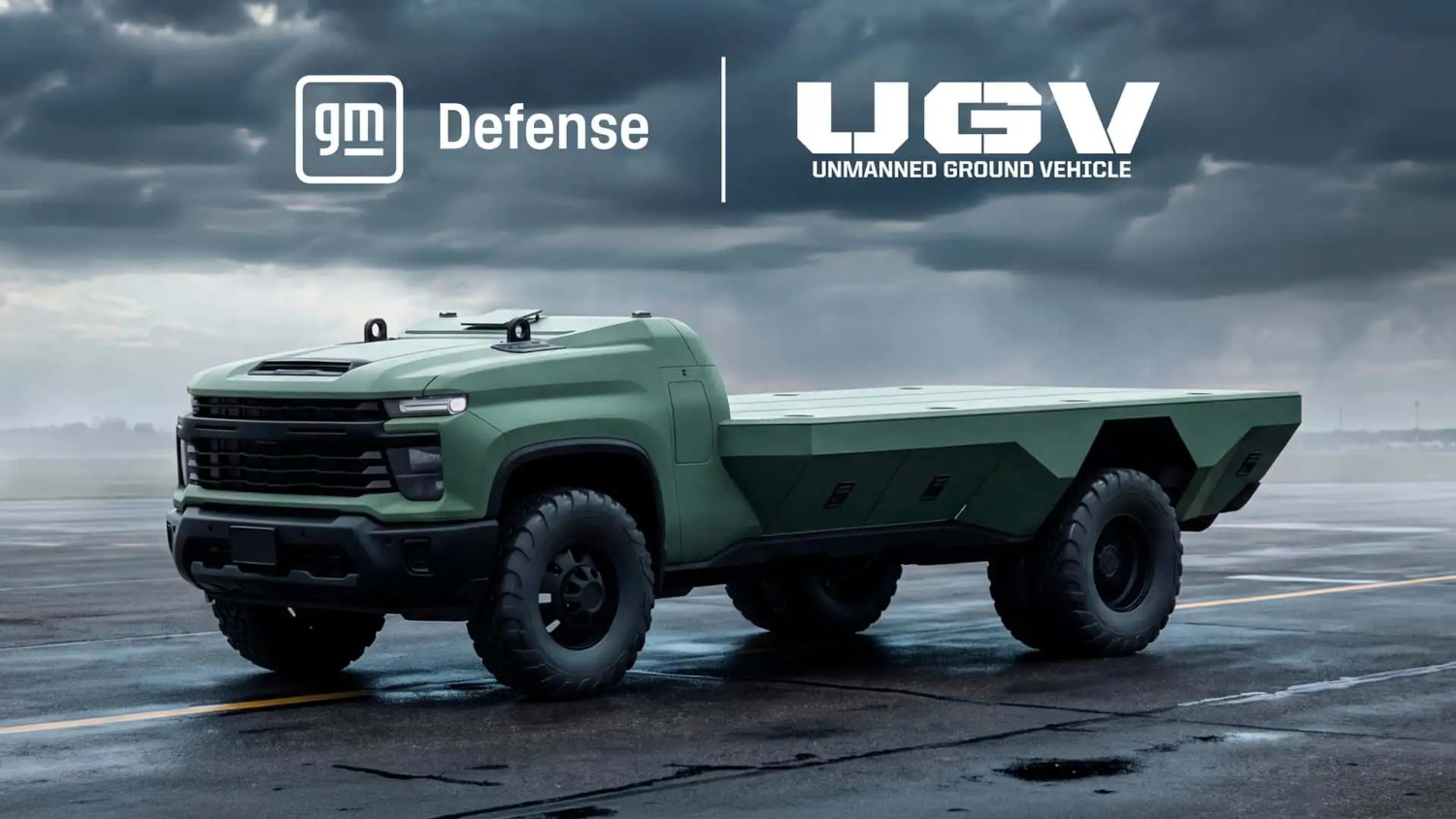
Resupply runs are among the most dangerous missions in a combat zone — moving ammunition, water, and medical supplies through terrain where enemy forces anticipate every route. GM Defense‘s proposed answer is straightforward: remove the driver entirely. At the 2026 Association of the United States Army annual meeting in Washington, D.C., the company unveiled an Unmanned Ground Vehicle built on Chevrolet Silverado 3500HD hardware. No cab. No crew. Functional Army trials are targeted for 2027, though no production contract has been announced.
A Pickup Truck With No One Inside
GM strips the Silverado 3500HD down to its platform — and finds a battlefield logistics concept underneath.
The foundation is what engineers call a skateboard architecture: the powertrain, suspension, and controls sit in a low platform designed to accept different upper bodies and mission-specific equipment. Removing the cab creates additional cargo space and eliminates the need to expose a driver to hostile fire. Reported concept specifications include an 8,000-pound maximum payload and approximately 100 kWh of onboard energy storage — figures attributed to early reporting and subject to revision.
Several details are worth understanding before the specs impress too quickly:
- Powertrain: This is not a battery-electric vehicle. According to reporting by CarScoops, GM indicated that an internal-combustion engine charges the onboard energy system through a power take-off — a mechanical connection that diverts engine output to generate electricity. Quieter operations are possible in theory; actual noise performance has not been publicly established.
- Autonomy: The concept reportedly uses drive-by-wire controls — steering, braking, and throttle managed electronically rather than mechanically — alongside an open, vendor-agnostic interface for autonomous software. Scout AI’s Gx Ground Agent was associated with the displayed vehicle, per Motor1 reporting.
- Missions: Stated roles include resupply of ammunition, water, batteries, and medical supplies, as well as casualty evacuation.
- Counter-drone equipment: A LOCUST X3 laser weapon and Squarehead Discovair G2+ acoustic detection sensor appeared alongside the vehicle at AUSA. These are displayed mission equipment, not confirmed integrated payloads.
- Status: Technology concept. No Army procurement decision has been announced.
GM Defense president Steve DuMont has been quoted as saying the company does not “begin with a blank sheet of paper” — a statement attributed to CarScoops that has not been independently confirmed from a primary transcript. The underlying point, however, is a real procurement argument. A commercial heavy-duty platform could draw on existing components and manufacturing capacity, potentially compressing development timelines compared with a ground-up military design — though those advantages remain to be demonstrated rather than assumed. GM Defense’s separately expanding Infantry Squad Vehicle program, with roughly 12,000 vehicles reportedly planned across approximately 39 active-duty and National Guard brigades per Defense News, gives the company a credible track record of Army delivery.
What 2027 Has to Prove
Army trials will determine whether a driverless Silverado can perform reliably in the conditions it was designed for.
The 2027 functional trial is the next meaningful checkpoint — and “targeted” is the operative word, since trials are not guaranteed and a procurement decision would come later still. Key questions evaluators are likely to examine include reliable driverless navigation, safe operation around troops, and communications performance in contested environments. Range figures, armor specifications, production costs, and actual quiet-operation performance all remain publicly unknown.
The core purpose of the concept is clear: keep a person out of the vehicle on the most hazardous resupply and evacuation runs. Whether that proposition earns an Army contract depends on what 2027 reveals.