

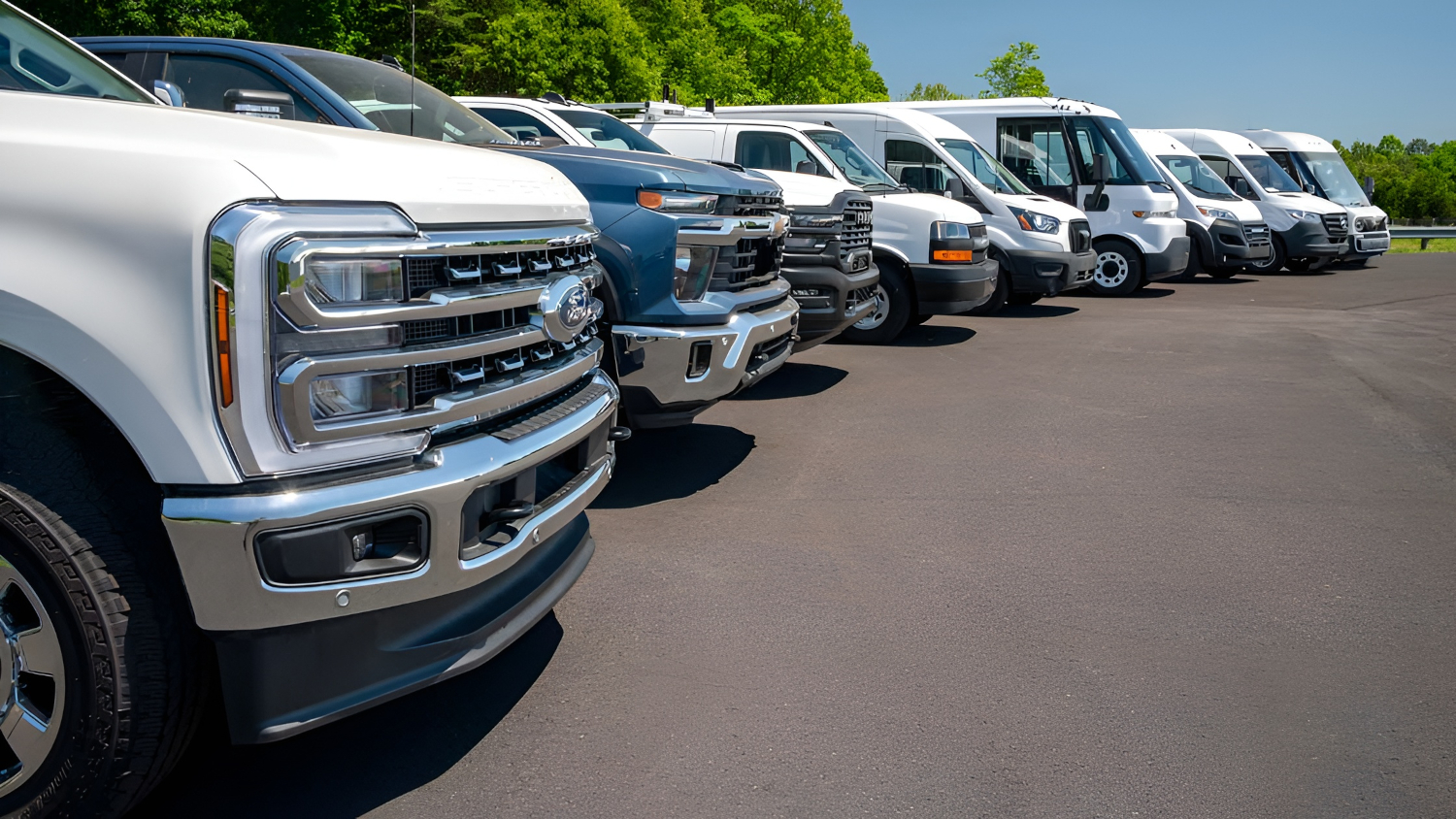
Not one heavy-duty pickup earned a Good rating. The Insurance Institute for Highway Safety has run its first-ever front crash-prevention evaluations on Class 3 pickups — vehicles with a gross vehicle weight rating (GVWR) between 10,001 and 14,000 pounds, the maximum total loaded weight the vehicle is designed to carry — and every tested model landed at Poor or Marginal. These trucks share roads with passenger cars, cyclists, and pedestrians, and their mass makes their failure to stop a problem that extends well beyond the cab. The broader picture of IIHS results across vehicle categories shows that safety gaps are not confined to commercial platforms alone.
The Pickups: A Failure Across the Board
Four trucks tested, none earned Good, and one recorded zero speed reduction at 43 mph.
The Chevrolet Silverado 3500HD and GMC Sierra 3500HD both earned Poor or Marginal for vehicle-to-vehicle front crash prevention and Marginal for pedestrian front crash prevention, according to IIHS results. The Ford F-350 matched that Poor vehicle-to-vehicle rating. In one 43-mph trial, the F-350 did not reduce its speed at all before reaching the target — not a partial brake, not a near-miss. The Ram 3500 was the strongest of the four, earning Marginal for vehicle-to-vehicle prevention and Acceptable for pedestrian prevention. That remains a limited result against a new benchmark.
- No Class 3 pickup earned Good in either test category
- The Silverado 3500HD reportedly failed to avoid the passenger-car target in all six vehicle-to-vehicle trials
- The F-350 avoided a collision only at 31 mph and failed four higher-speed tests
- The Ram 3500 was the only pickup rated above Poor in vehicle-to-vehicle prevention
Vans: A Wider Spread, One Clear Winner
Mercedes-Benz led the cargo-van field while two legacy models earned Poor across every category.
Cargo vans produced a more varied picture. The Mercedes-Benz Sprinter 2500 earned Good for vehicle-to-vehicle front crash prevention and Acceptable for pedestrian front crash prevention — the strongest result among all listed commercial vehicles. The Chevrolet BrightDrop 400 and Rivian RCV-Delivery 500, both purpose-built electric delivery vans, each earned Good for pedestrian prevention. The Chevrolet Express 2500 and GMC Savana 2500, by contrast, earned Poor in both categories. IIHS documentation indicates those models lack automatic emergency braking (AEB) — the system that detects an imminent collision and applies the brakes without driver input — a distinction that sets them apart from newer commercial platforms. Federal Regulators have separately moved to address other commercial safety technology gaps in parallel actions.
According to IIHS, front crash prevention carries particular importance for larger, heavier trucks and vans because of the danger their mass poses to people outside the vehicle. IIHS President David Harkey has reportedly described the findings as a wake-up call for commercial vehicle manufacturers, though that characterization should be confirmed against the official IIHS release before publication.
What Fleet Managers Should Do With This
For the first time, commercial vehicle safety has a public benchmark beyond towing capacity and payload.
Fleet managers now have a new IIHS safety benchmark for work vehicles — one that sits alongside payload ratings and operating costs rather than replacing them. IIHS says the program may expand to box trucks and tractor-trailers, which would extend this level of scrutiny to an even broader share of commercial traffic. Manufacturers are under growing pressure, according to IIHS, to make AEB standard and effective on commercial platforms, not only on passenger cars.
A loaded 3500HD traveling at highway speed in controlled IIHS testing repeatedly failed to engage its crash-avoidance systems. These ratings measure performance under defined test conditions — they do not predict every real-world scenario — but they establish, for the first time, exactly where the gap between commercial and passenger-vehicle safety technology stands. Drivers concerned about crash risk can also consult data on the most dangerous states to understand how location shapes real-world exposure.