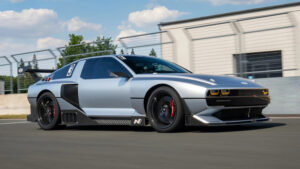


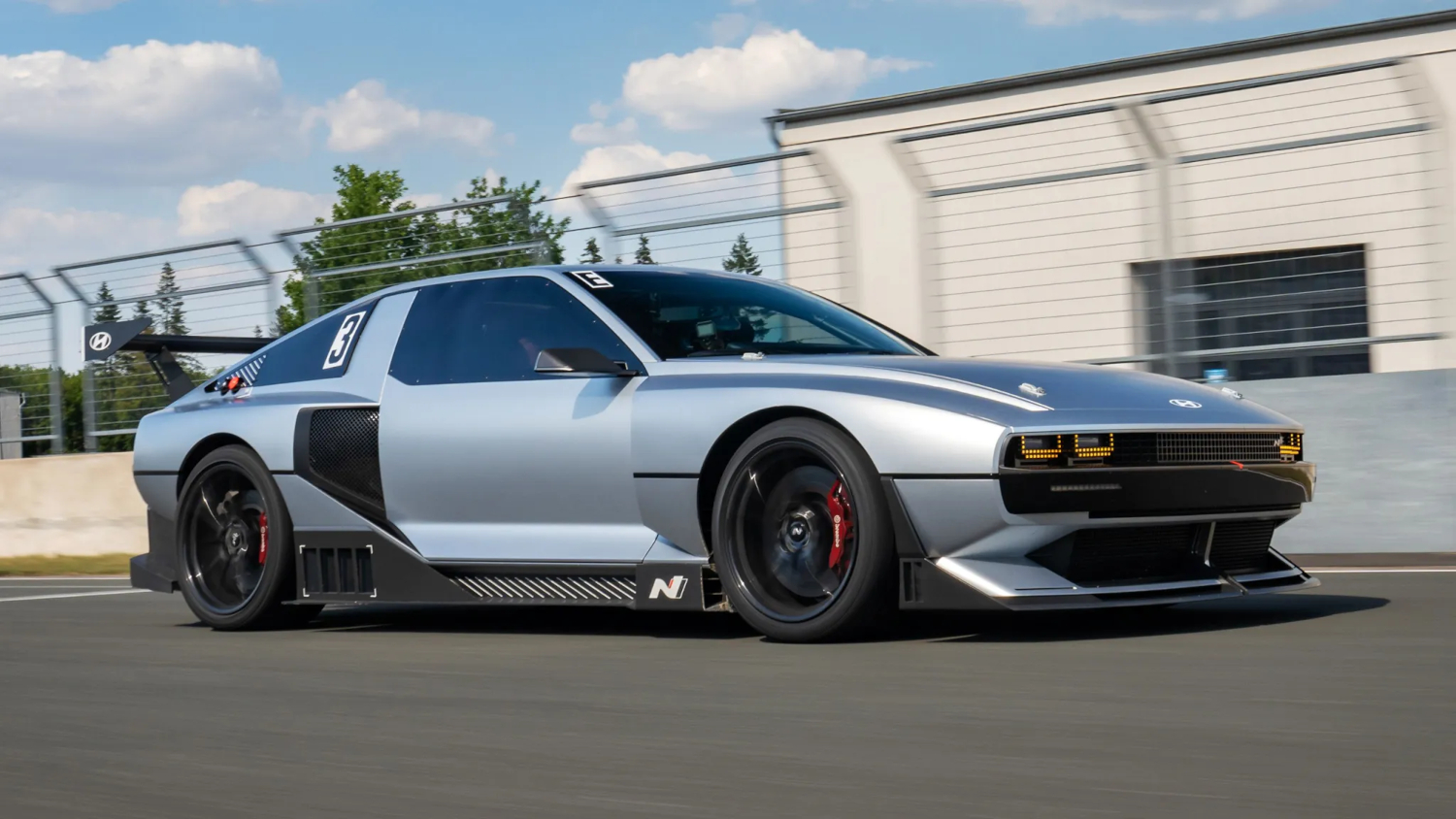
Hyundai built production clay and developed working prototypes on a Kia Stinger platform. They designed the interior. Then the business case stalled. Simon Loasby, Hyundai Design Center chief, confirmed to The Drive what enthusiasts feared: asked whether the N Vision 74 would ever reach production plans, his answer was blunt. “At the moment, no.” Not a vague concept-car dodge — a direct admission that the math couldn’t survive a low-volume ledger.
The Car That Could Have Been
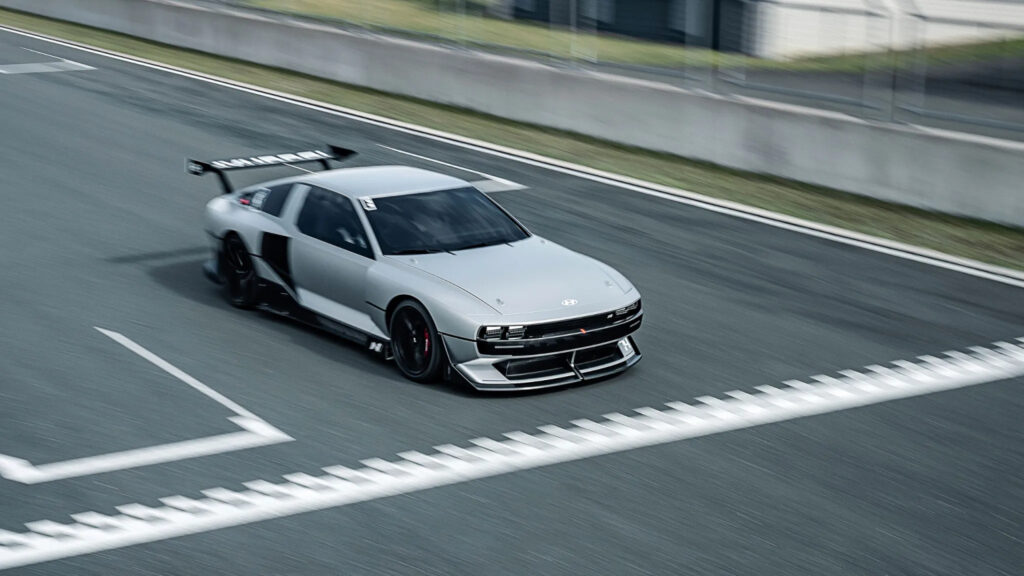
The N Vision 74 was never just a styling exercise — it was a functioning hydrogen-electric machine that proved Hyundai could think at that level.
This wasn’t a rendered fantasy. Hyundai built functioning examples carrying a 62.4-kWh battery, an 85-kW hydrogen fuel-cell stack acting as an onboard generator, and two rear motors producing more than 670 horsepower and 900-plus Nm of torque. Claimed range exceeded 600 kilometers, and hydrogen refueling took five minutes. The fuel-cell hardware came from the Nexo; the development platform from the Stinger. Watching the prototypes drift felt less like concept-car theater and more like genuine proof of concept — the kind that makes the eventual “no” genuinely sting.
So why isn’t it happening?
- Hyundai completed production clay and full exterior and interior development work
- The business case failed when evaluated strictly as a low-volume model
- Loasby acknowledged the car’s value shifts if brand-building impact is counted — but that recognition wasn’t enough for approval
- Car and Driver reported no production plans as far back as 2022, consistent with Loasby’s more recent comments
- The concept’s design DNA is migrating into the 2027 Elantra instead
“At the moment, no.” — Simon Loasby, Hyundai Design Center chief, to The Drive

The Legacy That Survived the Spreadsheet
The N Vision 74’s production future may be on hold, but its design influence is already reaching cars real buyers can own.
Loasby’s framing is worth sitting with. Hyundai recognized the N Vision 74’s brand-raising value internally — the company simply couldn’t greenlight a vehicle whose broader impact was harder to quantify than units sold. The prototypes ran. The concept drew serious design-world attention. What it couldn’t do was survive the spreadsheet as a standalone low-volume proposition.
What survived is unusually traceable. Loasby told The Drive that the new 2027 Elantra pulls directly from the N Vision 74 design “playbook” — the roof crease, flat roof profile, pillar treatment, wide fender forms, and wedge-like stance. The concept’s fingerprints are on a car that will actually reach driveways. The next Elantra N, Loasby suggested, is also expected to arrive substantially wider, echoing the widening approach Hyundai applied to the Ioniq 5 N and Ioniq 6 N — though no exact figure for the Elantra N has been confirmed.
The N Vision 74 follows a well-worn concept-car path: born to shift perception, stalled by economics, mourned by enthusiasts. What sets it apart is how clearly the inheritance runs. When the next Elantra N arrives wider and sharper, that connection to the N Vision 74 appears intentional — and perhaps that design migration was always a meaningful part of the concept’s purpose.