

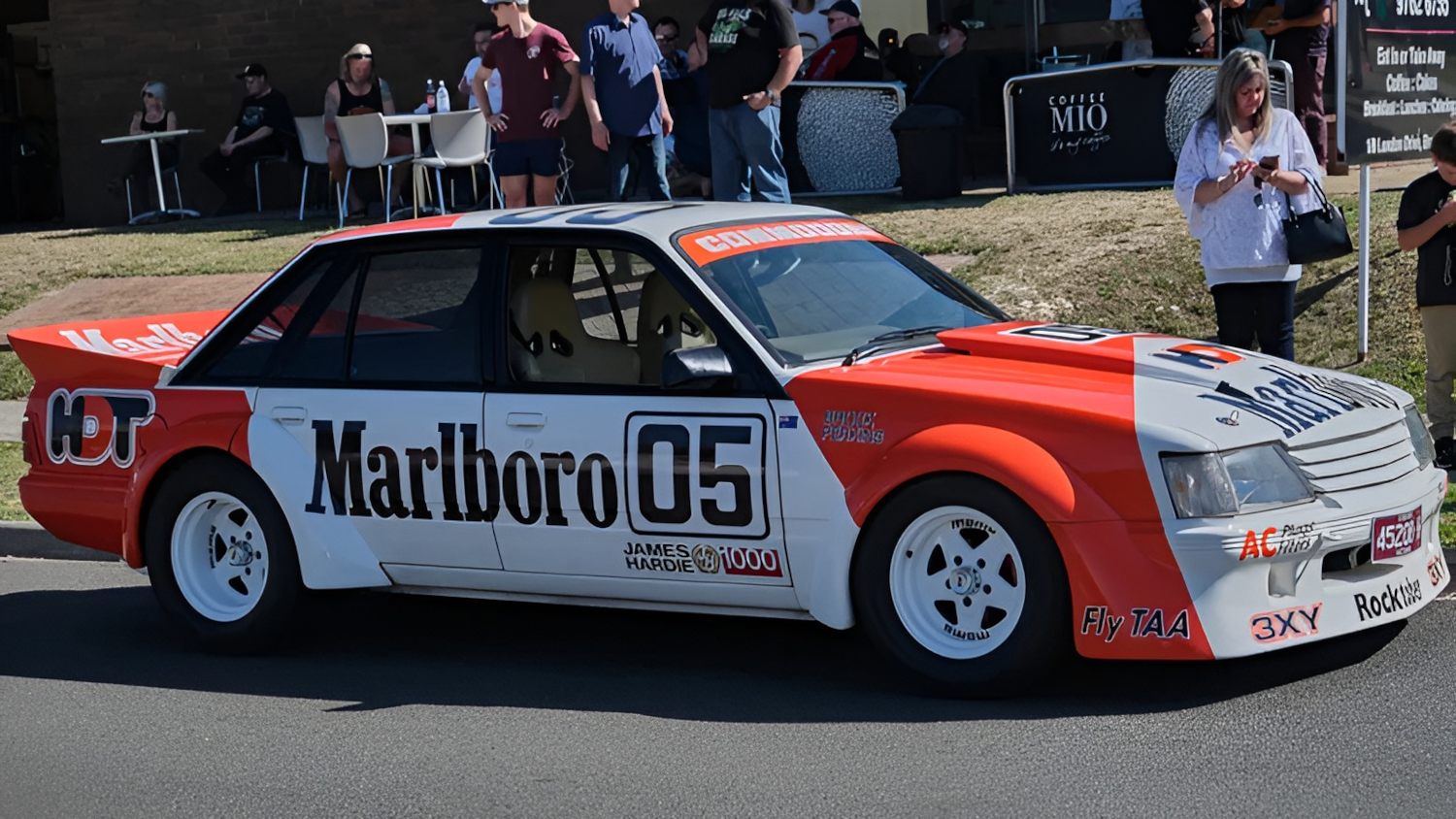
Viewers who tuned into Touring Car Masters at Sydney Motorsport Park in August 2026 got a Supercars replay and a message citing legal reasons. The race itself — period Falcons and Toranas doing what they were built to do — reportedly could not be broadcast. Not because anything had gone wrong on track. Because of what was painted on the cars.
A Law Written for Billboards Now Covers Bathurst Icons
A public health framework designed to stop cigarette companies from advertising is now catching privately owned race cars that haven’t carried an active sponsorship deal in decades.
Australia’s Public Health (Tobacco and Other Products) Act 2023 defines a tobacco advertisement as any communication likely to promote a regulated tobacco product. The definition is broad. It covers brand identifiers, logos, and recognizable visual treatments — meaning a gold-and-black color scheme or a distinctive red chevron may qualify, regardless of whether any tobacco company is currently paying a cent. Whether any particular livery satisfies that test remains fact-specific, but the risk is real enough that broadcasters are already acting on it.
Motorsport Australia subsequently updated its technical guidance, requiring that any livery “promoting, or likely to promote, a regulated tobacco product” be removed or covered. Critically, the burden of proof sits with the automobile owner, not the regulator.
Fox Sports did not broadcast the Touring Car Masters race at Sydney Motorsport Park in August 2026; viewers reportedly received a replay and a message citing legal reasons. Motorsport Australia’s revised rules apply specifically to historic, or “5th category,” automobiles — the very cars built to preserve earlier eras of competition. Previous rules recognized an exception for original cars that had officially licensed raced with tobacco sponsorship before December 24, 1992, drawing a clear line between authentic historic vehicles and later replicas or tribute builds.
Touring Car Masters competition manager Dean Bryant reportedly described the situation as a legal chain in which Fox Sports, Supercars and Motorsport Australia were each protecting themselves — leaving the car owner as the last exposed party. That characterization requires verification against his original statement before being treated as a direct quotation.
Restoration Work, Now a Legal Liability
Owners who spent years returning cars to exact period specification may now be required to conceal the very markings that give those restorations their historical meaning.
The preservation paradox is pointed. A competitor who painstakingly restored a Torana or Falcon to the livery it wore at Bathurst — right down to the correct typeface and color code — may now be required to cover those details to compete or appear on television. It is roughly equivalent to digitally scrubbing a band’s name from an archive concert poster to satisfy a rights dispute: the document survives, but its historical record does not.
The previous framework at least distinguished between authentic original cars and later replicas or tributes, offering a clearer path for genuinely historic vehicles. The newer guidance appears to reduce the practical significance of that distinction by applying the promotion test to historic automobiles as a category.
No specific historic-motorsport exemption has been identified in the materials reviewed under the 2023 Act. The available sources do not confirm a formal appeal process or a scheduled further revision to Motorsport Australia’s guidance. The cars can still race — they just may not be able to look like themselves doing it.