

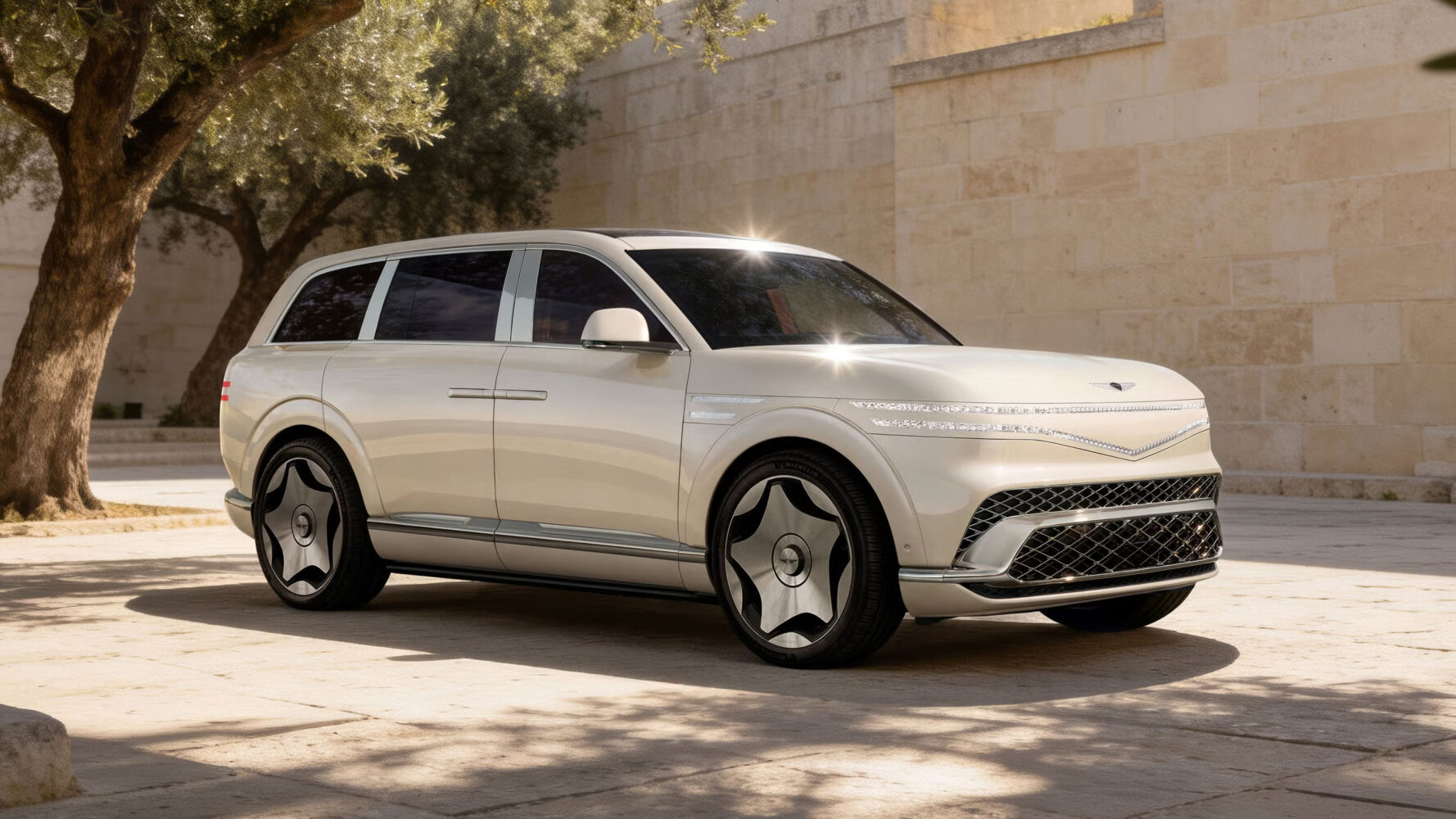
Those doors open like a curtain call. Both front and rear swing wide simultaneously — rear-hinged at the back, forward-hinged at the front — leaving an enormous, column-free opening where a door frame used to be. No B-pillar in sight. Bystanders at curbside could be forgiven for scanning the area for a film crew. This is Genesis’s new flagship electric SUV, and it has decided that boarding deserves to feel like an event. For those curious about cars coming from other brands that share this level of ambition, the landscape is rich.
Coach Doors That Earn the Drama
The GV90 Neolun turns a simple curbside arrival into something closer to a theatrical entrance.
The GV90 Neolun’s party trick is the Neolun Arch Gate — what Genesis claims is the world’s first independently opening hidden B-pillar coach door system on a production SUV. The B-pillar (the structural column between front and rear doors on most vehicles) is integrated directly into the rear door itself, appearing only when closed. A dual-motion hinge slides the rear door backward before swinging it outward, creating theater and clearance simultaneously. Genesis says substantial structural reinforcement makes this safe — not just cinematic. It signals something the European luxury establishment should probably pay attention to.
Key specs worth knowing:
- 657 horsepower and approximately 590 lb-ft of torque from a dual-motor all-wheel-drive system
- A 124 kWh battery — the largest ever fitted to any Hyundai Motor Group vehicle
- Estimated range of approximately 310 miles (internal testing; EPA certification pending)
- 10–80% charge in roughly 22 minutes on a 350-kW DC fast charger
- 208 inches long — physically larger than the Mercedes-Benz EQS SUV
A Cabin That Borrowed From the Wrong Industry (in the Best Way)
Inside the Neolun First Edition, the boundaries between luxury SUV and boutique hotel suite become genuinely difficult to locate.
Step through that dramatic opening and the GV90 Neolun First Edition greets occupants with a four-seat VIP layout, individual rear chairs, veneer wood floors, and wool-cashmere upholstery in color combinations — indigo with green, purple with beige — that feel lifted from a boutique hotel’s design brief. The front seats swivel 180 degrees for lounge mode, turning the cabin into a face-to-face social space when parked. Think business-class suite, minus the airline.
A 23.6-inch OLED display running Genesis’s Pleos Connect software rises an additional 3.4 inches when parked, enabling proper cinematic viewing between stops. There’s no start button; the car simply wakes when the door opens.
“The GV90 embodies a new era of luxury mobility,” according to Genesis, presenting the Neolun as a vehicle that redefines what a flagship SUV can offer its occupants.
Honest About the Tradeoffs
At an estimated price approaching $150,000, the GV90 Neolun asks buyers to weigh an extraordinary interior against a range figure that isn’t class-leading.
That 310-mile range is competitive — and it’s also not the top of the segment. Rivian and Lucid both clear 400 miles in their respective flagships. Genesis is making a deliberate bet: prioritize the experience inside over the number on the spec sheet. Whether that’s wisdom or vulnerability depends entirely on how often passengers notice the wood floors versus the charging stop.
Pricing remains unconfirmed. Automotive analysts estimate the standard three-row GV90 will start in the low $100,000s, with the Neolun approaching $150,000 — Maybach territory, earned or not. Availability is expected in the 2027–2028 timeframe.
For luxury road travelers, the real question isn’t the range. It’s whether a 22-minute charge stop, spent facing a travel companion across wool-cashmere seats while a 23.6-inch screen plays something worth watching, still counts as an inconvenience.