

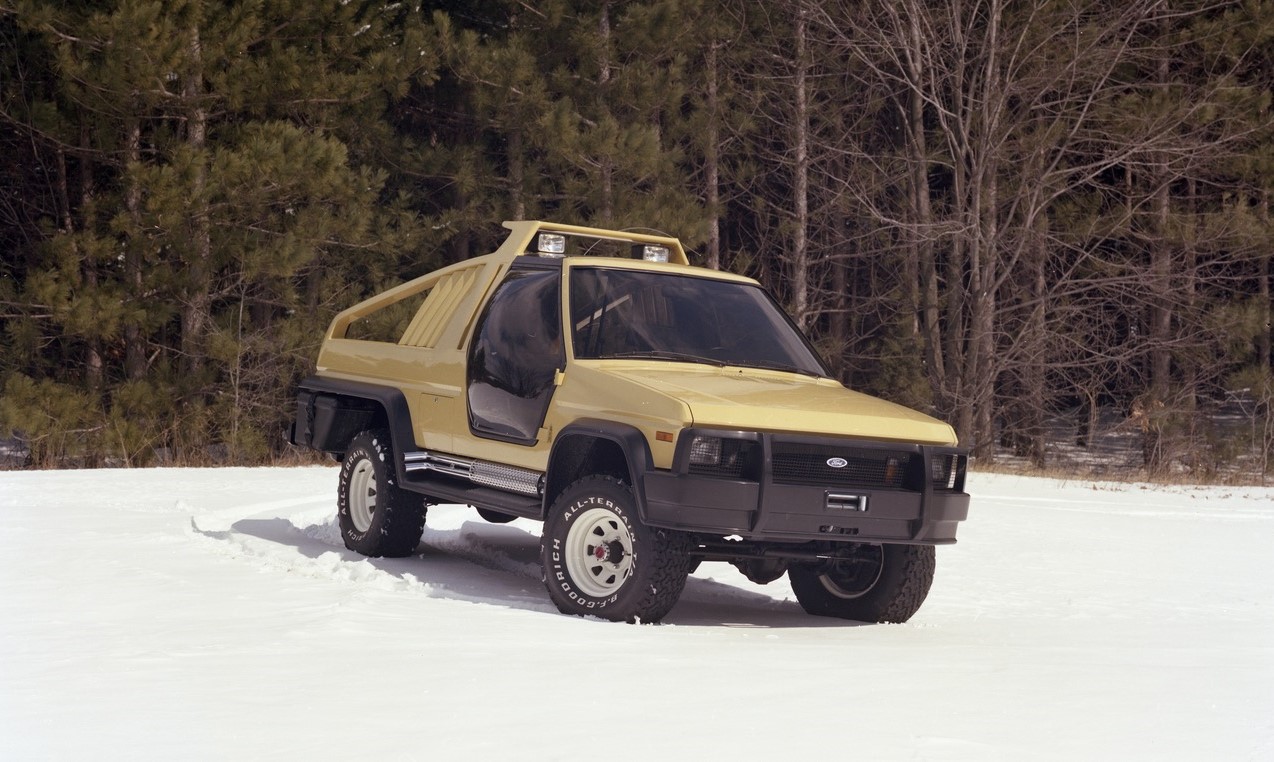
The 1980 Ford Montana Lobo concept challenged every assumption about truck design with its radical transparent bubble doors. During the economic uncertainty of the early 1980s, when automotive manufacturers typically favored conservative approaches, Ford’s design team envisioned a Bronco that appeared ready for interplanetary exploration rather than traditional off-road adventures.
This experimental vehicle abandoned conventional hinged doors in favor of transparent acrylic bubble canopies that lifted upward, resembling fighter aircraft cockpits. The innovative design addressed practical concerns beyond visual impact, potentially offering improved entry and exit accessibility while maintaining protection from environmental elements. The elevated seating position and transparent barriers could have provided enhanced visibility for occupants.
Design That Defied Truck Conventions
The Montana Lobo represented Ford’s willingness to explore unconventional automotive solutions during a period of design experimentation.
The concept vehicle emerged from Ford’s research and development initiatives, when creative freedom preceded market research constraints. The Montana Lobo incorporated several distinctive features that distinguished it from traditional Bronco models:
- Angular, wedge-shaped body panels that departed from conventional truck aesthetics
- Integrated safety structures visible through the transparent canopies
- Advanced dashboard configuration emphasizing modern instrumentation
- Maintained off-road capabilities consistent with Bronco heritage
- Distinctive metallic finish that reinforced the vehicle’s futuristic character
Ford approached the Montana Lobo as a design study rather than a production candidate. The bubble door system would have presented significant engineering challenges related to safety regulations, manufacturing complexity, and production costs that made commercial viability unlikely.
Legacy of Automotive Dreaming
This concept vehicle exemplified the era when automotive design exploration pushed boundaries without commercial constraints.
The Montana Lobo captures a distinctive period in automotive history when concept vehicles represented genuine design experimentation rather than subtle previews of upcoming production models. Contemporary Bronco designs emphasize heritage and nostalgia, while the Montana Lobo explored possibilities for completely reimagined truck architecture.
The concept’s current location appears uncertain, though it may be preserved within Ford’s historical vehicle archives. While the bubble door innovation never reached production vehicles, it demonstrates the creative potential that emerges when designers question fundamental automotive assumptions.
This largely forgotten concept serves as a reminder that meaningful automotive innovation requires asking fundamental questions about vehicle design, even when those explorations prove commercially impractical.