

Formula 1’s relentless chase for speed guarantees that countless engineering concepts hit the drawing board, yet many of the most radical designs never see a single race. These machines represent breakthroughs, pushing the boundaries of what’s mechanically possible, only to be stopped by regulation or pure physics. The sport’s rulebook has killed more promising ideas than any trackside barrier ever could. Their “what-if” legacy profoundly impacted motorsport engineering development, even from the sidelines.
1. Lotus 88

Colin Chapman’s twin-chassis masterpiece ran afoul of the rulebook before it could prove its revolutionary concept.
Colin Chapman’s 1981 Lotus 88 answered a simple question: what happens when engineering brilliance clashes with the rulebook? The car featured a twin-chassis design. An inner chassis carried the driver, engine, fuel tank and suspension, while an outer chassis carried the aerodynamic bodywork, sidepods, skirts and wings, each sprung independently.
This innovative setup employed a cutting-edge carbon-fibre monocoque reinforced with Kevlar, making the car remarkably light at around 585 kg without the driver. Power came from the classic Ford Cosworth DFV 3.0 L V8, producing around 490 bhp. Elio de Angelis and Nigel Mansell both felt the difference during testing; anyone who has survived an eight-hour haul in a questionable daily driver knows why driver comfort matters.
However, officials deemed the outer chassis a banned movable aerodynamic device before the car could ever race. The Lotus 88 appeared at practice sessions in 1981 (including Long Beach) but never started a Grand Prix. Officials pulled the plug on a potentially championship-winning concept, leaving an enduring “what-if” question that haunted the grid for years.
2. Williams FW07D
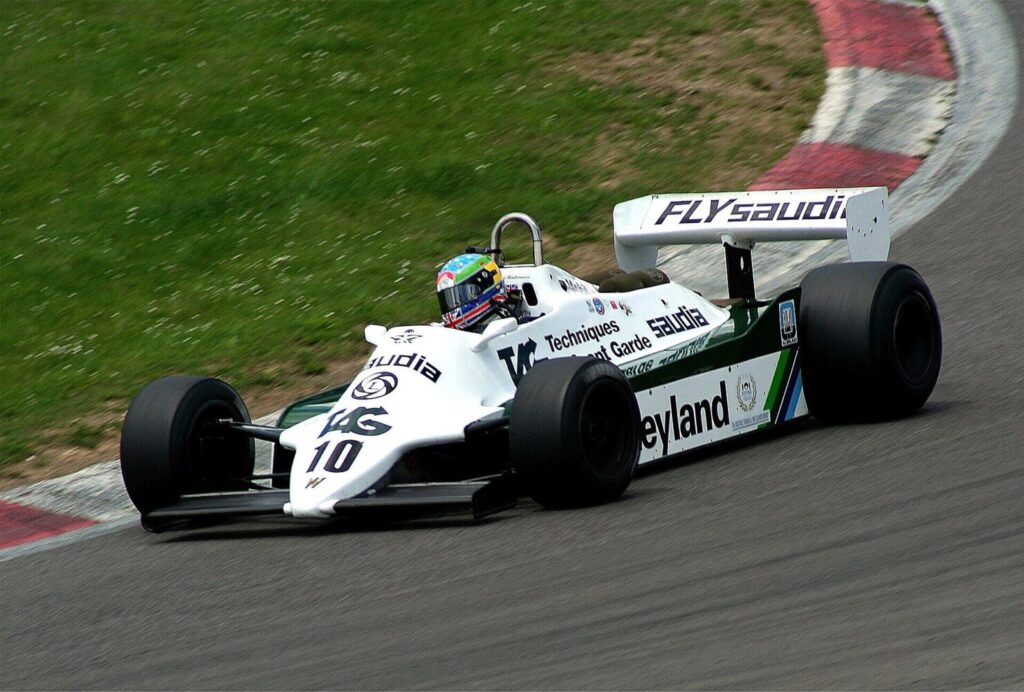
Williams’ experimental six-wheeler proved the concept but arrived just before the rulebook slammed shut.
A 510 bhp Cosworth DFV 3.0 L V8 engine roared, pushing an experimental Williams FW07D around the track in late 1981. This wasn’t some back-alley hot rodder bolting on slicks, but a serious engineering effort to gain a performance edge. The concept mirrored Tyrrell’s multi-wheel idea but placed four driven rear wheels at the back, aiming to reduce drag, improve mechanical traction and maintain a large tire contact patch with smaller rear wheels.
The FW07D retained Williams’ proven Cosworth DFV foundation, with a modified Hewland transmission and twin differentials driving both rear axles. Four small rear wheels of similar size to the front, all powered, improved traction and airflow to the rear. Drivers like Alan Jones (notably at Donington Park after the 1981 Caesars Palace GP), Keke Rosberg, Jonathan Palmer and others tested the car. Reports suggested the FW07D handled well and showed encouraging performance.
The car remained a pure test car that never raced, but it laid critical groundwork. Williams proved the six-wheel concept worked, directly leading to development of the later FW08B six-wheeler. The FW07D was written out of the script before its premiere.
3. Williams FW08B

The FIA limited F1 cars to four wheels just as Williams perfected the six-wheel concept.
The FIA’s decision in 1982 to limit Formula 1 cars to four wheels, with only two driven, abruptly ended the career of the Williams FW08B before it even began. This engineering marvel sported three axles and six wheels, with four driven rear wheels designed to reduce drag and enhance traction while maintaining airflow along the sidepods to the rear.
The FW08B was a six-wheel concept based on the 1982 FW08 chassis. It retained a naturally aspirated Cosworth DFV V8 engine, with a specially modified transmission package and differential arrangement to drive both rear axles. Drivers like Keke Rosberg, Jonathan Palmer and Jacques Laffite tested the car in 1982. Period reports described strong mechanical grip and promising performance.
The car never appeared in a World Championship race. The FIA updated technical regulations to limit F1 cars to four wheels with only two driven, effectively banning six-wheel, four-wheel-drive designs before the FW08B could race. Only a small number of FW08B prototypes were built; at least one has been restored by Williams and occasionally runs at special historic events.
4. Honda RC100

Honda’s secret F1 prototype passed crash tests and proved feasibility but never left Tochigi.
After withdrawing from Formula 1 as an engine supplier in 1992, Honda launched a quiet, internal project at its Tochigi R&D Center. The Honda RC100 emerged as a complete F1 prototype finished around 1993. This was a technical study; a stealth mission for younger Honda engineers to gain hands-on experience designing a complete F1 chassis and to explore the feasibility of a future full Honda works team.
The car used a carbon-fiber monocoque chassis and was powered by a reworked Honda RA121E/RA122E V12 derived from Honda’s 1991–1992 F1 engine program. Displacement sat around 3.5 L, with power output in the 770 hp range according to most sources (some quote higher figures up to 880 hp in different tuning specifications). The RC100 was completed around 1993 and initially tested at Honda’s Suzuka Circuit, including crash-test and track work to verify compliance with FISA/FIA safety regulations.
The RC100 reportedly passed an official crash test, proving it could have raced legally under 1993 regulations if Honda had chosen to enter. According to historical accounts, Honda president Nobuhiko Kawamoto personally drove an early version at the Tochigi test track, reflecting high-level interest despite the project’s unofficial status. Yet this formidable machine never saw a race grid, remaining a powerful “what if” in racing folklore.
5. Honda RC101
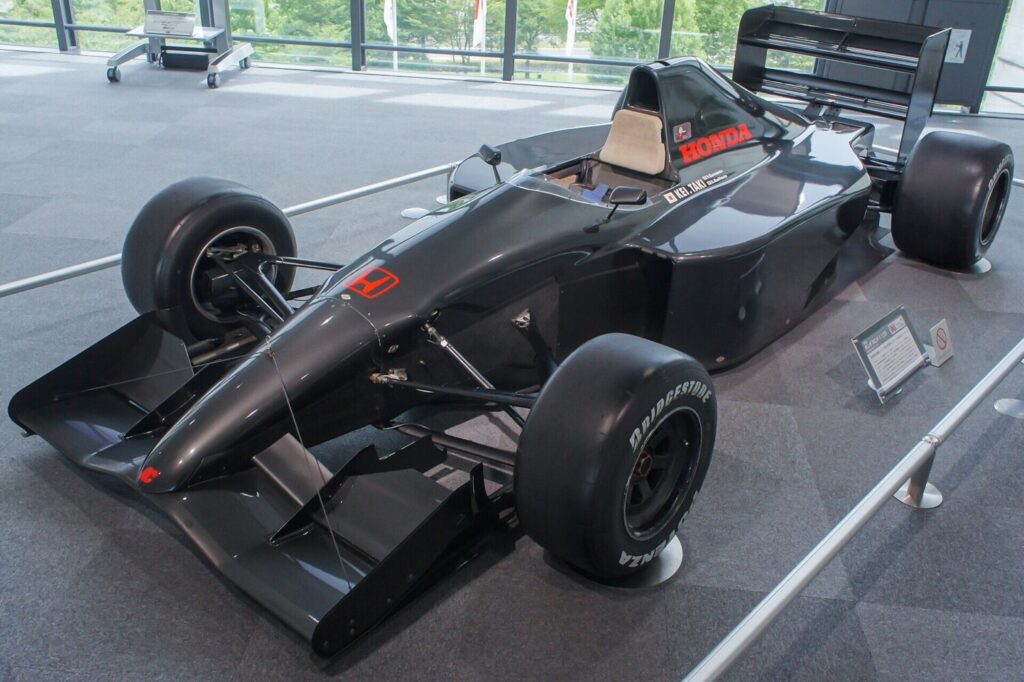
The second evolution addressed aerodynamic weaknesses and passed FIA crash testing in March 1993.
March 1993 marked a critical compliance milestone when the Honda RC101 prototype passed its official crash test. The second evolution of Honda’s secret F1 prototype program was designed to address aerodynamic weaknesses of the RC100 and fully meet 1993 Formula 1 regulations.
The RC101 used a stiffer carbon-fibre monocoque and an updated Honda RA122E V12 engine. Output sat around 770 hp at 14,500 rpm, linked to a titanium semi-automatic gearbox. Former F1 driver Satoru Nakajima acted as principal test driver at Suzuka, helping Honda refine suspension, balance and drivability as part of evaluating a possible works team.
The RC101 underwent FIA/FISA crash testing and reportedly passed an official crash test in March 1993, confirming chassis compliance with contemporary F1 safety standards. The project remained internal; cars were used extensively for testing but were never entered in a Grand Prix, with some early chassis later destroyed in crash tests. The RC101 was a key step in Honda’s 1990s exploration of building complete F1 cars, preceding both the RC101B and later official test projects like the RA099.
6. Honda RC101B
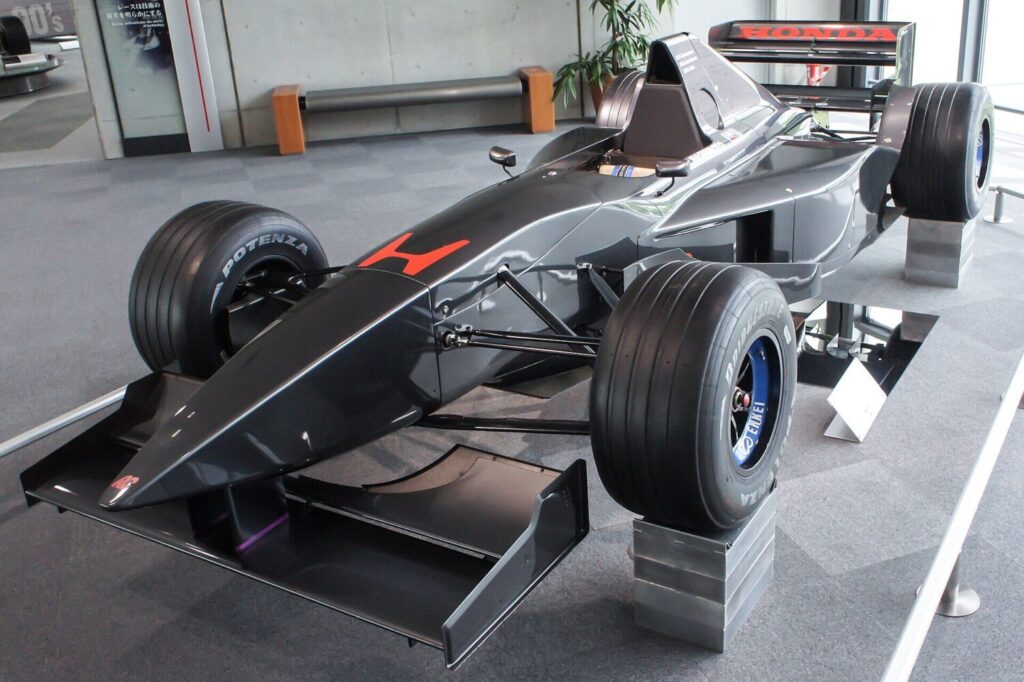
Honda’s most advanced secret prototype adapted to post-Imola regulations but arrived as the economy turned.
A 3.0 L Mugen-Honda V10 screamed 670–710 hp at roughly 13,500 rpm from the heart of the Honda RC101B. Developed around 1994–1996, this Formula 1 prototype was Honda’s response to post-Imola safety rule changes. The third and most advanced car in Honda’s early-1990s secret F1 program featured updated aerodynamics including a raised nose and stepped bottom (staged floor) to comply with new regulations, drawing inspiration from contemporary cars like the Benetton B193, Lotus 107 and Footwork FA13.
Unlike earlier V12-powered prototypes, the RC101B used a 3.0 L Mugen-Honda V10 engine (MF-351H in some sources), producing roughly 670–710 hp at around 13,500 rpm, paired with a Honda semi-automatic 6-speed gearbox. The car’s chassis weight sat around 510 kg, and it used grooved Bridgestone tyres to Japanese F3000 specification, reflecting its dual role as a development and compliance test platform.
The RC101B had its first public outing at Suzuka in January 1994, driven by Satoru Nakajima. The car later remained part of Honda’s collection; some sources note examples displayed at the Honda Collection Hall at Twin Ring Motegi from the early 2000s. Although technically capable and crash-test compliant, the broader economic slowdown and strategic decisions meant Honda eventually shelved the idea of entering F1 as a constructor, ending the RC100/101/101B program without a race debut.
7. Dome F105

Running 7 seconds off pole pace and 0.3 seconds outside the 107% rule killed Dome’s F1 dreams.
Running 7 seconds off the pole pace at Suzuka in 1996 sounded like a death knell for any Formula 1 aspirant. The Dome F105, a carbon-fibre and aluminium honeycomb monocoque designed by engineer Akiyoshi Oku, was built by Japanese constructor Dome in 1995–1996. The chassis was intended as the basis for a fully Japanese F1 team targeting entry around the 1997 season.
The car packed a Mugen-Honda MF-301H 3.0 L V10, in 1995 Ligier spec, producing about 670–690+ hp at 13,500–15,800 rpm depending on tune. Transmission was a 6-speed sequential semi-automatic supplied by Xtrac/DAMS/Minardi. Only one complete F105 chassis was built. It underwent extensive testing at Suzuka and other circuits with drivers including Marco Apicella, Naoki Hattori and Shinji Nakano.
Test driver Marco Apicella reported predictability through the chassis, a promising sign. However, Suzuka testing revealed a brutal reality: the car ran laptimes roughly 7 seconds off contemporary pole pace, leaving it 0.3 seconds outside the 107% qualifying cutoff. Funding and sponsorship proved the major obstacle; combined with performance limitations and a serious testing fire that damaged the sole chassis, Dome abandoned its planned F1 entry before submitting an official entry. The F105 remained a pure test car. The F105 now appears in Dome’s own museum/archives and is often cited as a prominent example of a promising but unrealized 1990s F1 newcomer.
8. McLaren MP4-18

Adrian Newey’s radical 2003 design failed spectacularly but informed the MP4-19.
The McLaren MP4-18 (sometimes written MP4/18) was a radical Formula 1 car developed for the 2003 season by McLaren Racing, designed chiefly by Adrian Newey, Mike Coughlan and Neil Oatley. The car pushed design limits with an exceptionally compact package, very low bodywork, tightly packaged cooling system and aggressive aerodynamics aimed at reducing drag while maximizing downforce.
This low-profile chassis promised peak performance from its Mercedes-Benz FO 110P/FO110M 3.0 L V10 engine (developed with Ilmor), rated around 850+ hp at up to 18,500 rpm, mounted low to reduce the center of gravity. The MP4-18 first tested publicly at Paul Ricard on 21 May 2003 with Alexander Wurz driving.
Subsequent tests revealed severe reliability and cooling problems. The car suffered repeated mechanical failures, overheating of engine and gearbox, and crashes. The MP4-18 reportedly struggled to pass FIA crash tests and was considered unsafe. Newey later described fundamental problems with aero-induced vortices around the sidepods and the cooling layout, which fundamentally compromised the concept.
Because of its problems and the competitiveness of the existing MP4-17D, team principal Ron Dennis chose never to race the MP4-18. McLaren continued with the older car, allowing Kimi Räikkönen to fight Michael Schumacher for the 2003 title and lose by only two points. The MP4-18 program nevertheless informed the design of the McLaren MP4-19 for 2004. Four MP4-18 chassis were reportedly built, with at least one never run. Actual test footage remains scarce, contributing to its reputation as F1’s most famous unraced car.