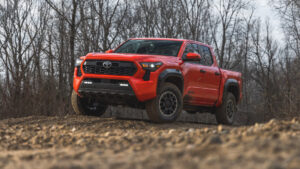


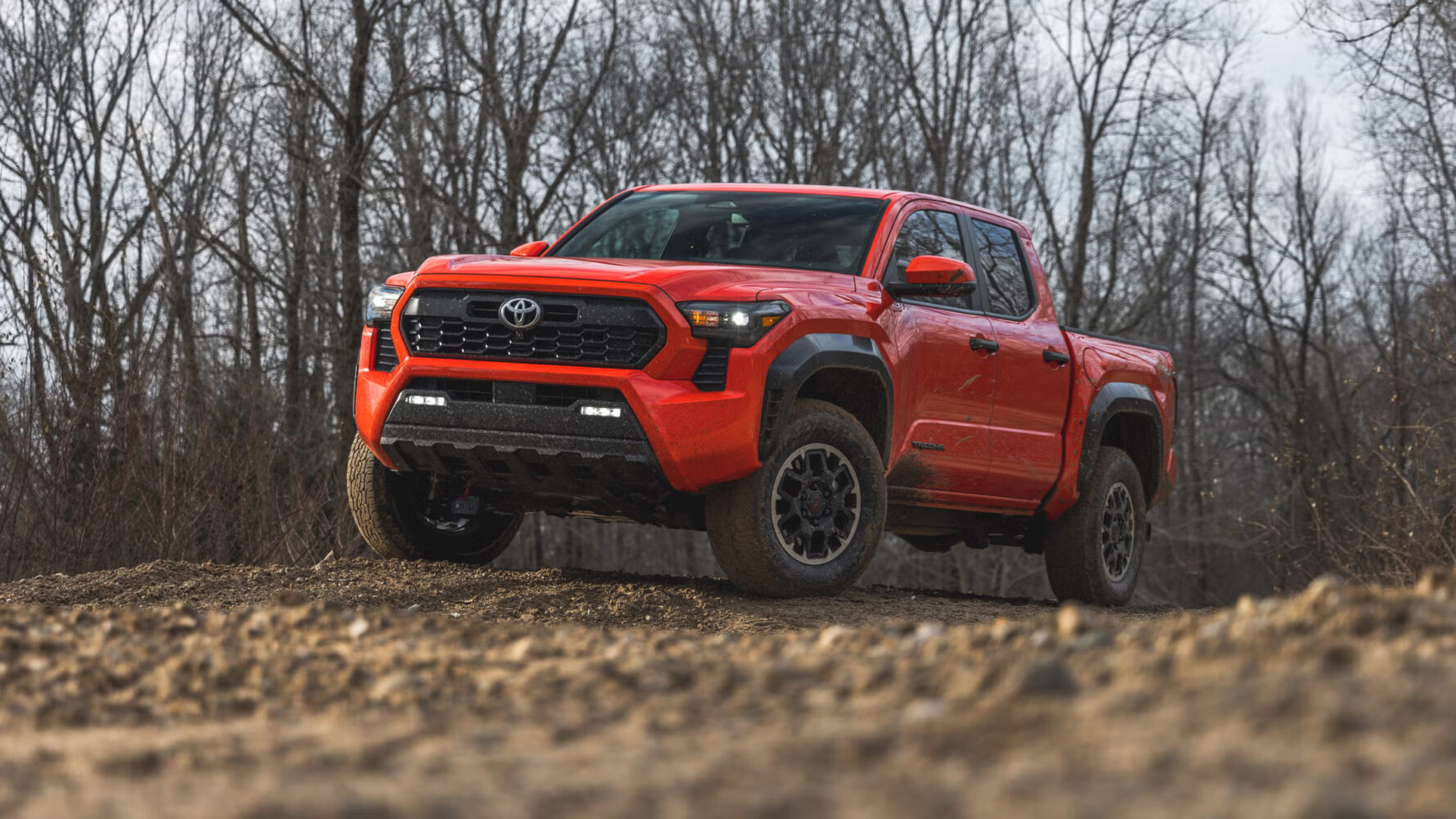
A suspension component detaching from a moving truck and landing in the path of the car behind it — that’s not trail damage. That’s a safety recall. Toyota has initiated NHTSA recall campaign 26V514, covering approximately 48,280 2024–2025 Tacoma TRD Off-Road trucks in the U.S., plus roughly 3,500 in Canada. If you own a TRD Off-Road or 2024 Hybrid TRD Off-Road, this affects you. SR, SR5, TRD Sport, Limited, TRD Pro, and Trailhunter owners are not part of this campaign.
The Part That’s Failing – And Why
Off-road hardware designed for rocks and ruts is being undone by something far more ordinary: road salt.
Bilstein monotube shocks with piggyback-style external oil reservoirs — small canisters mounted alongside the shock body to improve suspension travel and keep fluid cool under hard use — are standard equipment on TRD Off-Road models. The defect centers on the welded flange that connects the reservoir to the shock body. An untreated metal surface at that junction has no protection against the environment. Salt spray, moisture, and rock chips — the ordinary reality of truck ownership — corrode it over time. That corrosion expands, puts pressure on the weld, the weld fails, and the reservoir separates from the shock while the truck is moving.
Four facts confirmed by NHTSA’s Part 573 filing:
- 48,280 U.S. trucks and approximately 3,500 Canadian trucks are covered
- Both front and rear shock assemblies are involved
- Toyota first identified the issue in September 2025 after two leaky-damper complaints; a missing reservoir discovered during a dealer inspection triggered the full investigation
- By late July 2026, Toyota had logged 20 field technical reports and 62 warranty claims
Toyota’s official recall language is unambiguous: “If the reservoir detaches while driving, it can create a road hazard, potentially increasing the risk of a crash or injury to another road user.” — Toyota Motor North America
Toyota filed the formal NHTSA Part 573 report on August 6, 2026 — the same day dealer notifications began. Owner letters are expected to arrive by October 5, 2026. No universal stop-drive order exists in the official documentation, but the hazard is real. A detached reservoir at highway speed is not a minor fluid leak; it becomes debris for whoever is driving behind you.
What Owners Should Do Now
The repair is free, the steps are straightforward, and parts availability may not wait.
Owners can check their VIN at Toyota’s recall portal or the NHTSA database without waiting for a mailed letter. For direct questions:
- Toyota’s customer service line: 1-800-331-4331
- NHTSA vehicle safety hotline: 888-327-4236
Once confirmed, schedule a dealer visit — inspection and full replacement of affected front and rear shock assemblies is covered at no cost, parts and labor included.
Worth noting: Toyota needs to manufacture an estimated 193,000 replacement shocks to service all affected vehicles, which may create wait times as demand builds. Booking sooner rather than later is practical advice.
As NHTSA’s Safety Recall Report 26V514 states: “The corrosion buildup can create an expansive force on the welds securing the reservoir to the shock absorber, which can lead to weld failure.”
The trucks are not under a stop-drive order. But a suspension component that can separate at speed and land on a public road is not something to schedule around a vacation or a busy week. Check the VIN, book the appointment, and take the free repair. That’s the move.