

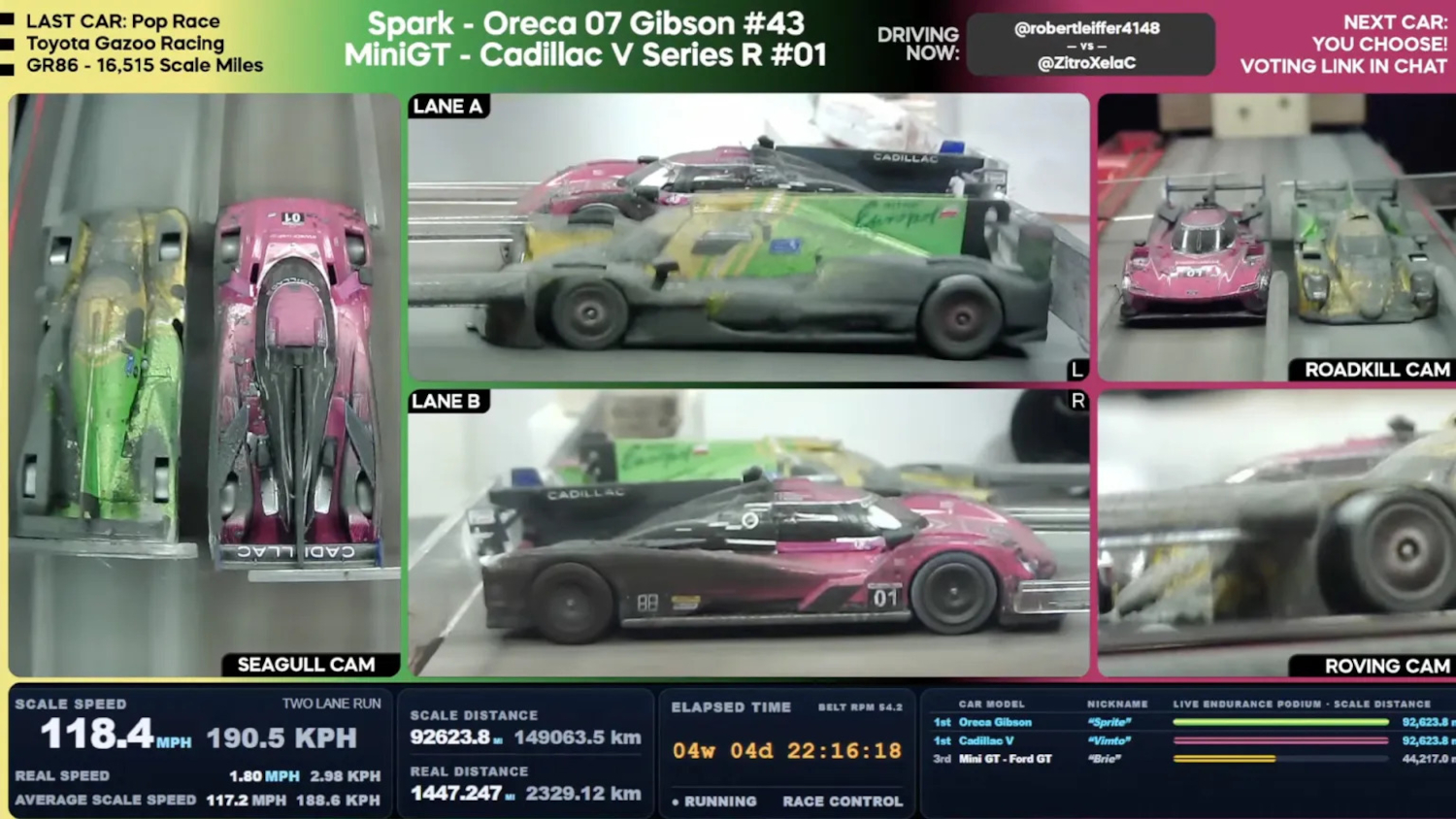
Two miniature race cars have been spinning on a homemade rolling-road rig since September 20 — and as of late October, neither has stopped. This is Diecast Endurance Run No. 10, hosted by Mr. Endurance on his YouTube channel. The competitors: a Spark Oreca Gibson and a MiniGT Cadillac V. Both are collectible scale models. Neither appears documented as a continuous endurance-test product. That gap between shelf life and experimental reality is precisely what makes the project worth watching.
What “Endurance Racing” Looks Like at 1:64 Scale
A homemade rig, multiple camera angles, and axle loads no product description ever prepared these cars for.
The setup is straightforward: two lanes, continuously spinning belts, cars retained in fixed positions. According to the channel’s own presentation, several persistent camera views — including overhead, side, and front angles, plus a dedicated feed tracking the Oreca’s increasingly unstable wheel — broadcast sessions across successive updates. Think Lo-Fi beats livestreams, except instead of a cartoon character studying, two plastic prototypes slowly work through their mechanical limits for an audience of collectors and motorsport fans. Axles, wheel hubs, and soft body components face sustained friction loads they were apparently never engineered to handle.
Key details, as reported by Diecast Endurance:
- The run has surpassed 784 hours of continuous operation, according to the channel’s Hour 784–795 update
- Based on wheel rotation, the channel estimates the cars have covered approximately 1,400 real-world miles — or roughly 92,600 miles scaled to full-size proportions (these are model-based calculations, not independently verified travel distances)
- Viewers vote on future entries, and the channel maintains a reliability ranking across multiple runs
- If the Oreca fails first, Mr. Endurance says the Cadillac will move onto its own belt for a separate solo endurance attempt
When Composure Becomes a Moving Target
The Cadillac looked steady — until the hours started telling a different story.
The two cars are not wearing evenly. The Oreca developed visible wheel wobble, and channel updates document its behavior shifting over successive milestones — at one point appearing to stabilize, then later footage showed it jumping more than the Oreca, a reminder that mechanical composure is a temporary condition, not a fixed trait. Like the Mini Porsche that tests the boundaries of miniature engineering, these models reveal unexpected behavior under sustained stress.
Mr. Endurance has indicated that if the Oreca fails first, the Cadillac will move to its own belt, producing both a head-to-head result and a separate solo endurance mark — a structure that extends the experiment beyond a simple knockout.
What the run actually surfaces is construction detail that display use would never expose: axle behavior under sustained load, wheel-hub wear, and dirt accumulation. These are collectible models apparently subjected to conditions well outside their standard use. One wobbles unpredictably; the other jumps. The tension between the two, and the uncertainty about which will hold longer, is exactly what keeps the audience returning across each new update.
The Real Race Is Against Irrelevance
Shelf ornaments become stress-test subjects — and the channel’s viewers are already deciding what runs next.
Diecast Endurance has built an unusually transparent experiment: a slow, observable, self-reported process in which the mechanical limits of scale models play out in real time across hundreds of hours of footage. Viewers are voting on which car enters the next run, and the channel’s reliability rankings give each result weight beyond the individual contest. According to Mr. Endurance, the rig is intended to keep running regardless of which car fails first — making the outcome a beginning as much as an ending.