


The 2025 model year covers significant ground — from a compact European EV priced for real-world accessibility to a full-size American electric truck that can power a house during an outage. Engineers have made genuinely notable advances in autonomous driving systems, powertrain efficiency, and cabin technology across all nine of these vehicles. Here is what each one actually offers.
9. Honda 0 SUV and 0 Saloon (Exterior)

Honda’s 0 series brings minimalist Japanese design philosophy to electric vehicles, built in Ohio for the American market while maintaining Honda’s global design language. The 0 SUV takes a crossover coupe profile that maximizes interior volume while prioritizing aerodynamic efficiency. The 0 Saloon presents a fastback silhouette with an integrated spoiler that activates at highway speeds for downforce without disrupting the clean body lines. Both models offer flush door handles and camera-based side mirrors on premium trims, with conventional mirrors available as standard.
Honda 0 SUV and 0 Saloon (Interior)

The Level 3 automation system handles lane changes and navigation autonomously under specified highway conditions, removing the need for constant driver supervision during long-distance driving. The Asimo interface learns preferred routes, adjusts regenerative braking strength based on driving habits, and stores individual preferences for ambient lighting, display configurations, and climate settings activated on driver recognition. Sustainable cabin materials include recycled ocean plastic fabric and responsibly sourced wood trim throughout.
8. Nissan Murano 2025 (Exterior)

The redesigned 2025 Murano draws design cues from the Nissan Ariya, replacing the previous generation’s relatively anonymous styling with organic lines and a V-motion grille that communicates the brand’s current design direction. A floating roof adds visual interest without reducing headroom. Aerodynamic improvements reduce wind noise and improve efficiency, and the distinctive light signature is recognizable at distance in both day and night conditions.
Nissan Murano 2025 (Interior)

ProPilot Assist manages lane position and following distance on the highway, reducing driver workload during long stretches. The turbocharged four-cylinder delivers more refinement than the outgoing V6 while improving efficiency. Premium trims include ventilated seats with five massage patterns, a redesigned center console that balances physical controls with digital interfaces, and rear USB-C charging, climate controls, and adequate legroom for taller passengers.
7. Ram 1500 REV (Exterior)
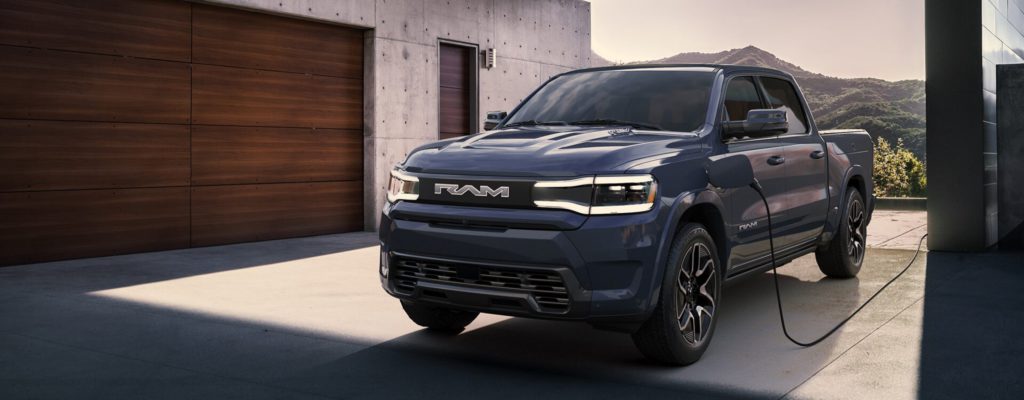
The Ram 1500 REV replaces the traditional grille with an illuminated badge and adaptive LED headlights, producing a front end that is distinctly Ram while reflecting the electric platform’s packaging freedom. Active air suspension lowers the vehicle at highway speeds to reduce drag and extend range. Integrated side steps deploy quietly on approach, and 120V outlets in the bed make the REV a functional mobile power source for job sites or outdoor use.
Ram 1500 REV (Interior)
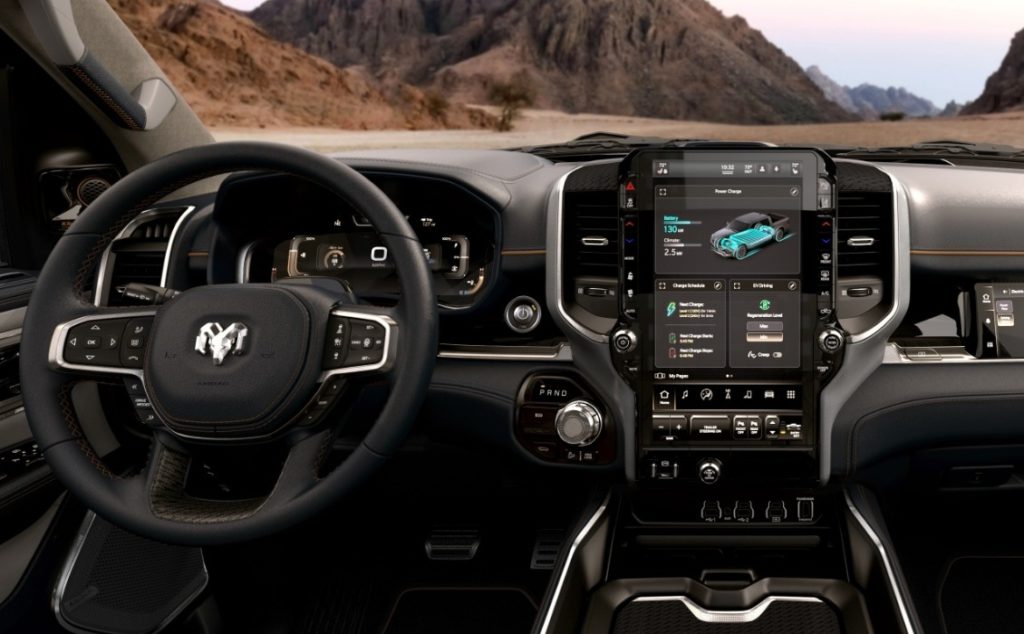
The flat floor created by the electric platform opens up cabin space that conventional drivetrain packaging cannot match, with a large center console and under-seat storage that holds tools securely. The bi-directional charging system can power a home for up to three days during an outage — a genuinely useful capability for areas with unreliable grid service. The 800V fast-charging system adds approximately 100 miles of range in under 20 minutes, and independent rear suspension delivers ride quality that body-on-frame leaf-spring setups cannot approach.
6. Toyota 4Runner 2025 (Exterior)

The 2025 4Runner updates the exterior with sharp LED headlights and a revised front fascia while preserving the body-on-frame proportions that define the nameplate’s off-road identity. Bulging fender flares accommodate serious wheel articulation, TRD models come standard with all-terrain tires and skid plates, and the raised stance delivers genuine ground clearance. The rear power window that drops into the tailgate — a practical feature for loading longer cargo — survives into the new generation.
Toyota 4Runner 2025 (Interior)

The 14-inch touchscreen responds quickly with wireless Apple CarPlay and Android Auto, and Toyota’s SUV lineup has broadly improved its tech integration in this generation. Hybrid trims feature energy management displays that show efficiency data without demanding attention. Washable surfaces and water-resistant seating options are available for buyers who use the 4Runner for actual outdoor activities, and storage compartments are distributed throughout the cabin practically. The optional third row serves smaller passengers adequately; folding it flat provides cavernous cargo space for gear-heavy trips.
5. Peugeot e-308 (Exterior)

The Peugeot e-308 brings European compact EV design to a segment that often defaults to conservative styling. The front fascia features Peugeot’s signature LED fang daytime running lights that make the e-308 immediately identifiable. The textured grille panel serves both aerodynamic and aesthetic purposes, the profile achieves strong interior space utilization, and aerodynamic alloy wheels reduce turbulence around the wheel wells to meaningfully extend range. The e-308 is primarily a European market product.
Peugeot e-308 (Interior)

Peugeot’s i-Cockpit layout positions a compact steering wheel below the instrument panel rather than in front of it, providing unobstructed gauge visibility once the driver adapts to the arrangement. The climate system directs conditioning only toward occupied seats, which extends winter range when the car carries a single occupant. The infotainment offers regenerative braking coaching without making it a constant presence. Over 80% of interior materials come from post-consumer recycled content, and the finish quality matches what buyers expect at this price point.
4. Volkswagen ID.2 (Exterior)

The Volkswagen ID.2 applies the brand’s EV design language to a genuinely affordable compact package, with wheels positioned at the extreme corners of the body to maximize interior space within the small footprint. LED lighting connects across the front fascia in visual continuity with larger ID models. The hatchback body offers a wide cargo opening that accommodates larger items than the exterior suggests. Clean surfaces and minimal detailing reflect Volkswagen’s restrained design approach in a segment where overstatement is common.
Volkswagen ID.2 (Interior)

Physical climate controls complement the touchscreen so frequently used functions stay accessible without menu navigation. The simplified dashboard places essential information directly ahead of the driver with the central screen handling entertainment and navigation. Estimated 450 km of range eliminates daily charging anxiety for most commuters, including those without home charging infrastructure. Rear seat space exceeds what the exterior dimensions suggest, a direct benefit of the dedicated EV platform eliminating the transmission tunnel that compresses floor space in conventional vehicles.
3. Mercedes-Benz E-Class 2025 (Exterior)

The 2025 E-Class continues Mercedes’ evolutionary approach to the executive sedan, refining proportions while integrating technology with visible restraint. Aerodynamic elements reduce the drag coefficient to levels that improve both efficiency and high-speed stability. Adaptive LED headlights adjust beam patterns based on traffic conditions, steering input, and navigation data to provide optimal illumination without affecting oncoming drivers. Autonomous driving sensors are integrated into the body without disrupting the clean design.
Mercedes-Benz E-Class 2025 (Interior)

Semi-autonomous systems handle stop-and-go traffic and highway driving competently enough to reclaim meaningful time during commutes. Augmented reality navigation overlays directional guidance on live camera feeds for clearer guidance in complex intersections. Leather alternatives match the premium feel and durability of traditional leather while reducing environmental impact. Seat kinetics make subtle position adjustments during long drives to prevent stiffness, and the customizable fragrance system and ambient lighting allow personalization without visual overstatement.
2. Lexus LX (Exterior)

The Lexus LX combines the spindle grille and sharp LED headlights of the brand’s current design language with body-on-frame proportions built around genuine off-road capability. The front vents channel cooling air to brakes sized for managing the vehicle’s weight on demanding descents. High ground clearance and substantial stance communicate the off-road hardware underneath. Electronically deploying running boards address the practical challenge of entering a vehicle built to clear obstacles.
Lexus LX (Interior)

The updated infotainment system replaces the previous touchpad interface with a direct touchscreen, addressing one of the outgoing model’s most criticized features. Multiple terrain modes adjust suspension height, throttle response, and traction control parameters for conditions from desert trails to highway use. Semi-aniline leather and open-pore wood trims define a cabin that reflects hand-finished quality rather than mass production. Power-folding third-row seats stow flat for maximum cargo loading, and the high-strength chassis eliminates squeaks and rattles during off-road driving that undermine the luxury experience in lesser vehicles.
1. Infiniti QX80 2025 (Exterior)
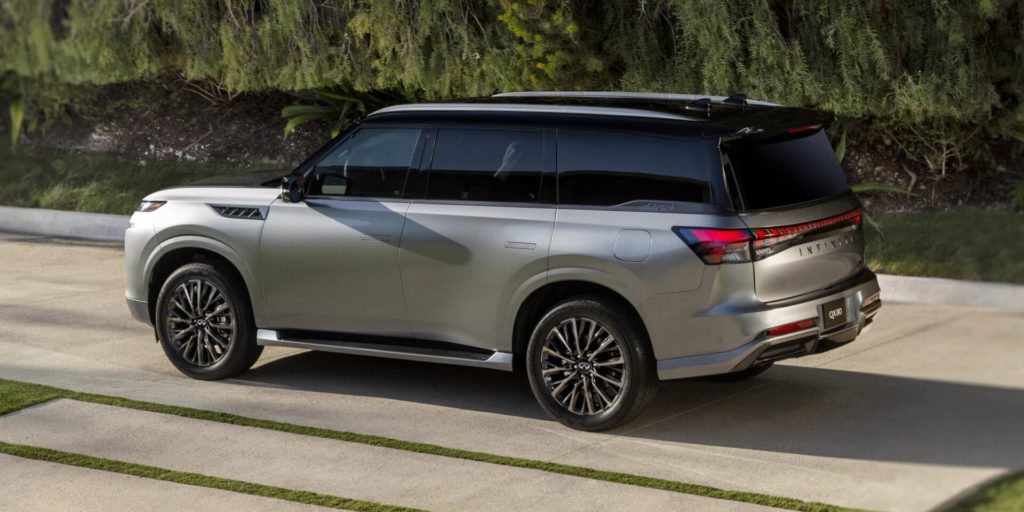
The 2025 QX80 introduces Infiniti’s updated design language with flowing lines and an illuminated emblem surrounded by a parametric grille that reads differently across viewing angles and lighting conditions. Adaptive LED headlights incorporate full-width daytime running lights that give the QX80 a distinctive road presence. Standard 22-inch wheels include noise-reducing resonance technology that addresses the road noise penalty typically associated with large-diameter wheel and tire combinations at this size.
Infiniti QX80 2025 (Interior)
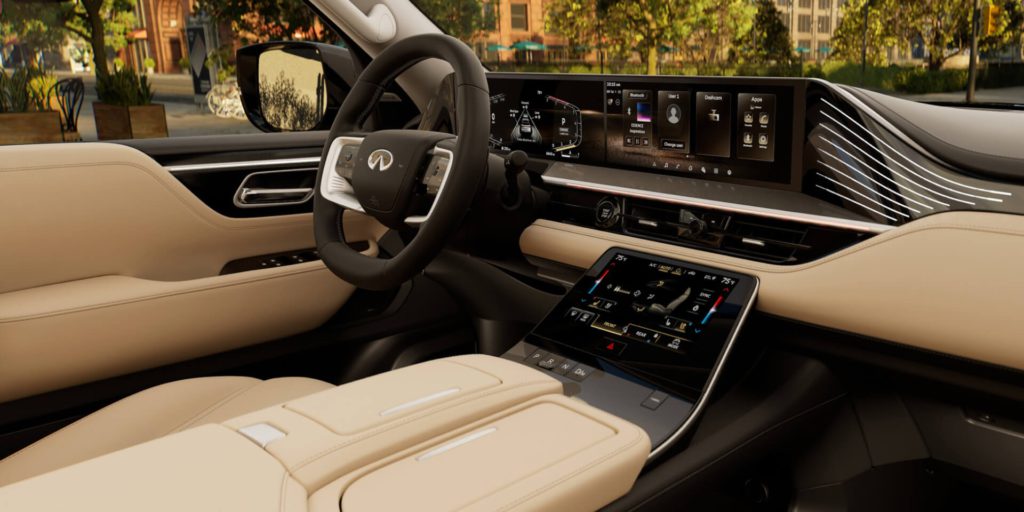
A standard 17-speaker Bose Performance Series audio system with genre-specific tuning anchors a cabin built around acoustic isolation, with active noise cancellation using opposing sound waves to suppress road and wind noise at highway speeds. Quilted leather surfaces with contrasting stitching and backlit emblems create material quality that exceeds the segment norm. Nanoe X air purification technology eliminates odors and reduces airborne contaminants regardless of external air quality. Rear entertainment screens with Amazon Fire TV integration allow passengers to continue streaming content from home without interruption — a practical feature for longer family trips.