

The first official deployment of a safety car in F1 occurred at the 1973 Canadian Grand Prix, a race that descended into chaos. What began as a local circuit’s ad-hoc choice has since transformed into a meticulously managed system. This evolution was a winding road, often bumpy, revealing how F1 moved from casual improvisation to precision control. Discover the bizarre, the beautiful, and the utterly outmatched machines that paced motorsport’s elite, and how they shaped Grand Prix safety.
1. Formula 1 Safety Car (general concept)
The safety car evolved from improvised chaos to standardized precision.
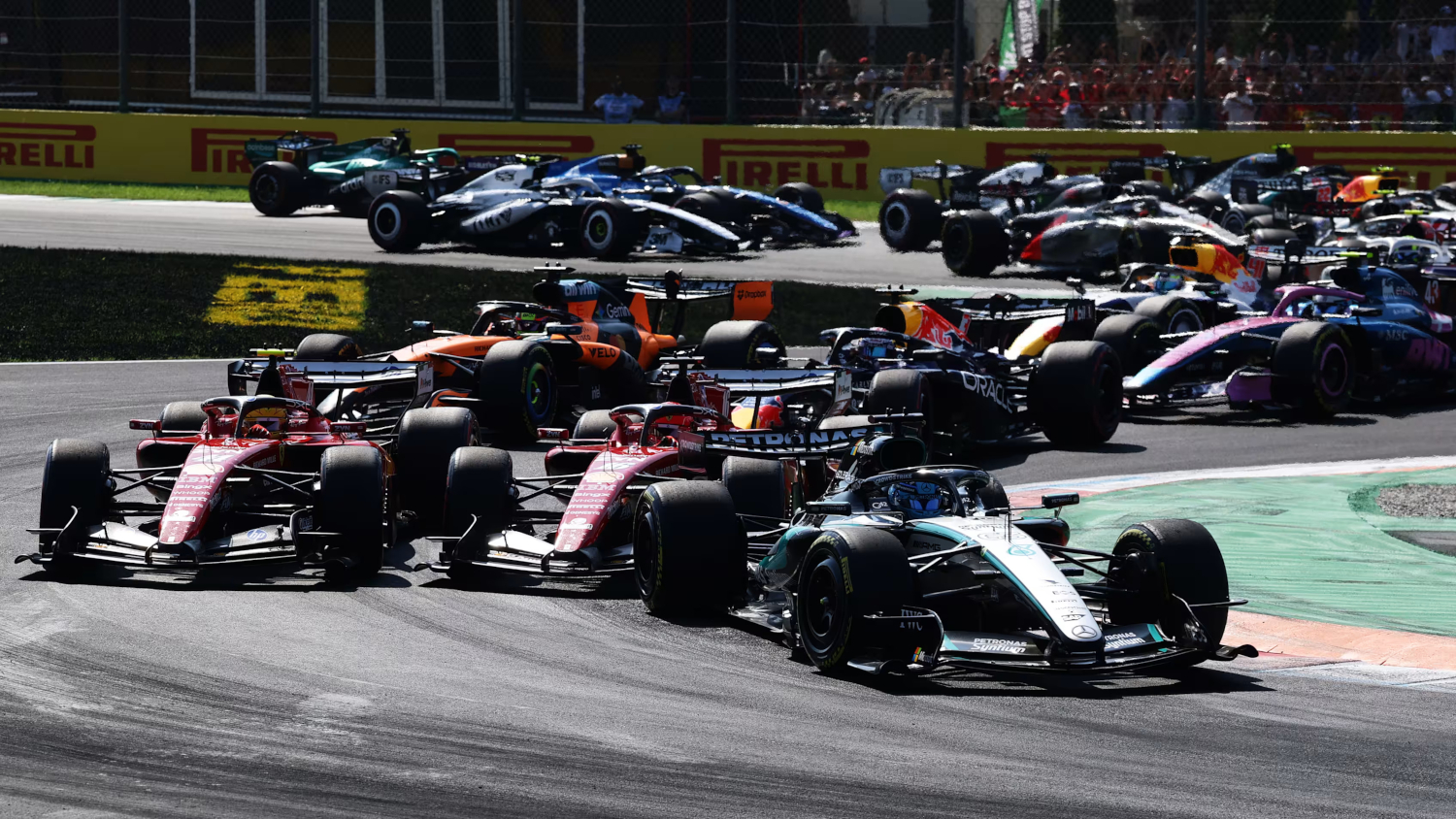
A single incident on track used to throw Formula 1 races into outright disarray, turning a precision sport into a logistical nightmare. Before 1993, when the FIA mandated a safety car for all Grands Prix, race officials were essentially winging it. Circuits used everything from local family sedans to random sports cars, with no unified rules on how to neutralize the field.
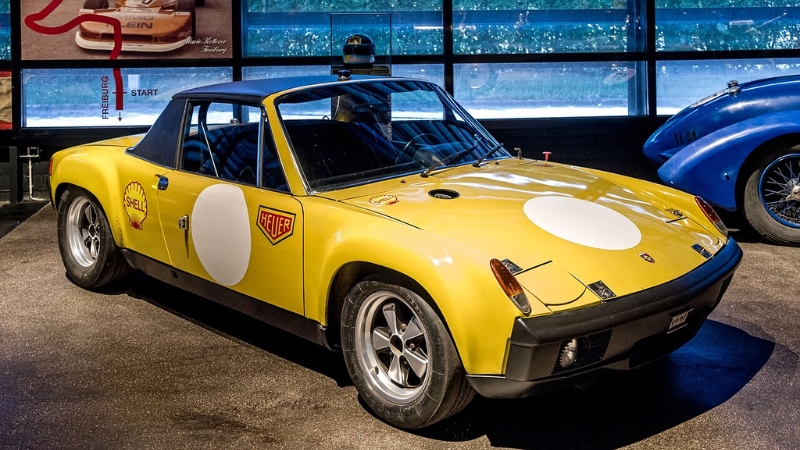
Consider the 1973 Canadian Grand Prix where a Porsche 914 safety car famously collected the wrong leader, leading to hours of post-race reconstruction just to figure out who actually won. Today’s system offers a proper lifeline with dedicated, high-performance vehicles and crystal-clear protocols, keeping the show on track and the drivers safe.
2. Bernd Mayländer – Formula 1 Safety Car Driver
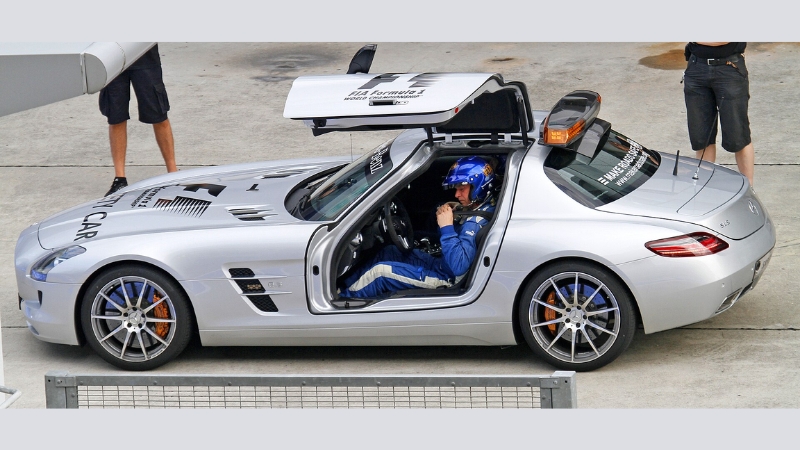
Since 2000, Mayländer has been F1’s unsung metronome, maintaining precision under pressure.
Bernd Mayländer has embodied consistency since 2000, serving as Formula 1’s official safety car driver. His role demands laser focus, maintaining a precise pace behind the safety car, often in treacherous conditions. He is the unsung metronome of F1, ensuring the field stays within strict parameters.
The rapid-fire exchange as Mayländer assesses a crash scene, relaying real-time track conditions to race control, operates with high-stakes precision. He guides the entire grid into formation, a task more demanding than parallel parking a semi-truck in a hurricane. Mayländer has piloted every Mercedes safety car since the CL 55 AMG era, establishing a unique record that few others in motorsport can claim.
3. 1973 Canadian Grand Prix Porsche 914 Safety Car
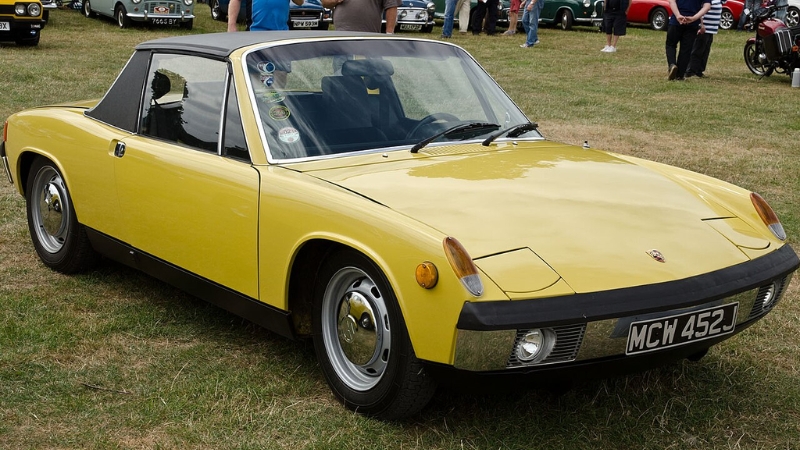
The rain-soaked debut exposed safety car chaos that lasted nearly two decades.
A rain-soaked track always spells trouble in motorsport, and the 1973 Canadian Grand Prix at Mosport Park delivered it in spades. The race became a chaotic debut for the safety car concept, deploying a bright yellow Porsche 914 during multiple incidents. Its driver mistakenly picked up the wrong car as the actual race leader, plunging the race into immediate confusion.
Officials spent hours post-race, piecing together lap charts and radio calls before confirming Peter Revson as the winner. This monumental error ultimately led to F1 largely abandoning official safety car use for nearly two decades, proving that sometimes, even good intentions pave the road to gridlock.
4. Lamborghini Countach Monaco Grand Prix Safety Car (early 1980s)
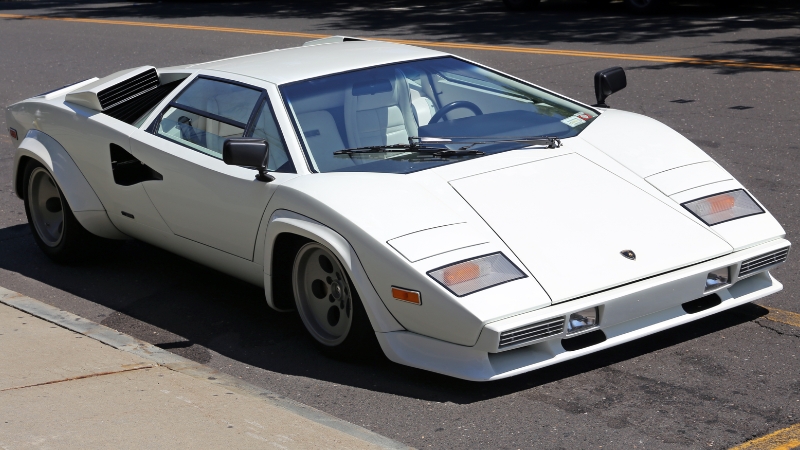
Monaco’s Countach was automotive excess on display, revealing a fragmented safety car era.
At the dawn of the 1980s, the Monaco Grand Prix flaunted automotive opulence, nowhere more evident than in its safety car choice. The Lamborghini Countach, with its razor-sharp wedge-shaped body and signature scissor doors, stalked the hallowed streets as an icon of raw, unapologetic excess between 1981 and 1983. This V12 mid-engine supercar, unleashing 375–455 hp, felt less like a safety vehicle and more like a rolling rock concert.
This era was the Wild West for Grand Prix safety, with each circuit playing its own hand. The Countach at Monaco stood out among a fragmented fleet, highlighting a disconnect where a global sport made ad-hoc decisions about critical race infrastructure. Its glamour ultimately exposed the chaotic lack of a unified safety car program.
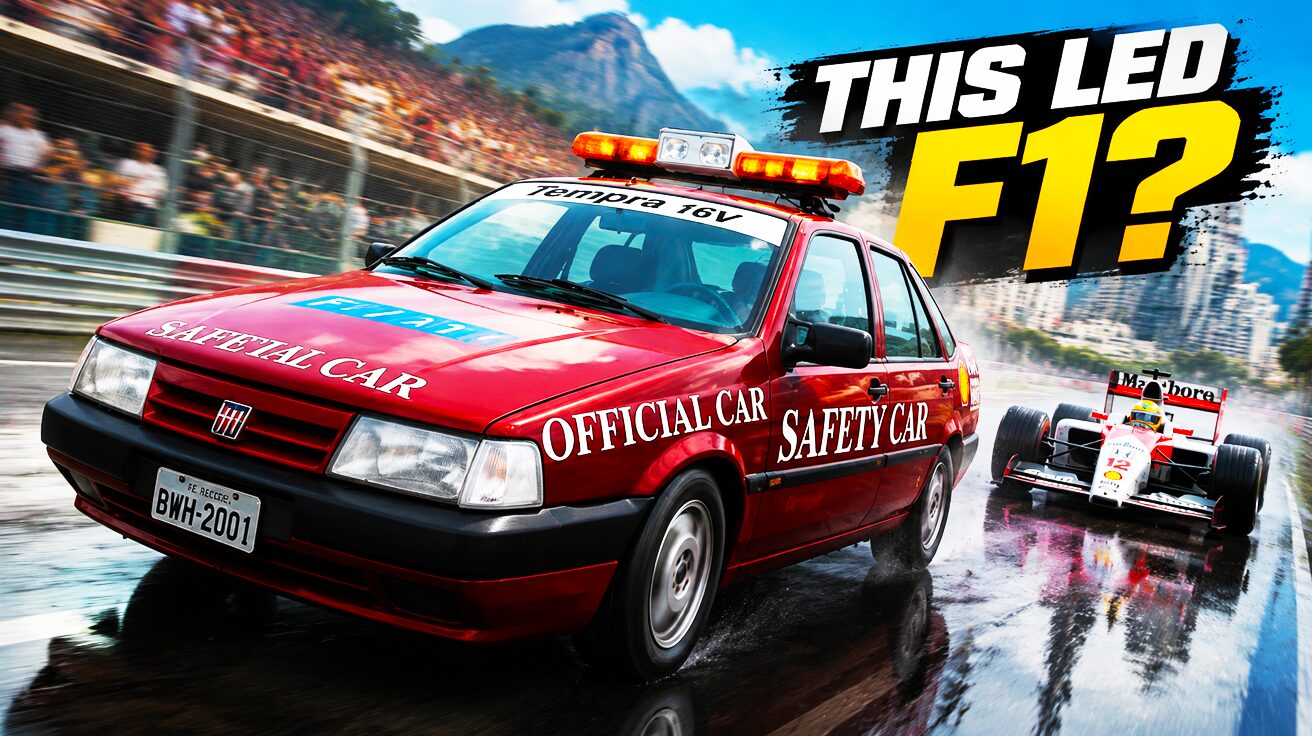
5. Fiat Tempra 16V – 1993 Brazilian Grand Prix Safety Car
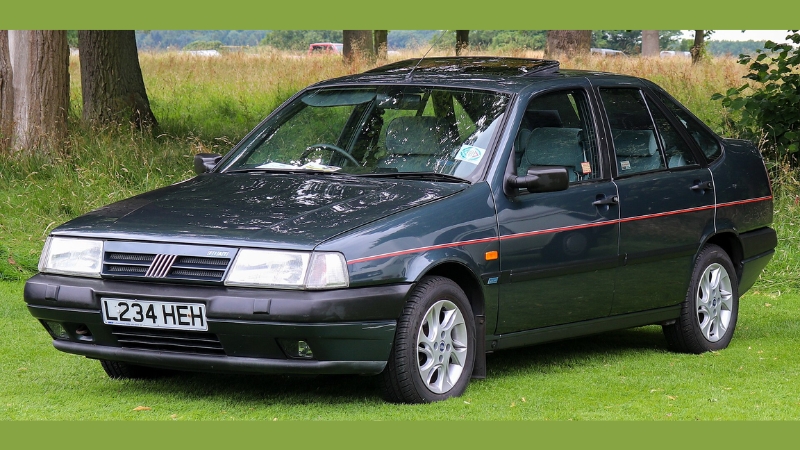
An ordinary sedan earned immortality through Senna’s final Brazilian victory.
The 1993 Brazilian Grand Prix at Interlagos tasked a most unlikely vehicle with safety car duties: a Fiat Tempra 16V. This was no high-performance machine, but a standard front-wheel-drive family sedan. Its 2.0-liter inline-four engine produced only 127–137 hp, a stark contrast to the screaming F1 cars it was meant to control.
The Tempra’s performance limitations quickly became evident; F1 drivers struggled to keep their specialized tires and brakes at optimal operating temperatures behind such a slow pace. Despite its humble capabilities, the car gained lasting fame when Ayrton Senna rode in it after his victory, cementing the unassuming Tempra’s place in Grand Prix lore.
6. Ford Escort RS Cosworth (Silverstone Safety Car)
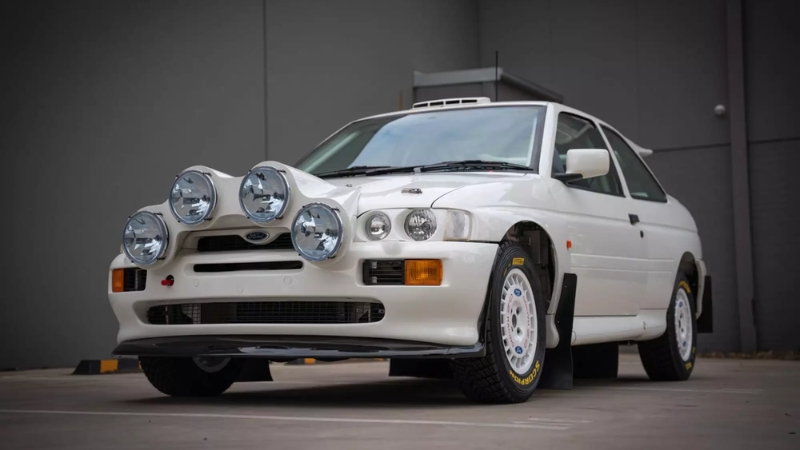
Rally DNA delivered the performance F1 desperately needed.
At Silverstone in the early 1990s, an unlikely hero with rally DNA stepped onto the Formula 1 stage. The Ford Escort RS Cosworth, a homologation special born from World Rally Championship demands, offered true performance. Its 2.0-liter turbocharged inline-four engine, combined with a robust four-wheel drive system, provided a visceral connection to the road.
The distinctive ‘whale tail’ rear spoiler signaled a serious performance machine. With an output between 220–227 hp, the Escort Cosworth possessed enough grunt to maintain a pace sufficient for F1 cars. This prevented their sophisticated tires and carbon brakes from cooling into useless lumps, ensuring the F1 machines stayed within optimal operating windows, ready to unleash their fury when the green flag finally waved.
7. Opel Vectra – German Grand Prix Safety Car (mid-1990s)
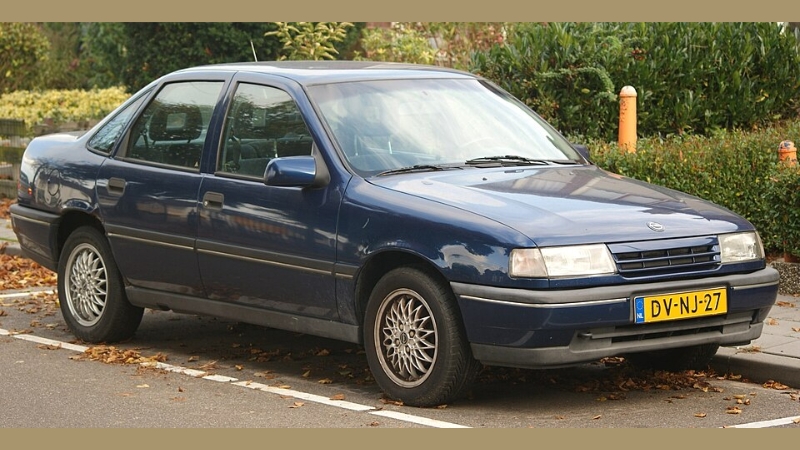
A family sedan sparked controversial debates about safety car performance requirements.
During a critical race scenario, the safety car must keep the Formula 1 field on a razor’s edge. The Opel Vectra, deployed as a safety car in Germany during the early 1990s, was a mid-size front-wheel-drive sedan, a decidedly humble choice for such a high-stakes role. Its engines, ranging from 1.6 to 2.0 liters, delivered a modest 90–136 hp.
This significant performance deficit sparked a grim debate in motorsport circles. Many observers controversially linked slower safety cars to Ayrton Senna’s fatal 1994 San Marino Grand Prix crash. The argument posited that F1 cars, forced to circulate at reduced speeds, lost vital tire and brake temperatures, making them unstable upon restart. While this specific link remains widely debated, the incident vividly highlighted the critical need for a genuinely high-performance safety car.
8. Honda Prelude – Japanese Grand Prix Safety Car (1990s)
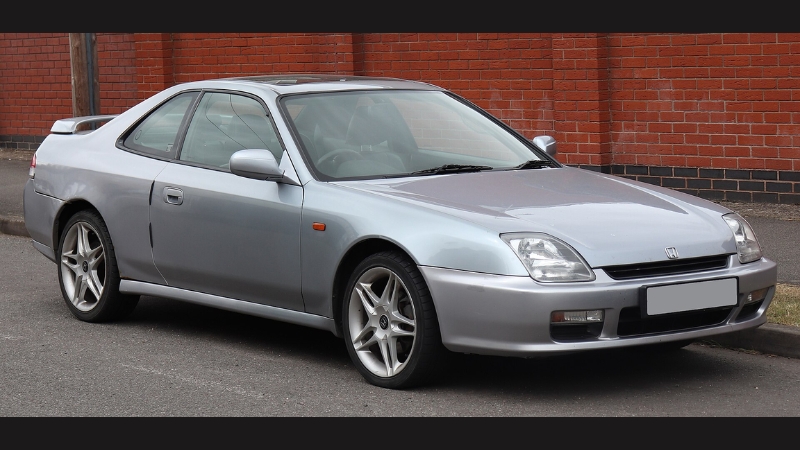
A capable coupe exposed the gap between road performance and F1 requirements.
Japan deployed the Honda Prelude as its F1 safety car in the early 1990s, reflecting a local favorite. This front-engine, front-wheel-drive coupe, celebrated for its precise handling, featured 2.0–2.3-liter four-cylinder engines, including VTEC variants. Outputting 133–190 hp, it carved public roads with the composure of a surgeon’s scalpel, ideal for spirited coastal drives.
Despite its road competence, the Prelude quickly exposed standard production car limitations in a critical F1 role. Its chassis struggled to keep Formula 1 tires, brakes, and aerodynamics in optimal temperature windows. This experience highlighted a crucial lesson: F1 safety car duties required dedicated, high-performance machinery, not merely a capable street coupe.
9. Renault Clio Williams – Argentine Grand Prix Safety Car
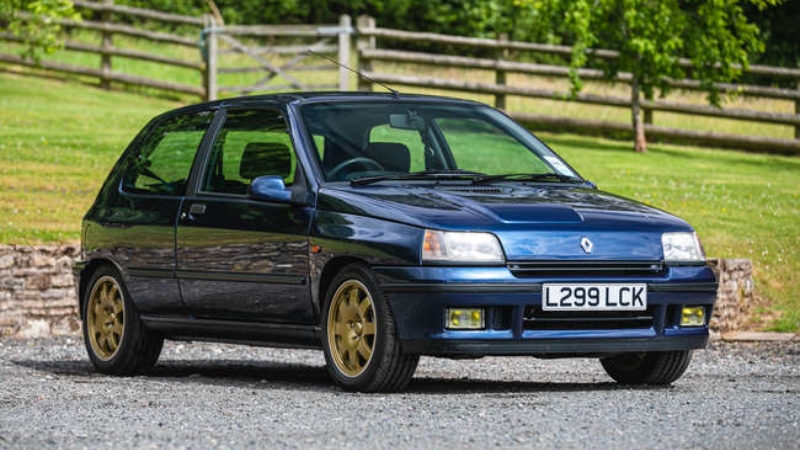
A rally homologation special proved hot hatches could handle F1 duty.
A hot hatch leading an F1 field was an unexpected sight, yet the Renault Clio Williams took on safety car duties in Argentina. This limited-production homologation special emerged from Renault’s rally program, built for speed and agility on diverse terrains. It packed a 2.0-liter naturally aspirated inline-four churning out 145 hp, alongside an uprated suspension and wider track that glued it to the asphalt.
Its distinctive Williams-branded aesthetics made it instantly recognizable on the track. While earlier safety cars often felt like family sedans, the Clio Williams proved a capable performer, demonstrating that these vehicles needed genuine dynamic ability to maintain F1 car tire and brake temperatures. Its deployment in Argentina redefined expectations, showcasing how even a compact performance car could set a credible pace.
10. Lamborghini Diablo – Canadian Grand Prix Safety Car (1995)
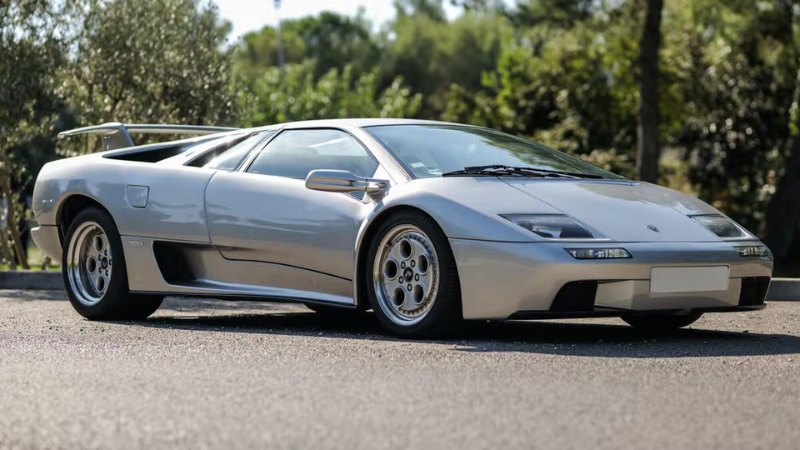
An Italian V12 supercar brought headline-grabbing power to Canadian GP safety duties.
The raw snarl of a V12 tearing through a Canadian Grand Prix circuit in 1995 was unmistakable, signaling an incident but also an event. Canada deployed a Lamborghini Diablo, an exotic mid-engine Italian supercar that commanded attention, its presence a stark contrast to the sedans often forced into safety car duty. With its 5.7-liter V12 engine initially producing 485 hp, the Diablo was capable of top speeds exceeding 320 km/h, delivering performance that could at least keep up with a diminished F1 field.
This deployment showcased the fragmented safety car era where individual circuits often pulled their own strings. Before standardized vehicles, race organizers selected whatever grabbed headlines, making each Grand Prix a unique spectacle of horsepower and bravado. The Diablo’s presence underlined a period when tracks gravitated toward show-stopping machinery.
11. Mercedes-Benz C36 AMG – First Official Mercedes F1 Safety Car (1996)
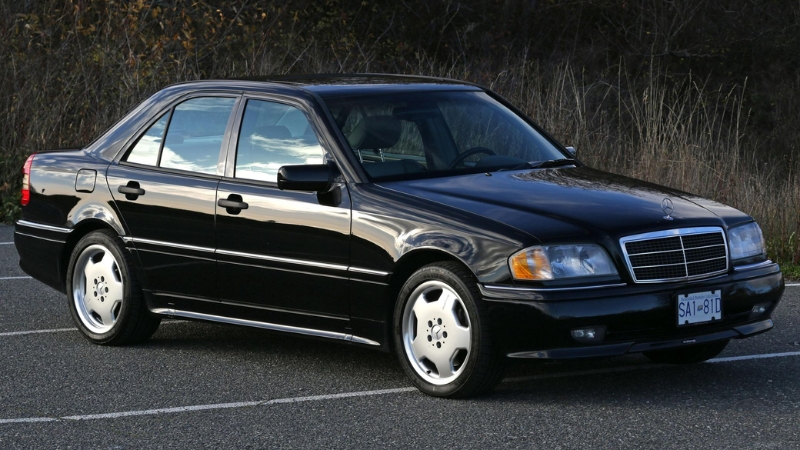
The C36 launched Mercedes’ standardized safety car era at Magny-Cours.
Before 1996, Formula 1 safety car duties were a chaotic free-for-all. This inconsistent approach often left F1 cars’ tires and brakes colder than a forgotten beer on a long drive. The Mercedes-Benz C36 AMG changed that at Magny-Cours, debuting as the sport’s first official, standardized Mercedes safety car. Built on the W202 C-Class, its 3.6-liter inline-six delivered a respectable 280 hp.
Uprated suspension and brakes ensured it could keep pace, maintaining vital temperatures. This launched a crucial partnership, cementing Mercedes-AMG’s role in F1 safety for decades to come.
12. Mercedes-Benz CLK 55 AMG – F1 Safety Car (1997–1999, 2003)
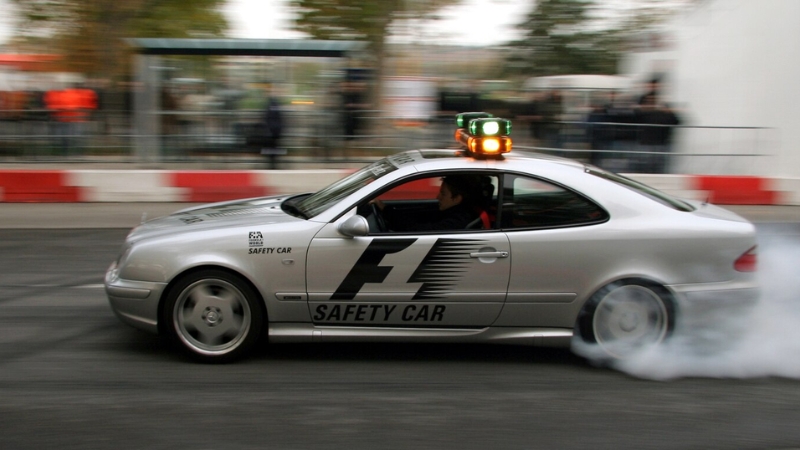
A potent V8 coupe became AMG’s rolling laboratory for performance innovation.
From 1997–1999, and again in 2003, the Mercedes-Benz CLK 55 AMG commanded the Formula 1 grid as its official Safety Car. This coupe replaced the C36 AMG, bringing a more potent 5.4-liter naturally aspirated V8 engine to the role. Outputting 342–360 hp, it provided the grunt needed to keep F1 tires and brakes within their narrow operating windows during caution periods.
Anyone who has driven a properly sorted V8 knows the direct line from pedal to pavement. The CLK 55 was a rolling laboratory for AMG, pushing road car technology within the crucible of top-tier motorsport. This dynamic role ensured innovations found in AMG road cars were first hammered out at speeds normally reserved for the Grand Prix elite, solidifying AMG’s performance credentials.
13. Mercedes-Benz CL 55 AMG – F1 Safety Car (2000)
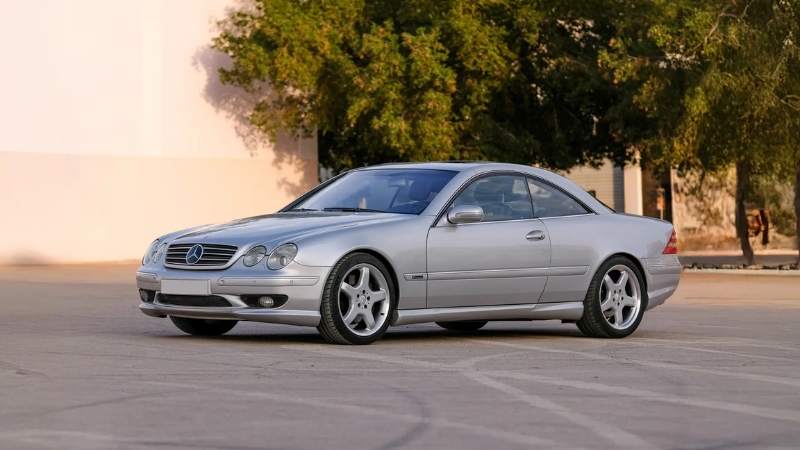
Luxury and performance merged as Mayländer’s early tenure began.
The Mercedes-Benz CL 55 AMG debuted as the official F1 safety car for the 2000 season, signaling a new era of high-performance luxury in the role. When debris scattered across the track, this CL-Class coupe, powered by a 5.4-liter V8 engine, would lead the field with quiet authority. Its advanced electronics and comfortable interior made it a far cry from a stripped-out race machine; it handled high-speed duties with calm confidence.
This period also marked Bernd Mayländer’s early tenure as the driver, perfectly timing the arrival of a vehicle that blurred the lines between a high-speed escort and a plush grand tourer. The shift in philosophy traded raw aggression for composed, capable power.
14. Mercedes-Benz SL 55 AMG – F1 Safety Car (2001–2002)
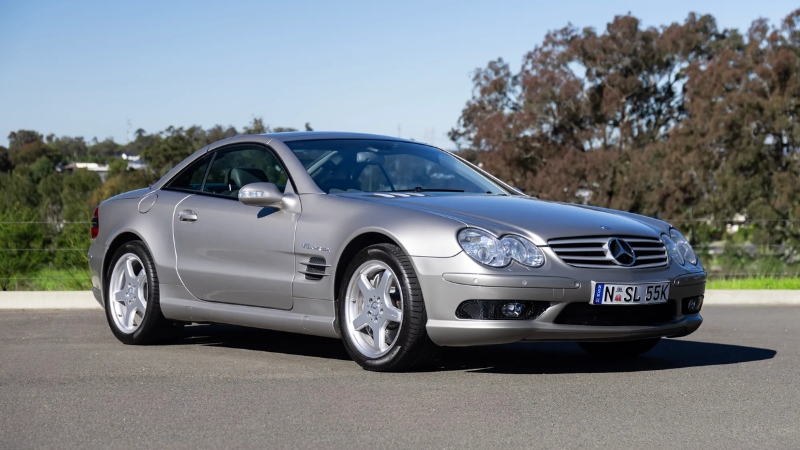
A supercharged roadster maintained relentless pace to keep F1 cars primed.
The Mercedes-Benz SL 55 AMG commanded the F1 grid as its official safety car from 2001–2002. Its engineering was critical for keeping F1 cars in their operational sweet spot during cautions. A 5.4-liter supercharged V8 cranked out around 476 hp, a relentless heartbeat. This high-performance roadster, despite its retractable hard-top, prioritized track performance, ensuring it could lead the pack with authority.
Its advanced traction systems precisely managed every burst of power on circuit, ensuring the safety car maintained speeds high enough to prevent F1 tires and brakes from turning cold and useless. The SL 55 AMG delivered unflappable pace, keeping the field primed for a full-throttle restart.
15. Mercedes-Benz SLK 55 AMG – F1 Safety Car (2004–2005)
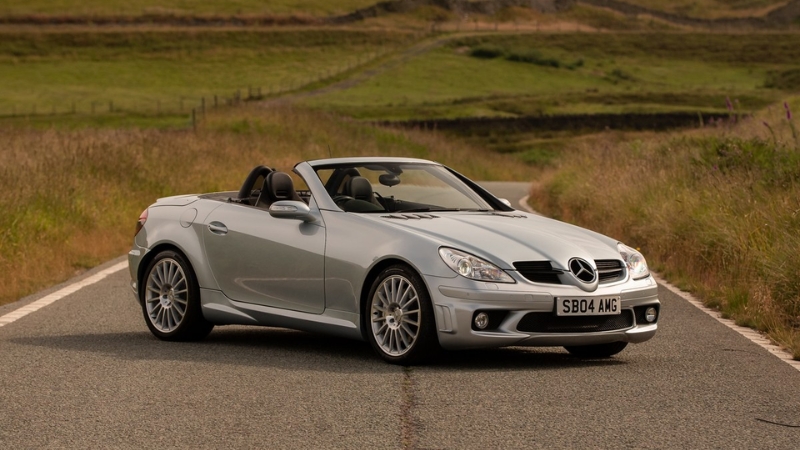
Compact agility met V8 power in Mercedes’ continued safety car evolution.
Formula 1 cars demand high operating temperatures for their tires and brakes. Slower safety cars caused the F1 field to crawl, compromising crucial performance. The Mercedes-Benz SLK 55 AMG, deployed from 2004–2005, offered a sharp solution. This compact roadster packed a 5.4-liter V8 engine, delivering 360 hp, providing necessary pace. It was a nimble workhorse, adept at managing the powerful F1 grid.
Its agile handling and significant power allowed the SLK 55 AMG to hustle through technical corners, maintaining speed and preventing the F1 field from cooling. Mercedes consistently updated their safety car fleet, ensuring F1 always had a potent pace car, season after season.
16. Mercedes-Benz CLK 63 AMG – F1 Safety Car (2006–2007)
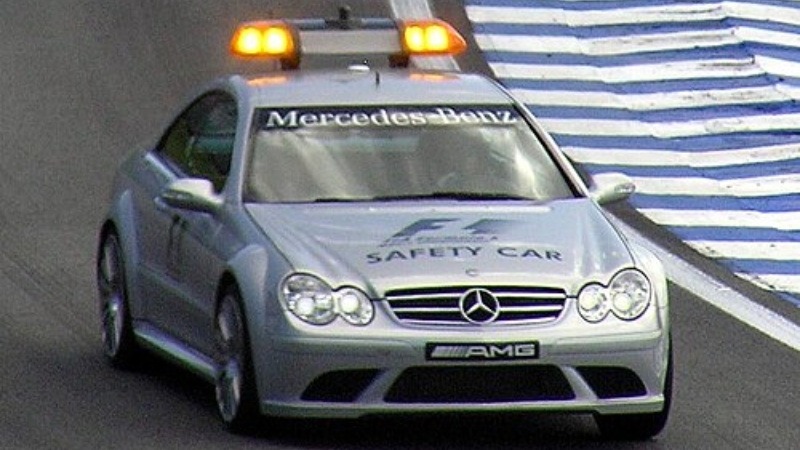
The AMG “63” engine brought 475 hp to match F1’s escalating demands.
Formula 1’s relentless push for speed demands ever more capable intervention vehicles, a truth underscored when the Mercedes-Benz CLK 63 AMG served as safety car during the 2006–2007 seasons. This was no minor tweak; its 6.2-liter naturally aspirated V8, the celebrated AMG “63” engine, pumped out around 475 hp. This provided a substantial power increase over earlier CLK safety cars, crucial for controlling an accelerating F1 grid.
Keeping pace with a field of twitchy F1 machines, all needing precise tire and brake temperatures, requires more than just straight-line grunt. The CLK 63 AMG ensured those F1 cars retained their performance edge. Its robust capabilities confirmed the safety car’s evolving role to truly lead, rather than simply follow, Formula 1’s escalating demands.
17. Mercedes-Benz SL 63 AMG – F1 Safety Car (2008–2009)
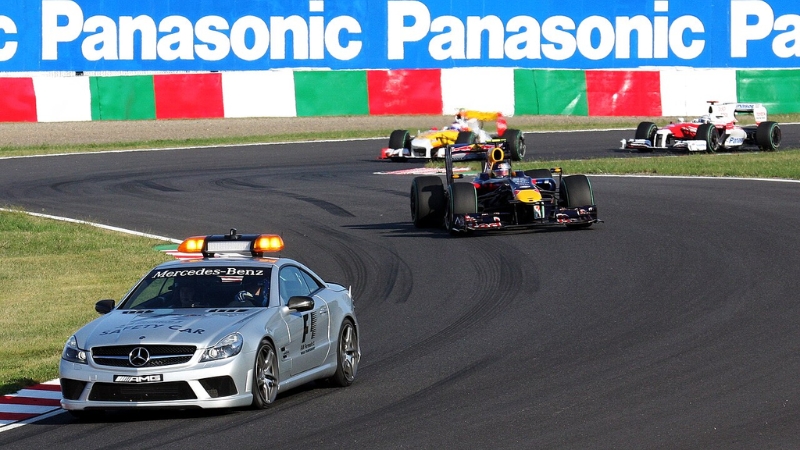
Over 500 hp and adaptive suspension kept F1 temperatures consistent.
Modern F1 safety cars require genuine performance, often lapping circuits faster than most street-legal sports cars. From 2008–2009, the Mercedes-Benz SL 63 AMG filled this critical role, asserting its high-performance GT status. Equipped with a 6.2-liter V8 engine similar to other “63” AMG models, it unleashed over 500 hp. This was a dedicated instrument, finely tuned to set the relentless pace demanded by Formula 1.
Its advanced seven-speed automatic transmission and adaptive suspension ensured precise power delivery and unflappable handling. Control matters when managing a grid of multi-million-dollar race cars needing warm tires. This grand tourer maintained high average speeds, ensuring F1 drivers kept their expensive rubber at optimal temperatures. The SL 63 AMG ensured critical operating conditions remained consistent.
18. Mercedes-Benz SLS AMG / SLS AMG GT – F1 Safety Cars (2010–2014)
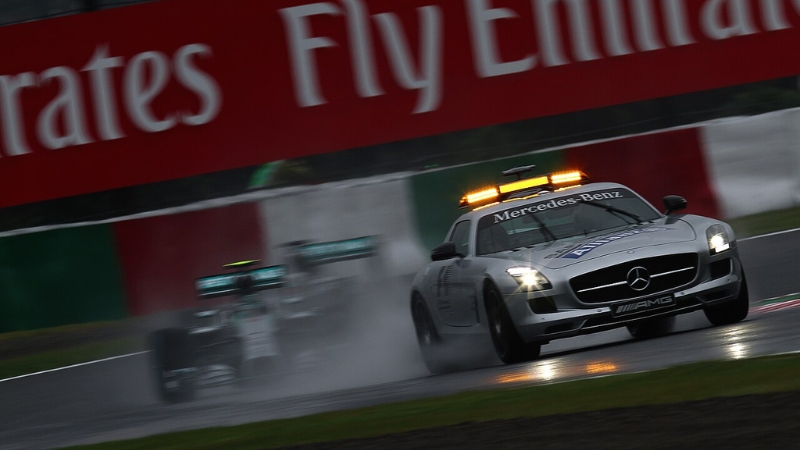
The first AMG-built safety car set a new flagship standard with gullwing doors.
The safety car game changed when AMG started building them from the ground up. This wasn’t some adapted sedan; the SLS AMG, debuting in 2010, was the first F1 safety car developed entirely by AMG, a true flagship. Its naturally aspirated 6.2-liter V8 screamed with 571 hp, and those iconic gullwing doors were more than just a party trick.
From mid-2012 through 2014, the uprated SLS AMG GT took over, pushing the envelope further. Its rear-wheel drive setup demanded precision, a clear difference from earlier, less focused safety car efforts. This car was a precision instrument, cutting through the air with surgical accuracy. Anyone who has tried to keep a high-strung track car from cooling down understands the challenge this machine solved, keeping those F1 tires in their optimal temperature range.
19. Mercedes-AMG GT S and GT R – F1 Safety Cars (2015–2021)
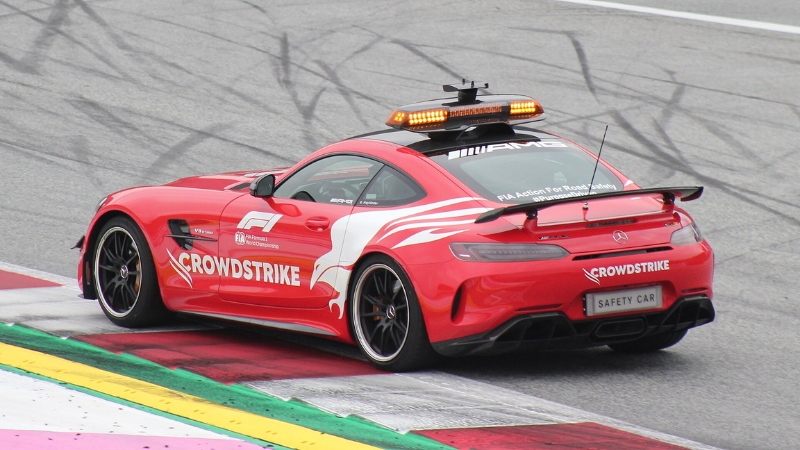
Twin-turbo evolution culminated in the 585-hp GT R track weapon.
When the Mercedes-AMG GT S debuted as the Formula 1 Safety Car from 2015–2017, it presented a formidable package, yet its successor marked a significant evolution in pace car capability. Both models utilize a front-engine, rear-wheel-drive architecture, powered by a 4.0-liter twin-turbo V8. The GT S delivered around 510 hp, sufficient to lead the top-tier racing field through chaotic scenes.
However, the Mercedes-AMG GT R, taking over from 2018–2021, arrived as a far more track-focused machine. Its V8 punched out 585 hp, propelling it to a top speed of 318 km/h. The GT R’s enhanced aerodynamics and stiffer suspension were built for sustained aggression; it was a surgical tool designed to maintain pace under pressure. This car solved the challenge of keeping high-strung performance cars happy during slow parade laps, cementing its place as an ideal guardian of the grid.
20. Mercedes-AMG GT Black Series – F1 Safety Car (2022–Present)
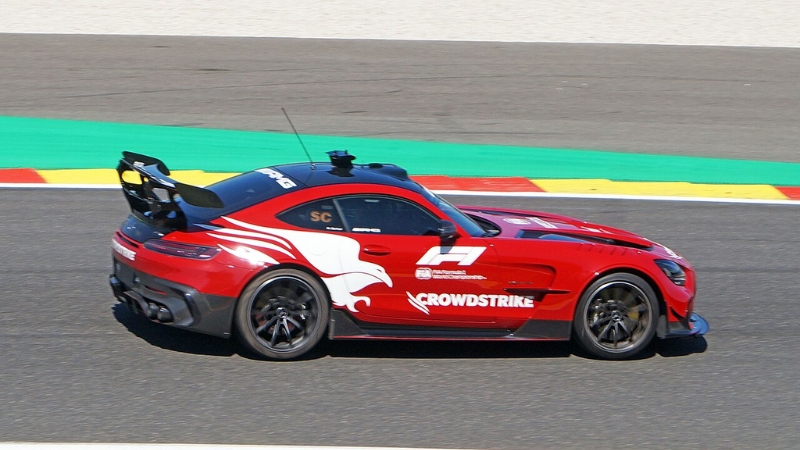
Over 730 hp makes this the most powerful F1 safety car ever deployed.
The GT Black Series stands as the most powerful F1 safety car ever deployed, shattering any lingering myths about leisurely parade laps. Since 2022, this formidable machine has commanded the field, powered by a heavily reworked 4.0-liter twin-turbo V8 churning out over 730 hp. It is a raw, unbridled force, yet precisely controlled, pulling like a freight train on the straights and pivoting through tight hairpins with rally-car precision.
Maintaining genuinely high speeds is critical for modern F1 cars; this AMG delivers with extensive aerodynamic enhancements and a track-oriented suspension. It keeps multi-million dollar F1 machinery at optimal tire and brake temperatures, unlike the slow parades of earlier eras. The precision required operates with surgical accuracy at warp speed, ensuring the field stays ready to sprint.
21. Aston Martin Official F1 Safety Car (2021–2025)
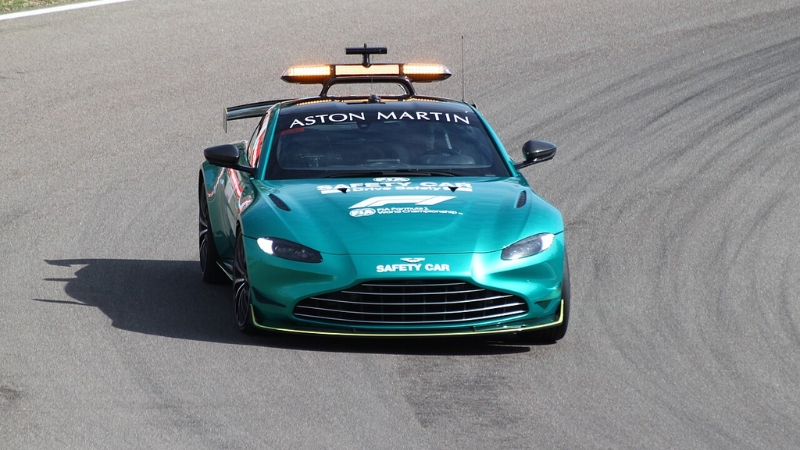
British Racing Green brought brand diversity to a Mercedes-dominated era.
The visual rhythm of Formula 1’s safety car deployments shifted dramatically in 2021 when Aston Martin joined the grid as a secondary official supplier. This brought a welcome flash of British Racing Green to tracks previously dominated by silver, like a rare vintage roadster appearing among a fleet of modern supercars. For the first time, races alternated between models, injecting brand diversity into a role Mercedes had held exclusively. This distinctive partnership provided an aesthetic refresh, lasting through 2025 before concluding.
The Aston Martin safety car, based on the formidable Vantage, was no mere badge-engineered offering; it packed a twin-turbo V8 engine and received extensive track-oriented upgrades to meet FIA’s rigorous demands. This ensured the car could maintain the speeds necessary to keep F1 tires warm. While some purists might have preferred a single, consistent leader, its visually striking appearance and the bold diversification of brands added a certain flair to safety car periods.