

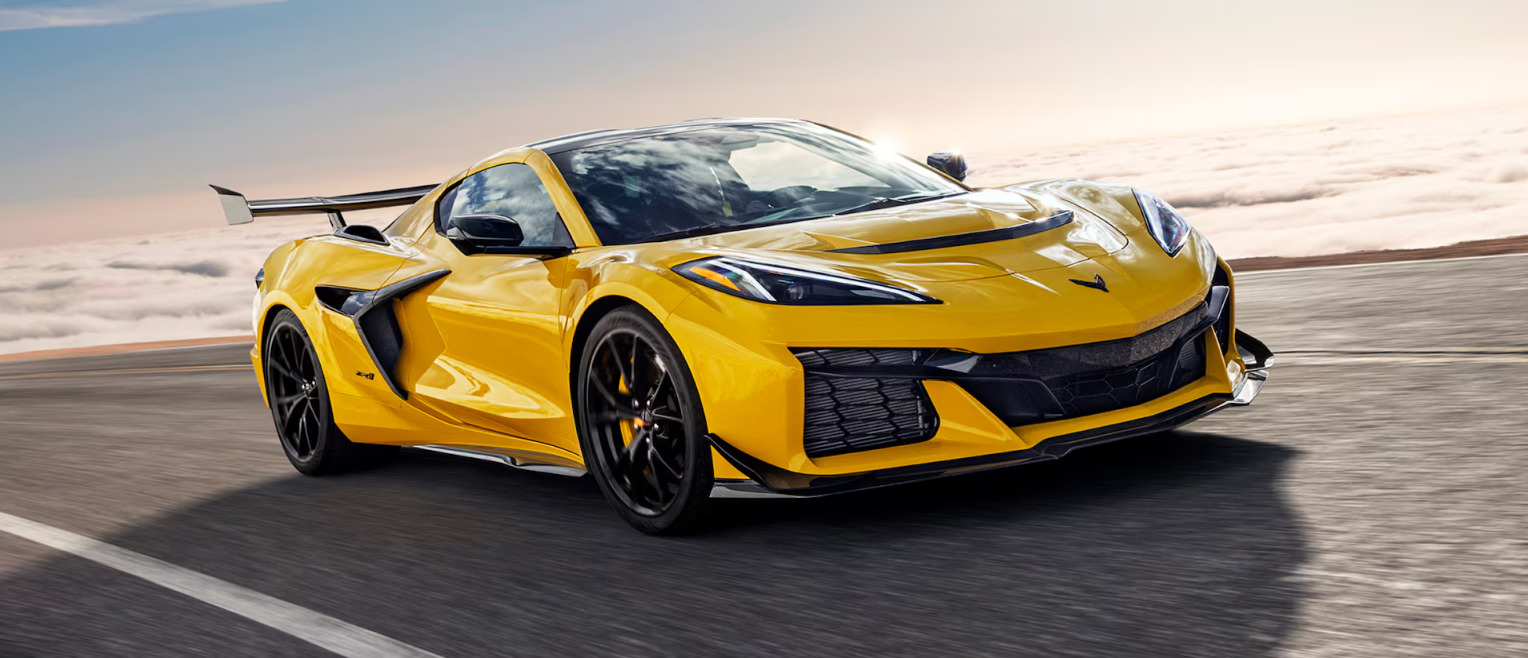
Your Instagram feed just got a lot more interesting if you follow American supercars. Chevrolet dropped a teaser showing their yellow ZR1 demolishing the Nürburgring, captioned “Fast as green hell”—and that’s not just social media hyperbole.
This 1,000+ horsepower beast represents the culmination of decades of American engineering ambition, and its upcoming lap time revelation could rewrite the supercar hierarchy faster than you can say “mid-engine revolution.”
While European exotics have traditionally owned the ‘Ring leaderboards, American muscle is closing the gap with surgical precision. The previous C7 ZR1 managed a respectable 7:04.00, and the current C8 Z06 clocked 7:10.51, but Ford’s Mustang GTD just threw down the gauntlet with a blistering 6:52.072.
Your move, Chevy—and industry insiders are betting the ZR1 will respond with America’s first sub-7-minute production car time.
Behind those dramatic aerodynamic curves lies the ZTK Performance Package, featuring a carbon fiber rear wing that generates legitimate downforce numbers. You’re looking at Michelin Pilot Sport Cup 2R ZP tires gripping asphalt with the tenacity of a TikTok algorithm. On the other hand, the advanced suspension system has already proven itself by setting lap records at Watkins Glen and Road Atlanta.
This isn’t just horsepower bragging—it’s precision engineering that translates raw power into measurable track dominance.
Racing to the Nürburgring isn’t as simple as showing up with your fastest car, though. Corvette chief engineer Tony Roma explained the certification complexities, citing the logistical challenges and substantial costs of obtaining a certified Ring time.
The process involves weather windows, track availability, and validation protocols that make your DMV experience look streamlined by comparison.
If you’re watching the American supercar landscape, this timing couldn’t be more critical. A sub-7-minute Nürburgring lap would position the ZR1 as the fastest American production car ever, giving buyers legitimate bragging rights against European competition that’s dominated this conversation for decades.
You’re witnessing a potential shifting of the performance guard, where American engineering finally matches its ambition with execution that Europeans can’t dismiss. The stakes extend beyond lap times into cultural territory: proving American supercars belong in the same conversation as McLarens and Porsches, not just at drag strips but on the world’s most demanding circuit.