

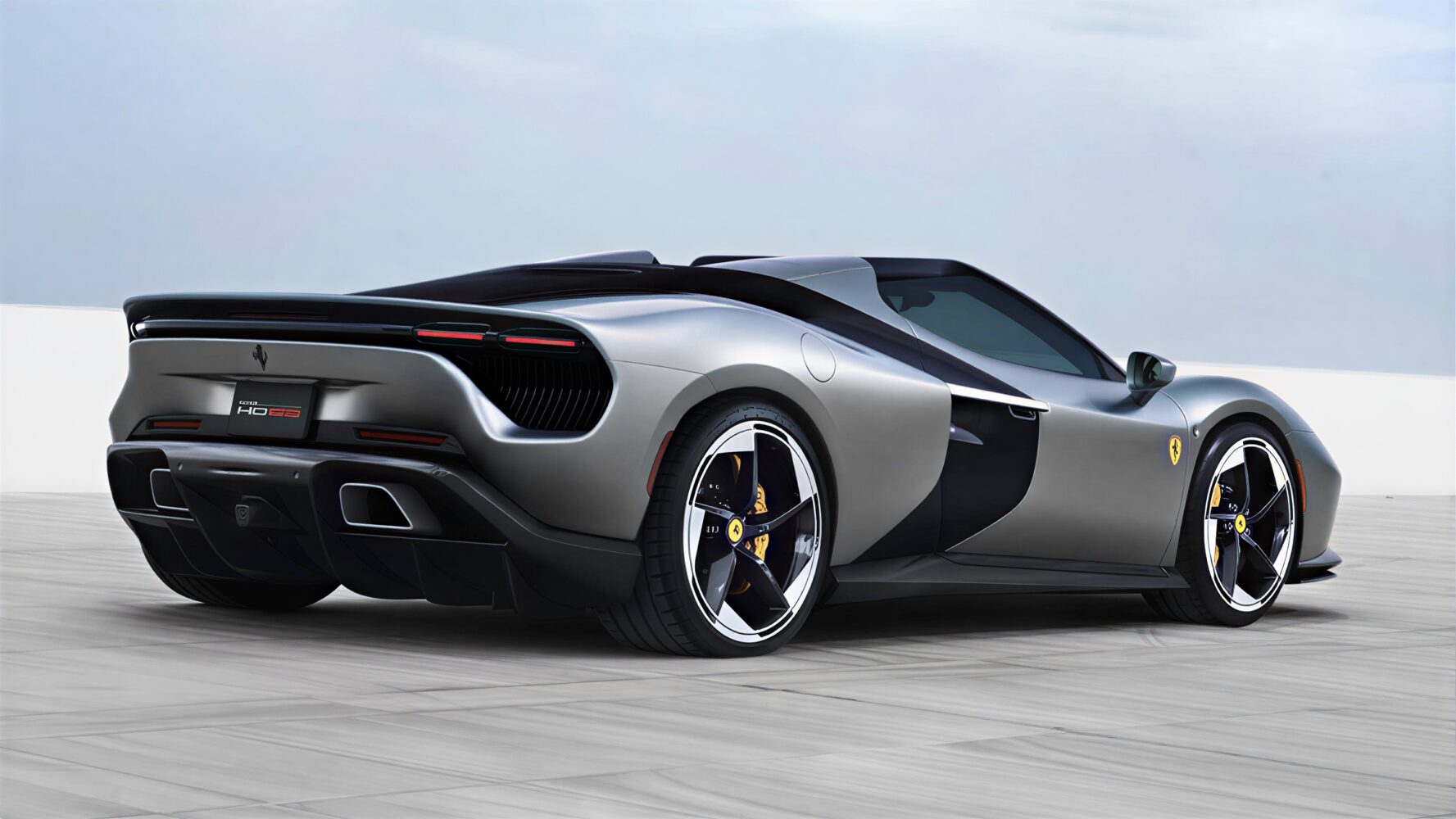
Most active rear wings rotate as one rigid plane — useful, but blunt. Ferrari’s newly filed U.S. patent proposes something fundamentally different: a rear wing that bends and twists asymmetrically under load, shifting downforce side-to-side mid-corner rather than simply adding or subtracting it overall. This isn’t an isolated idea. It arrives alongside a cluster of recent Ferrari aero patents and the company’s 2026 F1 Ferrari’s SF-26, already demonstrating active wings at Fiorano with dedicated Corner and Straight modes. Ferrari is clearly thinking about aerodynamics differently.
Bend, Don’t Just Tilt
The architecture works like this: multiple separate airfoils are mounted on flexible support plates, one assembly per side of the car, each driven by its own actuator. The wing behaves differently depending on what the car is doing:
Ferrari’s patent replaces a single rigid wing with flexible plates and independent actuators on each side.
- Hard braking — both sides curve upward simultaneously, increasing drag and rear downforce to stabilize the car
- Mid-corner — one side bends more than the other, shifting aerodynamic load toward the inside rear to help maximize grip through the turn
- Corner exit and straights — the wing returns to a flat, neutral profile, bleeding off drag for higher speed
Zenvo’s centripetal wing already shifts downforce laterally through a different pivot-based structure. Ferrari’s flexible-plate concept suggests a more continuously variable deformation across the wing span — potentially enabling finer load tuning than a discrete hinge allows.
According to reports from Autoblog and CarBuzz, the patent covers only the mechanical architecture; flexible composites or next-generation polymers remain speculative at this stage, with fatigue resistance under repeated high-load bending cycles as the core engineering challenge. Materials are simply not specified in the filing.
Paired with Ferrari’s separate predictive aero control patent — which uses algorithms to pre-position aero surfaces before a known corner — this wing could deliver a noticeably more planted rear end without any driver input required.
A Pattern, Not a One-Off
This patent is one piece of Ferrari’s broader push to make extreme power more exploitable through smarter aerodynamics — not simply more of it.
While rivals chase four-figure horsepower bragging rights, Ferrari is playing a different game entirely. These filings collectively suggest a company focused on making 800-plus horsepower genuinely usable rather than merely impressive on a spec sheet:
- Shape-shifting body panels
- Predictive aero algorithms
- Adaptive rear airfoils with discrete positions
The 2026 F1 regulations introduced active front and rear wings with dedicated Corner and Straight modes, replacing traditional DRS — the drag reduction system that opens a flap to cut rear-wing drag on straights. Ferrari’s SF-26 is already operating in that world at the track level.
Patents don’t equal production cars. Whether this bending wing ever reaches a road car depends on cost, durability, and whether it outperforms simpler active wings under real conditions. It may never ship. But it tells you exactly where Ferrari’s engineering priorities are pointed — and that direction makes every future Ferrari reveal genuinely worth tracking.