

Zero degrees Fahrenheit, January, and a car that won’t start — that moment makes battery choice feel less like a minor shopping decision and more like a survival skill. Project Farm‘s Todd tested nine new Group 65 batteries across two retailers, six performance categories, and one unforgiving cold-cranking benchmark. Walmart’s EverStart batteries cost less. In most categories, they also lost — and the performance gap in freezing conditions was significant enough to make the price difference feel largely irrelevant.
What the Test Actually Measured
Six metrics, nine batteries, and some uncomfortable results straight out of the box.
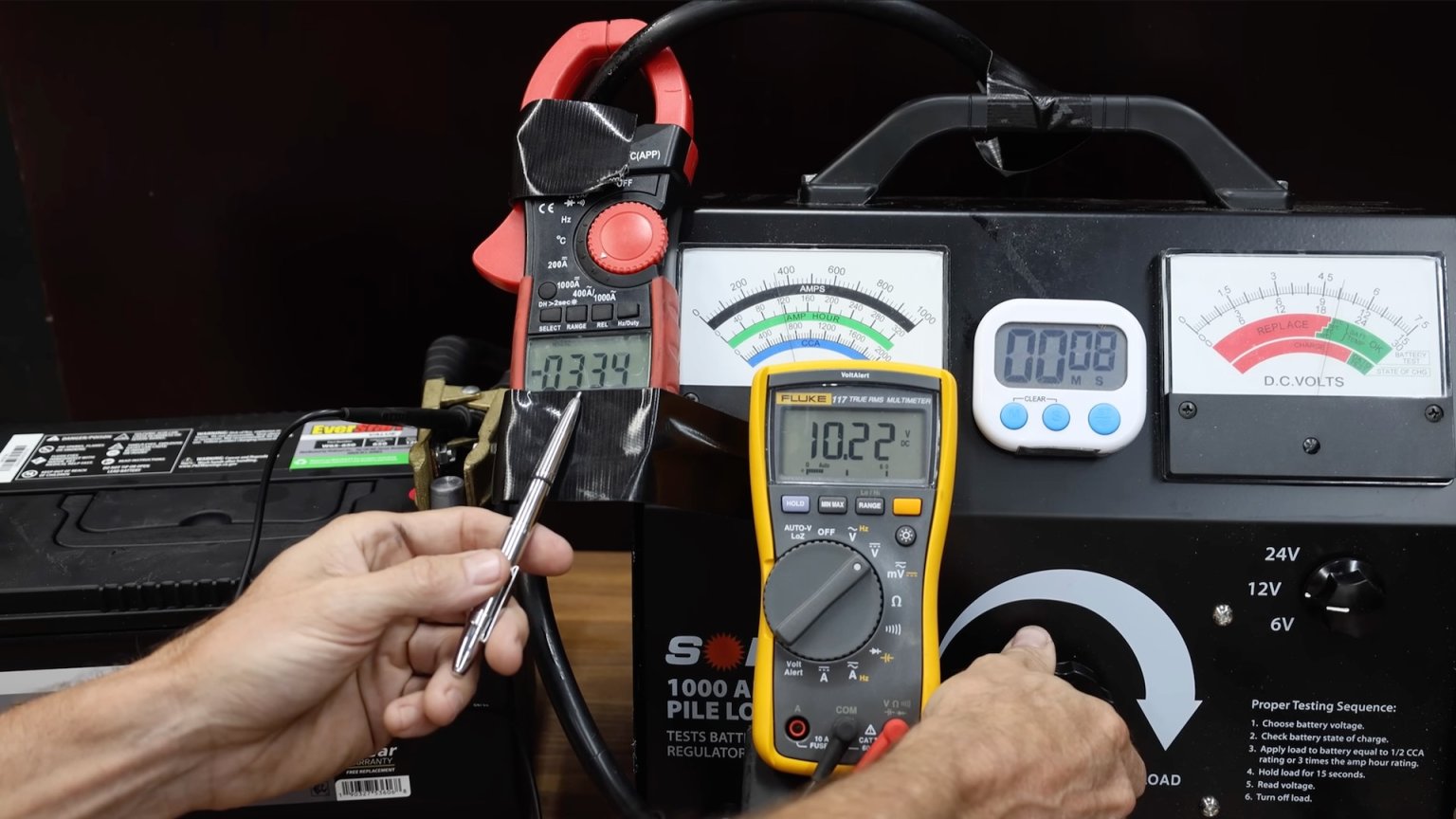
Todd measured voltage, amperage, internal resistance, state of health (a battery analyzer’s overall condition score), load performance, cold-cranking amps at zero degrees Fahrenheit, and reserve capacity across four Walmart and five O’Reilly batteries. The first concern appeared before any load test began. Walmart’s lead-acid batteries arrived showing state-of-health readings of 84–88% — unusually low numbers for products still in the packaging. Higher-than-expected internal resistance compounded the problem. For brand-new batteries, those are not encouraging opening numbers.
The Numbers That Matter
- Nine batteries tested: four Walmart EverStart ($79–$189) and five O’Reilly Super Start ($100–$260)
- Walmart lead-acid batteries registered state-of-health readings of 84–88% straight out of the box — unusual for new units
- The cheapest O’Reilly battery produced 827 amps at zero degrees Fahrenheit — 302 amps more than the cheapest Walmart battery, for roughly $20 more
- O’Reilly lead-acid batteries claimed the top two overall spots; every O’Reilly lead-acid model outperformed its cheaper Walmart equivalent
- One exception: Walmart’s AGM battery beat O’Reilly’s AGM in the load test, tying for third overall
“The entry-level O’Reilly Super Start Value registered 827 amps at zero degrees Fahrenheit — 302 amps higher than the cheapest Walmart battery, despite costing about $20 more.” — Project Farm test findings, via The Drive
A 302-amp gap at zero degrees is not a rounding error. That is the difference between an engine turning over and a dead car blocking the driveway while roadside assistance takes its time arriving.
One Win for Walmart, One Caveat for Everyone
Amid an otherwise decisive performance gap, one result complicates the narrative.
Walmart’s AGM battery outperformed O’Reilly’s AGM in the load test, tying for third overall — a result worth acknowledging. It also makes the findings more credible and more useful, because this was never a clean sweep. That said, this was one independent YouTube test, not a controlled lab study conducted across multiple sample sizes. Project Farm’s methodology was thorough, but these findings are best treated as a strong real-world comparison rather than a final verdict on every battery either retailer carries.
The practical lesson is not “never buy Walmart batteries.” Store name matters far less than battery type, CCA rating, and tested performance. Ten minutes of research before purchase beats two hours waiting for a jump-start on a frozen morning.