

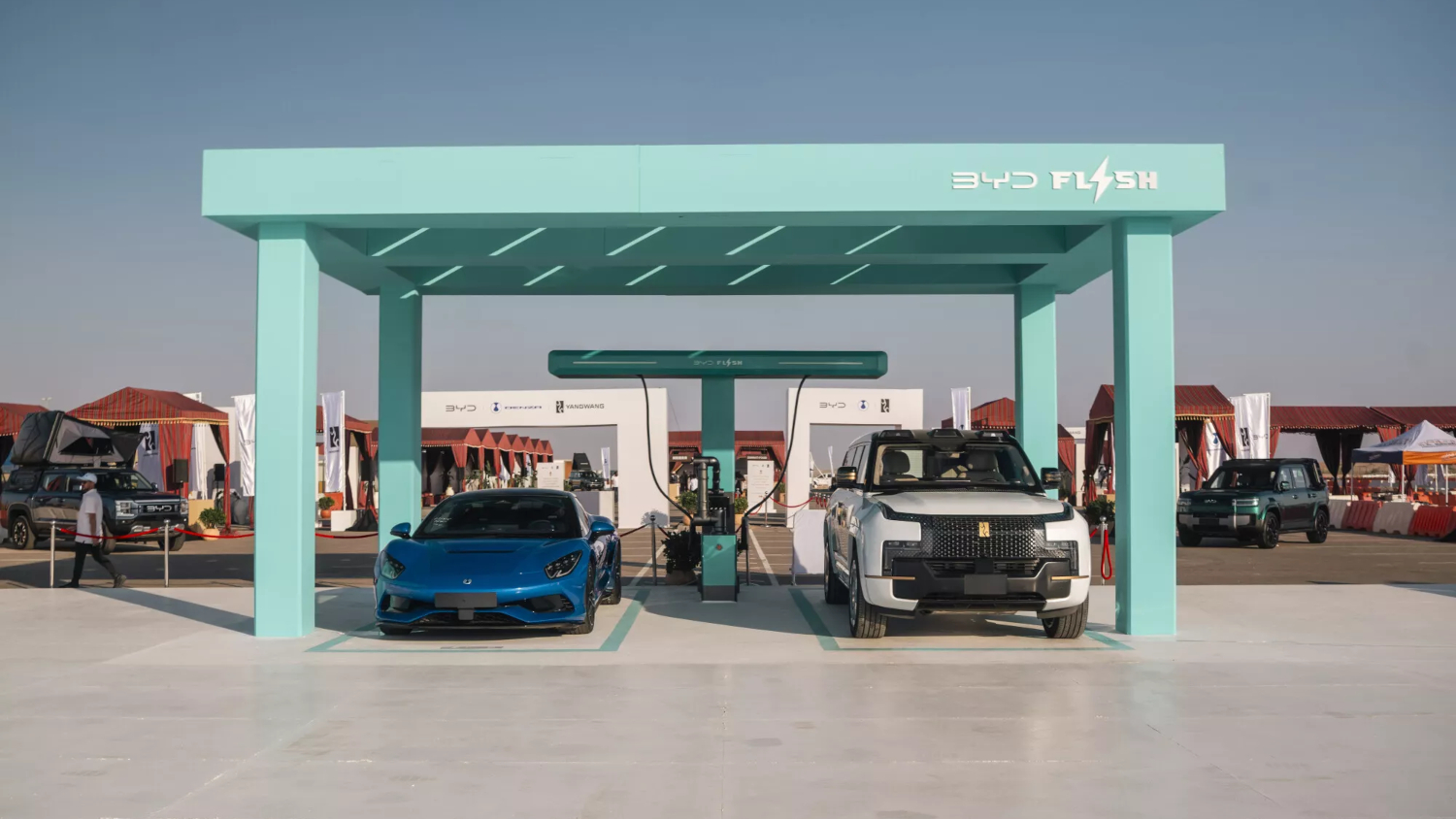
The EV charging stop as grudging coffee break may have an expiration date. BYD demonstrated a station in the Abu Dhabi desert combining solar panels, 370 kWh of onsite battery storage, a robotic arm that plugs the car in without human involvement, and a peak output of 1,500 kW. The local battery buffer is the key ingredient: the station draws electricity steadily from the grid, stockpiles it, then releases the full burst when a vehicle arrives. Battery storage can reduce the grid connection needed for peak charging, while the integrated solar-storage system is designed to support operation with limited or no grid access.
The Tech Behind the Five-Minute Promise
BYD’s Flash Charger posts headline numbers that dwarf competing networks — with significant asterisks attached.
Each Flash Charging unit runs two 185-kWh batteries, totaling 370 kWh of onsite storage. A single connector peaks at 1,500 kW — roughly triple Tesla’s V4 Supercharger maximum of 500 kW and more than four times Electrify America’s 350 kW ceiling. BYD claims compatible vehicles charge from 10% to 70% in five minutes, 10% to 97% in nine minutes, and 20% to 97% in 12 minutes at minus 30 degrees Celsius. That cold-weather figure matters: low temperatures are where most fast-charger promises quietly collapse. The figures apply only to compatible vehicles using BYD’s second-generation Blade battery; performance for other EVs will depend on their voltage architecture, battery chemistry, thermal system, and maximum acceptance rate.
Key specs at a glance:
- Peak output: 1,500 kW single connector; 1,000 kW to each of two simultaneous vehicles
- Onsite storage: 370 kWh total; grid draw at 100–560 kW
- Claimed charge time: 10%–70% in five minutes (compatible vehicles only)
- Solar integration: panels feed local storage; BYD has not disclosed the site’s solar output
- Deployment target: 6,000 Flash Charging stations globally by end of 2027; full solar-plus-robotics configuration unspecified
Impressive Numbers, Incomplete Picture
Peak charger output and real-world charging speed are not the same thing — and the gap between them is where most EV promises get complicated.
BYD surpassed Tesla in 2025 battery-electric vehicle sales, reporting 2.25 million BEV deliveries against Tesla’s 1.64 million, according to the BBC. The charging infrastructure push reads as the natural next move: build the vehicles, then own the refueling experience. Hybrids remain the fastest-selling cars in America, underscoring just how much ground pure-electric networks still need to close.
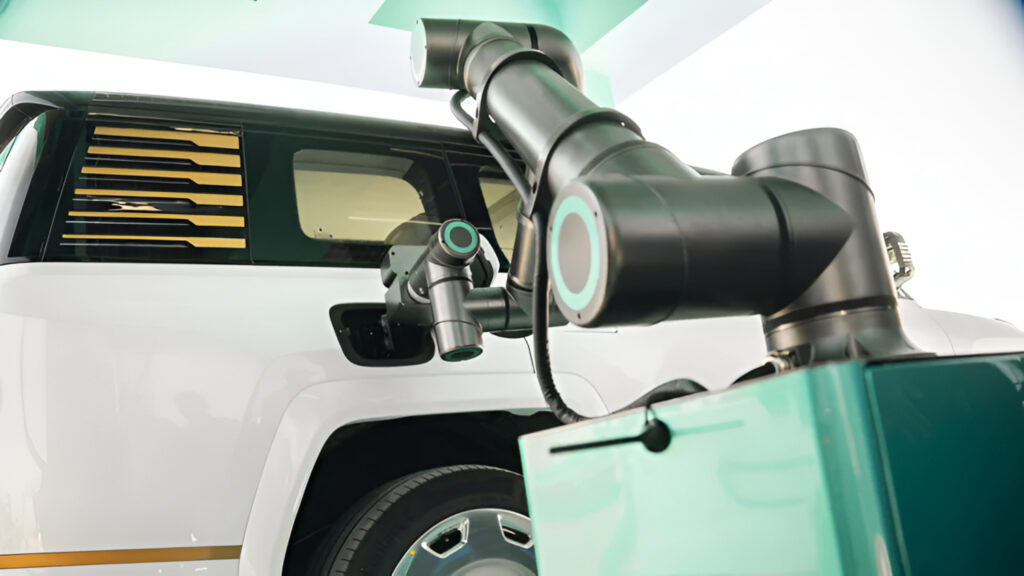
The robotic arm — which locates the charging port, opens it, and inserts the connector automatically using visual guidance and force feedback — fits that vision. Tesla, Volkswagen, Hyundai, and Xiaomi have explored similar automated-charging concepts, though BYD is currently the one demonstrating the technology at scale in a desert.
The honest caveat: peak charger capacity is not actual charging speed. Vehicle acceptance rates, battery temperature, charging-curve behavior, and station utilization all determine whether drivers ever see those headline figures. No independent field data across vehicle types or climates has been identified in the sources reviewed.
6,000 Stations – But How Many Look Like This?
The deployment target is measurable; what proportion of those stations will carry the full solar-and-robotics package remains an open question.
BYD plans 6,000 Flash Charging stations globally by end of 2027. How many will include solar generation, off-grid capability, or robotic arms is not yet specified. The Abu Dhabi installation is a logical demonstration environment — abundant sun and limited grid infrastructure make the case for solar-buffered charging clearly. Whether the full solar-plus-robotics package proves economically viable at ordinary urban or highway locations is a question the available public information does not yet answer.
BYD has announced and demonstrated the system, and the numbers are large. The Abu Dhabi installation demonstrates the concept, but public information does not yet establish its cost, uptime, commercial scale, or real-world performance across different vehicles and climates. Six thousand stations by 2027 is the benchmark worth watching.