

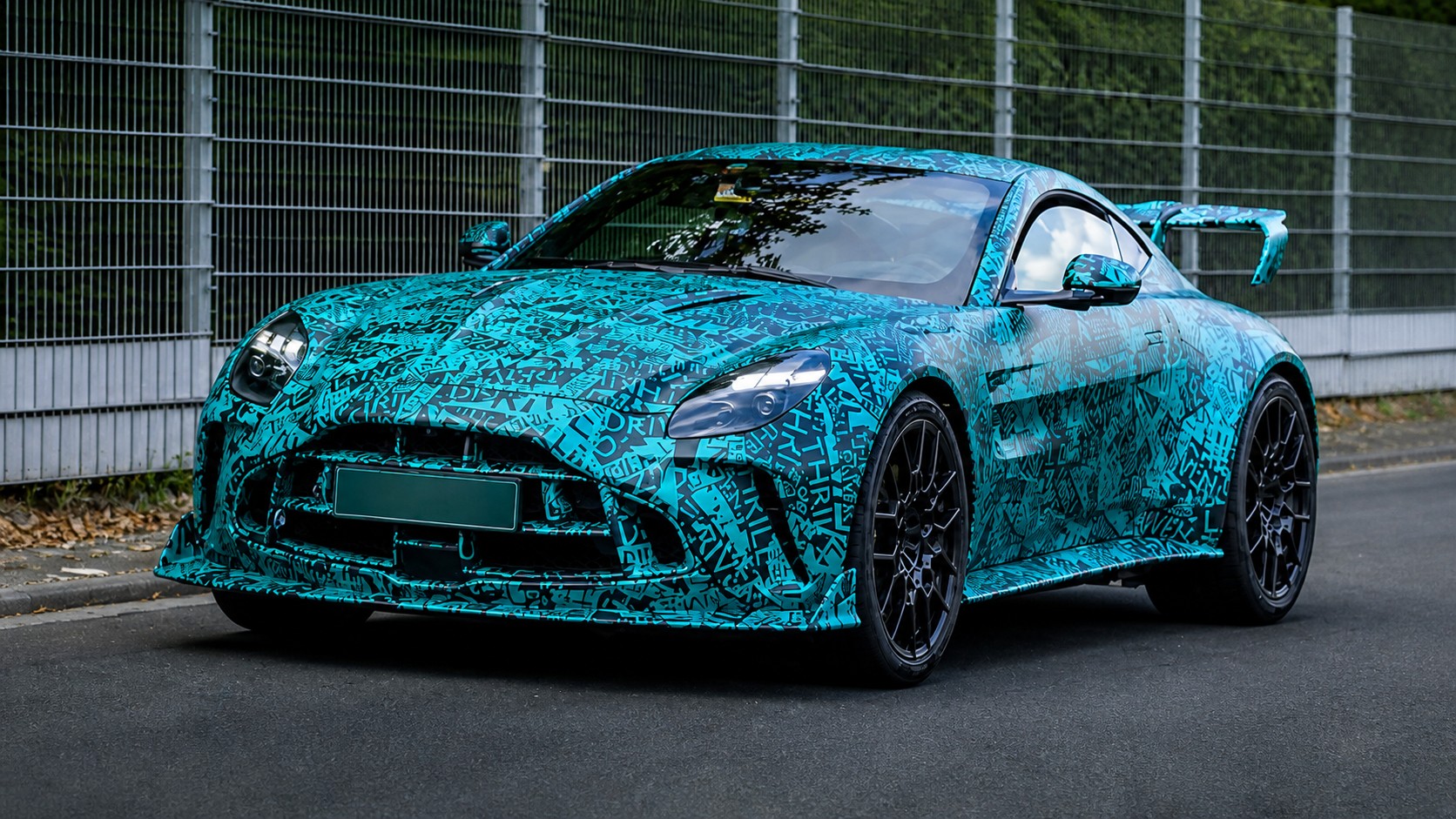
A nearly production-ready red prototype lapping the Nordschleife with a fixed rear wing, dive planes, and a reworked diffuser is not a styling exercise. Spy photographers caught what appears to be a near-final Vantage RS — or possibly Vantage AMR, as Aston Martin has not confirmed the name — testing at the Nürburgring with bodywork that looks ready for a showroom floor.
The car sits above the current Vantage (656 hp) and Vantage S (around 670 hp), aimed squarely at track-biased buyers who find grand-touring a bit too comfortable. Carscoops describes it as Aston’s “wildest Vantage yet” — one that reportedly “wants a word with the Porsche 911 GT3.”
What the Aero Is Actually Doing
Every vent, wing, and dive plane on this prototype has a specific job to do.
The front end runs a larger lip splitter flanked by dive planes, generating front-axle downforce and keeping brake temperatures honest during sustained circuit work. Additional venting on the top and rear of the front fenders manages airflow after it has done its job. The grille is larger and more open than the standard Vantage’s, suggesting cooling upgrades for an engine working harder and longer.
At the rear, a fixed high-mounted wing sits on the decklid with end plates that curve downward — hardware that points to serious aerodynamic development rather than a cosmetic add-on. A reworked diffuser completes the package.
Key changes visible on the prototype:
- Larger front splitter with dive planes for front-axle downforce
- Front fender vents for airflow management and brake cooling
- Restyled, larger grille for sustained track-use cooling capacity
- Fixed rear wing, high-mounted, with downward-curving end plates
- Revised diffuser integrating four centrally positioned exhaust outlets
From Eight Pipes to Four – and What That Actually Means
The exhaust evolution from early mules to this near-production prototype reveals just how aggressively Aston Martin experiments before converging on a final design.
Early RS mules turned up at the Nürburgring with eight exhaust tips — four at the corners, four clustered centrally. French outlet Caradisiac later confirmed those extra tips were “factices” — fake outlets used for chassis testing purposes — and they are gone on the near-production car. The current prototype shows four outlets mounted centrally within the diffuser. Cleaner, more production-plausible, and a useful reminder that dramatic spy shots often reveal testing methodology more than finished design.
On power, details remain unconfirmed. The twin-turbo 4.0-liter V8 is expected to carry over, with output reportedly set to exceed the Vantage S’s approximately 670 hp. Car and Driver speculates the RS could push beyond 700 hp. “There’s little doubt the RS will outgun the Vantage S,” according to Carscoops. Nothing is officially confirmed.
What It Costs to Play This Game
With the standard Vantage starting at around $194,500 and the Vantage S at approximately $199,500, the RS is expected to demand a significant premium.
Car and Driver projects RS pricing closer to $250,000 or higher — unconfirmed, but the aero package alone makes the jump feel plausible. Carscoops points to a 2027 market launch; Caradisiac suggested in mid-2026 that commercialization was arriving “next year.” Whether this car earns a genuine conversation with the 911 GT3 depends entirely on what Aston Martin reveals under that hood — and the brand is not talking yet.