A 2023 Chevy Bolt EUV sits plugged into a ChargePoint station in a Jamaica Plain municipal lot. A woman in a black SUV pulls up, peers through the Bolt’s window, unplugs the charging cable, and redirects it to her own car. When the Bolt’s owner returns: cord back in the holster, thief gone, $40 ticket on the windshield.
This isn’t just a neighborhood grievance. It’s what happens when EV enforcement rules are built around observable charging status — not the reason charging stopped. Boston’s system doesn’t ask why your car isn’t drawing power. It only checks whether it is.
One Minute, Two Sessions, One Ticket
The ChargePoint logs compress the entire incident into a single, damning sixty-second gap.
The owner’s session ended at 5:17 PM. A different account’s session on the same port began at 5:18 PM — confirmed in writing by ChargePoint headquarters. Staff at Blanchard’s liquor store, adjacent to the lot, provided access to their security footage. The footage shows the black SUV arrive, the woman check through the Bolt’s window, deliberately unplug the cable, and redirect it to her own vehicle. When the owner returned, the cord was holstered. The thief had gone. The ticket had not.
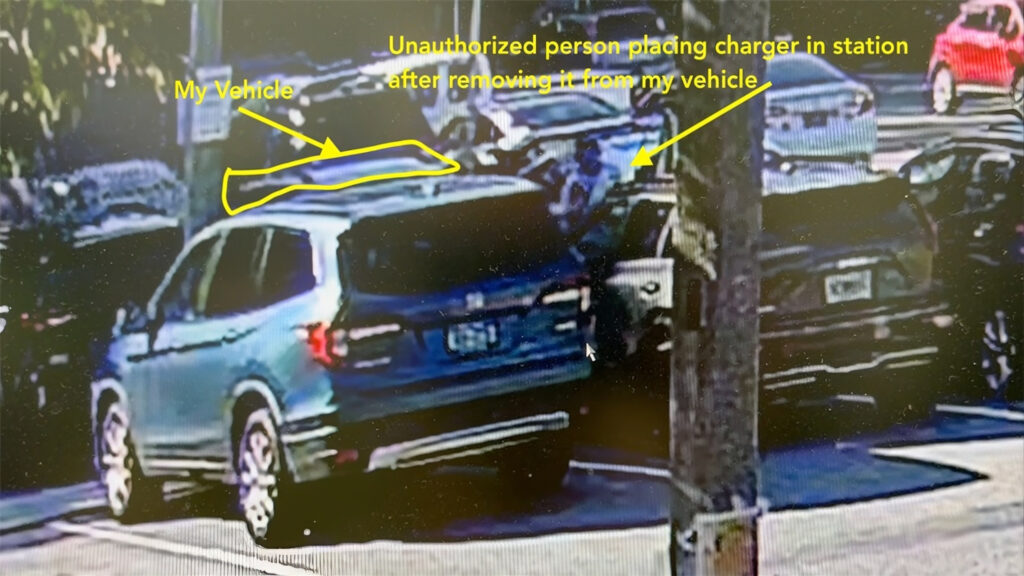
The evidence she assembled is detailed and specific:
- The Bolt EUV has no factory charger lock — a vulnerability the owner noted is shared, in her words, with “the much more pricey Tesla line.”
- The $40 ticket cited approximately 2.75 hours parked without actively charging; the non-charging time limit at this lot is two hours, while actively charging vehicles are permitted four.
- Her appeal includes ChargePoint’s written session confirmation and a screenshot from Blanchard’s security footage.
- Since the incident, she has enabled a built-in charger-theft alarm on the Bolt — a software feature she had not previously activated — and purchased an aftermarket 3D-printed connector lock, which she describes with open skepticism about its effectiveness.
The Rules Don’t Ask Why Your Car Stopped Charging
Boston’s enforcement framework is built around what the charger sees, not what actually happened.
Under Boston’s interim EV traffic rules, “actively charging” means the EVSE is connected and the vehicle is drawing power. The moment that stops — for any reason — enforcement sees a car occupying a space it is no longer entitled to hold. City documentation designates these spaces “No Parking Except for Electric Vehicles While Charging, 4 Hour Limit.” EVs not actively charging, non-EVs, and vehicles past the posted limit can all be ticketed. The rules include no carve-out for third-party interference.
This is where the appeal becomes the real story. By pairing ChargePoint’s timestamped session records with Blanchard’s CCTV footage, the owner built a paper trail that makes the timeline impossible to dispute. She has submitted both to contest the fine and has said she will share the outcome publicly — making this appeal worth watching for every first EV driver navigating public charging rules.
What Every Public Charger User Should Know Now
The EV industry hasn’t solved charger theft at scale, which means documentation is currently the strongest defense available.
The owner called her 3D-printed locking accessory a workaround, not a solution — and that distinction matters. Automakers have not standardized connector locks, and charging networks have not widely adopted session-linked hardware safeguards, leaving drivers to improvise. Practical steps any public charger user can take today include:
- Enabling any built-in theft alarm a vehicle supports.
- Knowing which nearby businesses have CCTV cameras facing a lot.
The appeal outcome will answer a harder question: whether Boston’s enforcement system has room for nuance when a third party causes the violation. That answer carries weight well beyond Jamaica Plain.